

030-333 Online Practice Questions and Answers
Questions 4
Initial training sessions for a person with severe chronic obstructive pulmonary disease most likely would NOT include.
A. Continuous cycling activity at 70% ofVo
B. Use of dyspnea scales, RPE scales, and pursed-lip breathing instruction.
C. Intermittent bouts of activity on a variety of modalities (exercise followed by short rest).
D. Encouraging the client to achieve an intensity either at or above the anaerobic threshold.
Questions 5
During the cool-down phase of an exercise session, clients should be encouraged to:
A. Rehydrate.
B. Decrease the intensity of activity quickly to decrease cardiac afterload.
C. Limit the cool-down period to 5 minutes.
D. Increase the number of isometric activities.
Questions 6
Transitional care exercise and rehabilitation programs are NOT appropriate for:
A. Clients with functionally limiting chronicdisease.
B. Clients with comorbid disease states.
C. Asymptomatic clients with a functional capacity of 10 MET.
D. Clients at 1 week after CABG surgery.
Questions 7
Which of the following statements regarding exercise for the elderly is FALSE?
A. A decrease in maximal HR is responsible for reductions in the maximal oxygen consumption as we age.
B. A loss of fat-free mass is responsible for the decrease in muscular strength as we age.
C. The ACSM recommends a cardiorespiratory training intensity of 50% to 70% of HRR for older adults.
D. Resistance exercise training is not recommended for older adults.
Questions 8
All of the following are helpful suggestions for an athlete trying to gain weight EXCEPT:
A. Increase portion sizes at meals.
B. Eat more high-calorie foods (e.g., candy bars, soft drinks).
C. Eat one extra meal per day.
D. Snack on energy- and nutrient-dense foods (e.g., fig bars, nuts and dried fruit).
Questions 9
Which of the following is a fixed expense?
A. Office supplies.
B. Salaries.
C. Utilities (e.g., telephone).
D. Laboratory charge backs for blood work.
Questions 10
Continuous quality improvement (CQI) is a systematic process of program evaluation that involves all of the following steps EXCEPT:
A. Data analysis.
B. Goals assessment.
C. Outcomes assessment.
D. Budget assessment.
Questions 11
Policies and procedures are important in a fitness center, because they:
A. Explain how to use the fitness equipment properly.
B. Clarify the rights of and risks in being a fitness member.
C. Are general guidelines for operating a fitness program or department.
D. Explain the employee insurance plans and how to use them.
Questions 12
A 70-kg client is running on a treadmill at 5 mph and a 5% grade. What is his caloric expenditure rate?
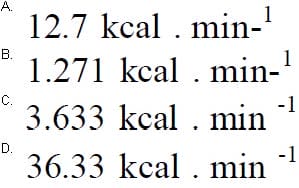
A. B. C. D.
Questions 13
A 143-pound woman regularly exercises on a treadmill at a speed of 5.5 mph and a 2% elevation. How much weight will she lose weekly if she exercises for a duration of 45 minutes per session, with a frequency of three sessions per week?
A. 1.5 kg.
B. 2.07 kg.
C. 0.25 pounds.
D. 0.45 pounds.


Home | About Us | Contact Us | FAQ | Guarantee Policy | Privacy Policy
Any charges made through this site will appear as Global Simulators Limited. All trademarks are the property of their respective owners.
Copyright © 2004-2026 pass2lead.com, All Rights Reserved.