

1Z0-052 Online Practice Questions and Answers
Questions 4
Which two are true about server-generated alerts? (Choose two.)
A. Stateful alerts are preserved across instance restarts.
B. They are automatically written to alert.log.
C. By default, an email is sent by the database instance for each server-generated alert.
D. Stateless alerts can be found in DBA_OUTSTANDING_ALERTS.
E. By default, a server-generated alert is raised for each tablespace that has 85 % or more of its space used.
Questions 5
Examine the command that is used to create a table:
SQL> CREATE TABLE orders (
oid NUMBER(6) PRIMARY KEY,
odate DATE,
ccode NUMBER (6),
oamt NUMBER(10,2)
) TABLESPACE users;
Which two statements are true about the effect of the above command? (Choose two.)
A. A CHECK constraint is created on the OID column.
B. A NOT NULL constraint is created on the OID column.
C. The ORDERS table is the only object created in the USERS tablespace.
D. The ORDERS table and a unique index are created in the USERS tablespace.
E. The ORDERS table is created in the USERS tablespace and a unique index is created on the OID column in the SYSTEM tablespace.
Questions 6
Which two kinds of failures make the Data Recovery Advisor (DRA) generate a manual checklist? (Choose two.)
A. Failure when no standby database is configured
B. Failure because a data file is renamed accidentally
C. Failure that requires no archive logs to be applied for recovery
D. Failure due to loss of connectivity-for example, an unplugged disk cable
Questions 7
Which two statements are true regarding Oracle Data Pump? (Choose two.)
A. EXPDP and IMPDP are the client components of Oracle Data Pump
B. DBMS_DATAPUMP PL/SQL packages can be used indedendently of the DATA Pump clients
C. Oracle Data Pump export and import operations can be performed only by users with the SYSDBA privilege
D. Oracle Data Pump imports can be done from the export files generated in the Original Export Release
9.x
E. EXPDP and IMPDP use the procedures provided by DBMS_METADATA to execute export and import commands
Questions 8
You execute this command to drop the ITEM table, which has the primary key referred in the ORDERS
table:
SQL> DROP TABLE scott.item CASCADE CONSTRAINTS PURGE;
Which two statements are true about the effect of the command? (Choose two.)
A. No flashback is possible to bring back the ITEM table
B. The ORDERS table is dropped along with the ITEM table
C. The dependent referential integrity constraints in the ORDERS table are disabled
D. The dependent referential integrity constraints in the ORDERS table are removed
E. The table definition of the ITEM table and associated indexes are placed in the recycle bin
Questions 9
Which three operations require undo data? (Choose three.)
A. Committing a transaction
B. Flashing back a transaction
C. Recovering a failed transaction
D. Running a read-consistent query
E. Changing a tablespace status from READ ONLY to READ WRITE
Questions 10
You are working on a database that must be functioning 24 hours a day, 7 days a week. The database is configured in ARCHIVELOG mode.
Which two options do you have for performing user-managed backups? (Choose two.)
A. You can perform consistent backups only.
B. You can perform a complete database backup without shutting down the database instance.
C. You can back up data files only when all data files have the same SCN recorded in the control file.
D. You can back up only those data files whose headers are frozen by using ALTER TABLESPACE BEGIN BACKUP or ALTER DATABASE BEGIN BACKUP commands.
Questions 11
Your database is in shutdown state. What will happend if you issue next command: SQL> startup
A. instance will started
B. instance started and DB is mounted
C. instance started, DB opened and finally mounted
D. instance started, DB mounted and finally opened
Questions 12
The user SCOTT owns the CUST table that is placed in the SALES tablespace. The user SCOTT opens a
session and executes commands as follows:
SQL> INSERT INTO cust VALUES(101, 'JACK');
1 row created.
SQL> INSERT INTO cust VALUES(102, 'SMITH');
1 row created.
As a DBA, you execute the following command from another session:
ALTER TABLESPACE sales READ ONLY;
Which statement is true regarding the effect of this command on the transaction in Scott's session?
A. The command fails as a transaction is still pending.
B. The transaction in Scott's session is rolled back and the tablespace becomes readonly.
C. The command waits and the user SCOTT can execute data manipulation language (DML) statements only as part of the current transaction.
D. The command hangs until all transactions on the objects in the tablespace commit or rollback, and then the tablespace is placed in readonly mode.
Questions 13
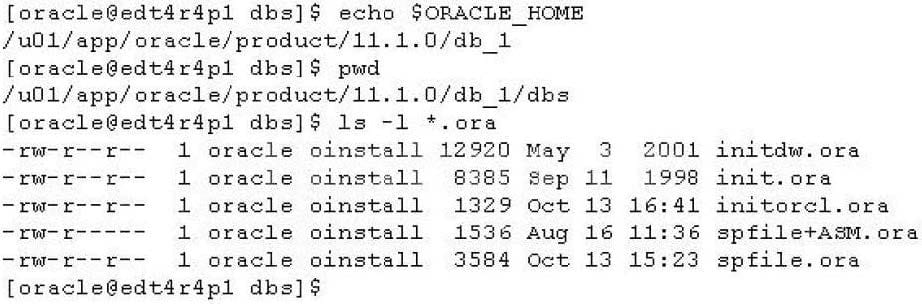
View the Exhibit and note the files available in the $ORACLE_HOME/dbs folder. The ASM instance is already running. You used the following steps to start the database instance and open the database:
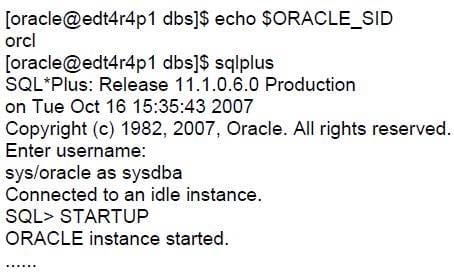
Which file is used to start the instance in this case? Exhibit:
A. init.ora
B. spfile.ora
C. initorcl.ora
D. spfile+ASM.ora


Home | About Us | Contact Us | FAQ | Guarantee Policy | Privacy Policy
Any charges made through this site will appear as Global Simulators Limited. All trademarks are the property of their respective owners.
Copyright © 2004-2026 pass2lead.com, All Rights Reserved.