

1Z0-060 Online Practice Questions and Answers
Questions 4
An Automatic Database Diagnostic Monitor (ADDM) finding in your production database reports that the shared pool is inadequately sized. You diagnose that this is due to the different kinds of workloads and this occurs only during peak hours. The following are the parameter settings for the database instance: You want to balance the memory between the System Global Area (SGA) components depending on the workload.
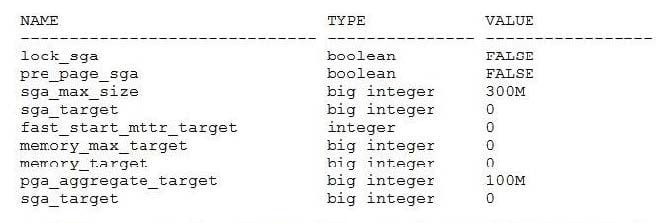
Which option would solve this problem?
A. setting the PGA_AGGREGATE_TARGET parameter to 200M and the SGA_MAX_SIZE parameter to 400M
B. setting the MEMORY_TARGET and SGA_MAX_SIZE parameters to 400M
C. setting the SGA_TARGET parameter to 300M
D. setting the SGA_MAX_SIZE parameter to 400M
Questions 5
Your multitenant container (CDB) containing three pluggable databases (PDBs) is running in ARCHIVELOG mode. You find that the SYSAUX tablespace is corrupted in the root container.
The steps to recover the tablespace are as follows:
1.
Mount the CDB.
2.
Close all the PDBs.
3.
Open the database.
4.
Apply the archive redo logs.
5.
Restore the data file.
6.
Take the SYSAUX tablespace offline.
7.
Place the SYSAUX tablespace online.
8.
Open all the PDBs with RESETLOGS.
9.
Open the database with RESETLOGS.
10.
Execute the command SHUTDOWN ABORT.
Which option identifies the correct sequence to recover the SYSAUX tablespace?
A. 6, 5, 4, 7
B. 10, 1, 2, 5, 8
C. 10, 1, 2, 5, 4, 9, 8
D. 10, 1, 5, 8, 10
Questions 6
Which three are true about the large pool for an Oracle database instance that supports shared server connections?
A. Allocates memory for RMAN backup and restore operations
B. Allocates memory for shared and private SQL areas
C. Contains a cursor area for storing runtime information about cursors
D. Contains stack space
E. Contains a hash area performing hash joins of tables
Questions 7
Identify two correct statements about multitenant architecture. (Choose two.)
A. Multitenant architecture can be deployed only in a Real Application Clusters (RAC) configuration.
B. Multiple pluggable databases (PDBs) share the SGA of a multitenant container database (CDB).
C. Multiple CDBs share certain PDB resources.
D. Multiple non-RAC CDB instances can mount the same PDB as long as they are on the same server.
E. Patches are always applied at the CDB level.
F. A PDB can have a private undo tablespace.
Questions 8
You created a new database using the "create database" statement without specifying the "ENABLE PLUGGABLE" clause.
What are two effects of not using the "ENABLE PLUGGABLE database" clause?
A. The database is created as a non-CDB and can never contain a PDB.
B. The database is treated as a PDB and must be plugged into an existing multitenant container database (CDB).
C. The database is created as a non-CDB and can never be plugged into a CDB.
D. The database is created as a non-CDB but can be plugged into an existing CDB.
E. The database is created as a non-CDB but will become a CDB whenever the first PDB is plugged in.

Questions 9
Which three statements are true concerning the multitenant architecture? (Choose three.)
A. Each pluggable database (PDB) has its own set of background processes.
B. A PDB can have a private TEMP tablespace.
C. PDBs can share the SYSAUX tablespace.
D. Log switches occur only at the multitenant container database (CDB) level.
E. Different PDBs can have different default block sizes.
F. PDBs share a common system tablespace.
G. Instance recovery is always performed at the CDB level.
Questions 10
You install a non-RAC Oracle Database. During Installation, the Oracle Universal Installer (OUI) prompts you to enter the path of the Inventory directory and also to specify an operating system group name.
Which statement is true?
A. The ORACLE_BASE base parameter is not set.
B. The installation is being performed by the root user.
C. The operating system group that is specified should have the root user as its member.
D. The operating system group that is specified must have permission to write to the inventory directory.
Questions 11
You use the segment advisor to help determine objects for which space may be reclaimed.
Which three statements are true about the advice given by the segment advisor? (Choose three.)
A. It may advise the use of online table redefinition for tables in dictionary-managed tablespaces.
B. It may advise the use of segment shrink for tables in dictionary-managed tablespaces it the no chained rows.
C. It may advise the use of online table redefinition for tables in locally managed tablespaces.
D. It will detect and advise about chained rows.
E. It may advise the use of segment shrink for freelist managed tables.
Questions 12
Which two statements are true about Enterprise Manager (EM) express in Oracle Database 12c? (Choose two.)
A. By default, EM express is available for a database after database creation.
B. Multiple databases on the same node (or host) may each be individually managed by using EM Express.
C. You can perform basic administrative tasks for pluggable databases by using the EM express interface.
D. You cannot start up or shut down a database instance by using EM express.
E. You can create and configure pluggable databases by using EM express.
Questions 13
In which two scenarios is an RMAN recovery catalog automatically resynchronized? (Choose two.)
A. when a registered database is opened with the RESETLOGS option
B. when a redo log is archived
C. when backup metadata records are aged out of the control file based on the CONTROL_FILE_RECORD_KEEP_TIME parameter value
D. when the backup retention policy configuration is changed for a registered database
E. when a manual redo log switch is performed


Home | About Us | Contact Us | FAQ | Guarantee Policy | Privacy Policy
Any charges made through this site will appear as Global Simulators Limited. All trademarks are the property of their respective owners.
Copyright © 2004-2026 pass2lead.com, All Rights Reserved.