

1Z0-102 Online Practice Questions and Answers
Questions 4
You run the default startmanageWeblogic (.cmd in Windows) script as shown here: startmanageWeblogic.sh server1 http://192.168.1.102:8001.
What does this do?
A. It starts the administration server named server1, which is running at 192.168.1.102.8001.
B. It starts the managed server named server1, which is running at 192.168.1.102.8001.
C. It starts the managed server named server1 whose Node Manager is running at 192.168.1.102.8001.
D. It starts the Managed Server named server1 whose Administration Server is running at 192.168.1.102:8001.
Questions 5
Each domain has a directory called servers that contains subdirectories for each server in the domain. Your domain has a managed server named managed1. When will the managed1 directory be created?
A. When the managed1 server is defined in the configuration Wizard
B. When the domain is created
C. When the administration server comes up for the first time
D. When the managed1 server1 comes for the first time
Questions 6
Identify three properties required by the domain Configuration Wizard when creating a new domain.
A. machine name
B. Managed Server name
C. domain startup mode
D. domain name
E. administrator username and password
Questions 7
In WLST, you enter the shutdown () command with no arguments. Which statement is true in this case?
A. The server you are connected to will shut down.
B. The command does a "Force" shutdown.
C. The command blocks user interaction.
D. The command has timeout of 30,000 milliseconds.
Questions 8
You run the following WLST script and it completes successfully. Which statement best describes what the script created?
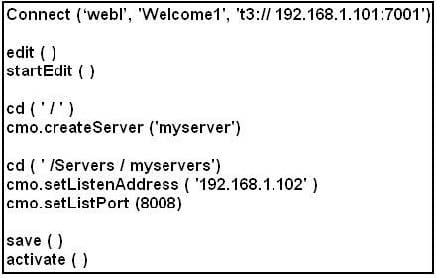
A. A CMO named myserver with the listen address 192.168.1.102 and port 8008
B. A Managed Server named myserver with the listen address 192.168.1.102 and port 7001
C. A Managed Server named myserver with listen address 192.168.1.102 and port 8008
D. An Administration Server named myserver with the listen address 092.168.1.102 and port
Questions 9
You have opened a terminal window (or a Window command prompt) to run a WLST script named weeklydeployer.py. You enter the following command:
Java weblogic.WLST weeklydeployer.py
Instead of the WLST initializing and the script running, however, you receive the NoClassDefFoundError java exception for weblogic/WLST.
What is the problem?
A. You forgot to set PATH to include the java executable.
B. There is an error in the code of the script.
C. You forgot to set CLASSPATH to include weblogic.jar.
D. You are not in the directory where weeklydeployer.py resides.
E. You should have omitted the ".py" in the file name; it is assumed by WLST.
F. You forgot to set PATH to include the WLST executable.
Questions 10
You monitor a running JMS topic with the console and note the following values:
Consumers Current = 3 Message Current = 1 Message Pending = 0 These values do not change for several minutes. Which is the most plausible explanation?
A. Production on the topic has been paused.
B. A message arrived after a durable subscribe disconnected from the topic.
C. One of the consumers received a message but did not acknowledge it.
D. None of the consumers are durable subscribes.
Questions 11
You wish to provide failover for HTTP sessions within a cluster. However, you are limited by the following constraints:
1.
While under load, your servers have very little free memory.
2.
you do not have appropriate access rights to modify your company's database.
Which is the best option, given these restrictions?
A. in-memory replication
B. automatic migration
C. file persistence
D. JDBC persistence
E. replication groups
Questions 12
Which two are typically found in the WEB-INF folder of a Java web application?
A. the web application HTML and JSP files
B. the classes directory containing the compiled classes
C. the web.xml deployment descriptor
D. the weblogicserver.xml deployment descriptor
Questions 13
Which two statements are true about data sources that have been created?
A. Data sources must be targeted to a server.
B. Data sources must be bound in the JDNI tree of a server.
C. Data sources are an Oracle WebLogic Server-specific feature.
D. Data sources are tied directly to a connection pool.
E. Data sources are required for a domain.


Home | About Us | Contact Us | FAQ | Guarantee Policy | Privacy Policy
Any charges made through this site will appear as Global Simulators Limited. All trademarks are the property of their respective owners.
Copyright © 2004-2026 pass2lead.com, All Rights Reserved.