

1Z0-144 Online Practice Questions and Answers
Questions 4
Examine the following command:
SQL>ALTER SESSION SET plsql_warnings * 'enable: severe', 'enable: performance', 'ERROR: 05003';
What is the implication of the above command?
A. It issues a warning whenever ERROR: 05003 occur during compilation.
B. It causes the compilation to fail whenever the warning ERROR.05003 occurs.
C. It issues warnings whenever the code causes an unexpected action or wrong results performance problems.
D. It causes the compilation to fail whenever the code gives wrong results or contains statements that are never executed.
Questions 5
View the Exhibit and examine the code and its outcome on execution:
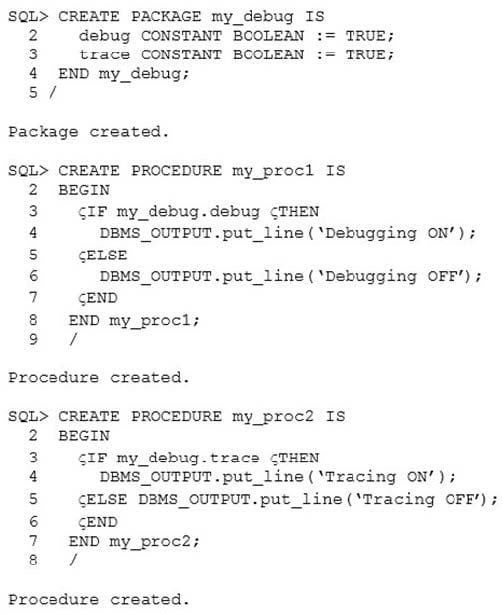
What would be the effect on the two procedures if the value of debug is set to FALSE? (Choose two.)
A. MY_PROC2 is not recompiled.
B. MY_PROC1 is recompiled but remains unchanged.
C. MY_PROC2 is recompiled but remains unchanged.
D. MY_PROC1 is recompiled without the debugging code.
Questions 6
View the Exhibit and examine the blocks of code that you plan to execute.
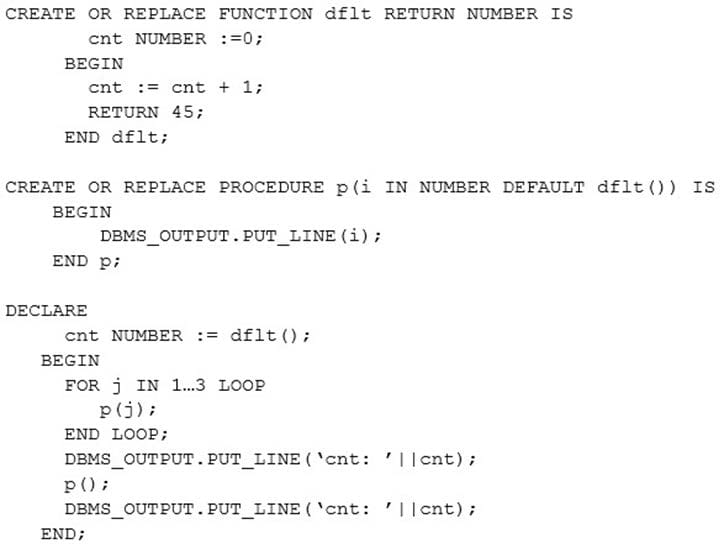
Which statement is true about the blocks of code?
A. All the blocks execute successfully and the anonymous block displays123cant: 4545cnt: 45.
B. All the blocks execute successfully and the anonymous block displays123cut: 045cart: 1.
C. The anonymous block gives an error because the function invocation in line 2 is not valid.
D. The procedure creation gives an error because the function invocation in line 1 is not valid.
Questions 7
Which two statements are correct about PL/SQL package components? (Choose two.)
A. A package must have both specification and body.
B. A package body can exist without the package specification.
C. A package specification can exist without the package body.
D. When a packaged public variable is called for the first time in a session, the entire package is loaded into memory.
Questions 8
Which tasks must be performed during the installation of the UTL_MAIL package? (Choose two.)
A. setting the UTL_FILE_DIR initialization parameter
B. running the utlmail.sql and prvtmail.plb scripts
C. setting the SMTP_OUT_SERVER initialization parameter
D. using the CREATE DIRECTORY statement to associate an alias with an operating system directory
E. granting read and WRITE privileges to control the type of access to files in the operating system
Questions 9
Examine the following partial code:
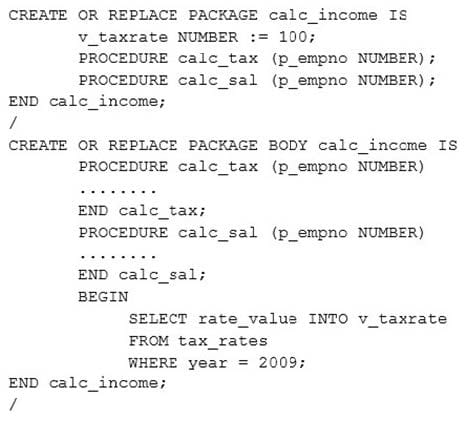
Which statement is correct about the unnamed block of code at the end of a package body?
A. It generates an error because all the blocks of code in a package body must be named.
B. It generates an error because V_TAXRATE is a public variable that is already initialized in the package specification.
C. It acts as a package initialization block that executes once, when the package is first invoked within the user session.
D. It acts as a package initialization block that executes each time a package subprogram is invoked within the user session and refreshes the initialized variable's value.
Questions 10
You want to store values of different data types in a PL/SQL block and store one record at a time for processing the information.
Which type of composite data type would you choose to fulfill the requirement?
A. VARRAYS
B. Nested table
C. PL/SQL records
D. Associative arrays
Questions 11
You execute the following block of code: Which statement is true about the outcome?
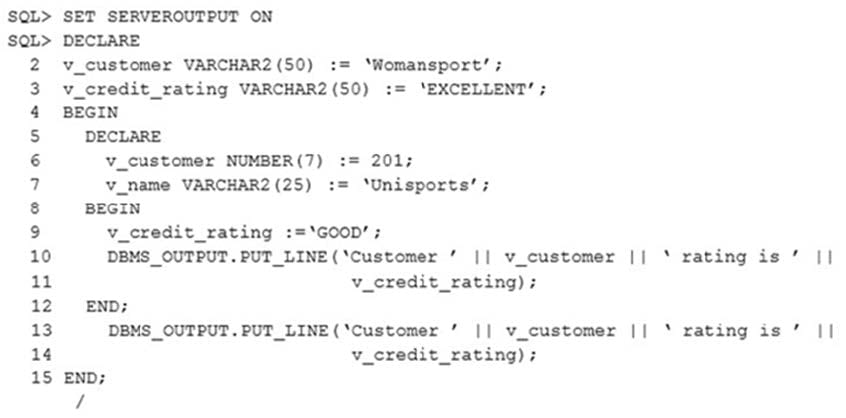
A. Both output statements show different values.
B. Both output statements show exactly the same values.
C. It gives an error because the nested blocks are not labeled.
D. It gives an error because the V_CUSTOMER variable cannot have different types in the nested blocks.
Questions 12
Which three statements are true about wrapping? (Choose three.)
A. The PL/SQL wrapper detects and reports only syntactic errors.
B. The PL/SQL wrapper detects and reports both syntactic and semantic errors.
C. When wrapping a package or object type, both the body and specification should be wrapped.
D. When wrapping a package or object type, only the body should be wrapped, not the specification.
E. To change a wrapped object, the original source code needs to be modified and then wrapped again.
F. To change a wrapped object, the wrapped code can be unwrapped, modified in a text file, and then wrapped again.
Questions 13
View the Exhibit and examine the blocks of code that you plan to execute.

Which statement is true about the blocks of code?
A. All the blocks execute successfully and the anonymous block displays
B. All the blocks execute successfully and the anonymous block displays
C. The anonymous block gives an error because the function invocation in line 2 is not valid.
D. The procedure creation gives an error because the function invocation in line 1 is not valid.


Home | About Us | Contact Us | FAQ | Guarantee Policy | Privacy Policy
Any charges made through this site will appear as Global Simulators Limited. All trademarks are the property of their respective owners.
Copyright © 2004-2026 pass2lead.com, All Rights Reserved.