

1Z0-574 Online Practice Questions and Answers
Questions 4
Which of the following interactions does not occur as part of a web-based single sign-on scenario?
A. A gateway, deployed In the Web Server, intercepts requests destined for protected resource
B. The user is prompted for login credentials when a protected resource is accessed and the user has not (recently) logged In.
C. Credentials are passed to the application for validation.
D. Authorization checks are optionally performed before the user is permitted access to the application.
E. A cookie is returned, which is used to permit access to other protected resources in that domain
Questions 5
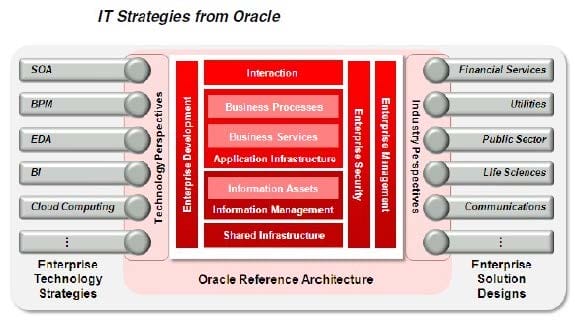
Enterprise Architecture consists of Business Architecture, Application Architecture, Information, Architecture and Technical Architecture (BAIT). Which statement best describes Oracle Reference Architecture (ORA) in the context of BAIT?
A. ORA addresses all four (Business, Application, Information, and Technical) equally.
B. ORA is primarily focused on the Technical Architecture, with some content on the other three aspects-of BAIT.
C. ORA has content applicable to the Technical Architecture only.
D. ORA is primarily focused on the Business Architecture, with some content on the other three aspects of BAIT
E. ORA is primarily focused on the information Architecture, with some limited content on the other three aspects of BAIT.
F. ORA has content applicable to Information Architecture only.
Questions 6
Which product provides the standard communication protocols (for example, HTTPS) between the Client Tier and the Service Tier as well as Message Security?
A. Oracle platform Security Services
B. Oracle WebCenter
C. Application Development Framework
D. Oracle HI IP Server
Questions 7
Which of the following environments are typically clustered?
A. Development Environment
B. User Acceptance Testing (UAT) Environment
C. Staging Environment
D. Nonfunctional Testing Environment
Questions 8
Service composition is the creating of a new SOA Service by aggregating existing SOA Services. Which statements are correct concerning the use of service composition within the Service-Oriented Integration architecture?
A. The SOI architecture is a layered architecture; therefore service composition is not allowed.
B. Service composition is allowed, even encouraged, by the SOI architecture.
C. Service composition within the SOI architecture is allowed only when the aggregation is over SOA Services from lower layers in the architecture.
D. Service composition should be avoided because service aggregation is provided by the Mediation Layer.
E. Service composition is allowed, but is discouraged because service composition leads to complex dependencies.
Questions 9
The Oracle Reference Architecture (ORA) includes the central layers as well as Technology Perspectives and Industry perspectives. Which statements best describe how these are related within ORA?
A. The Technology Perspectives are reference architectures incorporating specific technologies, products, and standards.
B. The Technology Perspectives provide a view of ORA focused on specific technologies, product and standards.
C. The Industry Perspectives are reference architectures for specificindustries, for example, Telco, Pharma.
D. The Industry Perspectives extend the central layers of ORA toincludeindustry-specific capabilities, components, and so on.
E. ORA is a collection of reference architectures, some based on technology (Technology Perspectives), and some based on industry verticals (Industry Perspectives).
Questions 10
When two or more technology perspectives are combined, which statement best describes how the Oracle Reference Architecture (ORA) applies to the combination?
A. One of the layersin ORAis the Business Services layer that contains the SOA Services. It is these SOA Services that provide the connection between different technology perspectives; therefore the Business Services layer is the interlock between two or more technology perspectives.
B. Each technology perspective adds to the core ORA capabilities. The core ORA capabilities support
each of the technology perspectives by providing a common foundation.
C. The vertical layersin ORA (Enterprise Development, Enterprise Security. Enterprise Management) provide the capabilities needed to combine two or more technology perspectives.
D. Each technology perspective is a separate reference architecture that leverages ORA as the common foundation for each of the individual reference architectures.
E. The vertical layers of ORA are identical for each technology perspective. Each technology perspective adds capabilities to the horizontal layers of ORA, especially the business Processes, Business Services, and Information Assets layers.
Questions 11
Which statement best describes the mapping of User Interaction logical architecture layers to deployment tiers?
A. The web tier and the application tier together map to the service layer, while the dates tier is an example of the resource layer component.
B. The web tier and the application tier together map to the client layer, while the data tier is an example of the resource layer component.
C. The web tier fulfills the majority of the client layer capabilities; the application tier maps to the service layer; the data tier is an example of the resource layer component.
D. The Logical view and Deployment view of the User Interaction architecture do not map effectively from one to the other because other intermediate views are needed.
Questions 12
The Service-Oriented Integration (SOI) architecture can be deployed in a variety of ways. One deployment option is a hierarchical deployment, where each division within the enterprise can deploy the layers of the SOI architecture by using their chosen hardware and software platforms.
A separate enterprise-wide deployment of the upper layers of the architecture is used to provide cross-divisional integration. Which statements are true for this type of hierarchical deployment of SOI?
A. Hierarchical deployment of the SOI architecture is the recommended deployment whenever an enterprise has two or more business divisions.
B. Hierarchical deployment of the SOI architecture is an anti-pattern and should be avoided du-the additional costs associated with supporting multiple hardware and software platforms.
C. Hierarchical deployment of the SOI architecture is a transitional phase moving toward a peer-peer deployment where the enterprise-wide deployment of the upper layers is eliminated.
D. Hierarchical deployment of the SOI architecture supports aquestions because each aquestions can be treated as a new division with its own chosen hardware and software platforms.
E. Because each division is allowed to select the hardware and software platform, industry standards become more important to ensure interoperability between the divisions and the enterprise-wide upper layer.
F. Because each division is allowed to select the hardware and software platform, platform vendors will have the complete for business, which will reduce the costs of hardware and software, thus reducing the cost of technical deployment versus a shared deployment.
Questions 13
AAPML and CARML are part of what standards effort?
A. WS-Security
B. Web Services Interoperability
C. JCA and JAAS
D. Identity Governance Framework


Home | About Us | Contact Us | FAQ | Guarantee Policy | Privacy Policy
Any charges made through this site will appear as Global Simulators Limited. All trademarks are the property of their respective owners.
Copyright © 2004-2026 pass2lead.com, All Rights Reserved.