

1Y0-402 Online Practice Questions and Answers
Questions 4
Scenario: A Citrix Architect is designing an environment for a large company. The company has identified
the following user groups and requirements.
Product Managers - Typically, they work from inside the company network but are able to work from home.
They need to use a variety of standard productivity and web-based SaaS applications.
Field Sales Engineers - They frequently work with mobile devices and tend to access the environment
externally. They need access to sales tools and the front-end of the customer database.
Web Developers - Internal and remote workers who use specialized hardware with a graphics card to
handle resource-intensive applications.
Which FlexCast model should the architect assign to Web Developers?
A. VM Hosted Applications
B. Published Apps
C. Published Desktops
D. Hosted VDI
Questions 5
Scenario: While assessing the User Layer, a Citrix Architect finds that most of the internal users connect using corporate-owned laptops, desktop devices, and thin clients. Many of these laptops and desktop devices are running Windows 10, while the remainder of the machines are running Windows 7 and are in the process of being migrated to Windows 10. Some users also connect using personal devices.
Currently, Citrix Receiver is manually installed on any endpoint device added to the company. All these devices use Citrix Receiver version 4.8 and above. The IT team is planning to automate a process to update all the devices with the latest version of Citrix Receiver and to automate another process for automatic installation of Citrix Receiver without incurring extra costs and maintenance.
What should the architect recommend to upgrade Citrix Receivers for internal Windows endpoints?
A. The use of deployment tools for internal endpoints.
B. The deployment of Enterprise software.
C. Configure Receiver auto-updates through Citrix Cloud.
D. Edit the Web.config file and set upgradeAtLogin to True.
Questions 6
Scenario: A Citrix Architect has designed an active/passive XenApp and XenDesktop environment for a
customer, where the passive datacenter serves as the disaster recovery datacenter for all users.
The following has been configured:
NetScaler Global Server Load Balancing (GSLB) to provide single URL direction to the active datacenter.
GSLB has health monitors configured for the load balanced servers.
NetScaler Gateways are on both datacenters.
NetScaler load balancing occurs for StoreFront and Delivery Controller XML services.
A single XenApp and XenDesktop Site exists.
Four Delivery Controllers are members of the Site.
Two Delivery Controllers are members of the primary zone in the active datacenter.
Two Delivery Controllers are members of the satellite zone in the passive datacenter.
SQL is deployed in the active datacenter.
Local Host Cache is enabled.
Two StoreFront servers are deployed in each datacenter aggregating resources from the Delivery
Controllers in the respective datacenter.
Virtual Delivery Agent (VDA) machines are deployed in both datacenters and configured to register with
Delivery Controllers in their zone.
What would happen if the SQL Server in the primary datacenter were turned off?
A. VDA machines from the primary datacenter would register with the Delivery Controllers in the passive datacenter.
B. GSLB will NOT identify that the SQL Server is down and sessions cannot launch.
C. StoreFront in the primary datacenter would still be able to launch sessions.
D. GSLB will start redirecting connections to the secondary datacenter.
Questions 7
Scenario: A Citrix Architect needs to design a single-Site XenApp and XenDesktop environment. Through earlier design discussions, the architect has determined the environment details listed in the Exhibit.
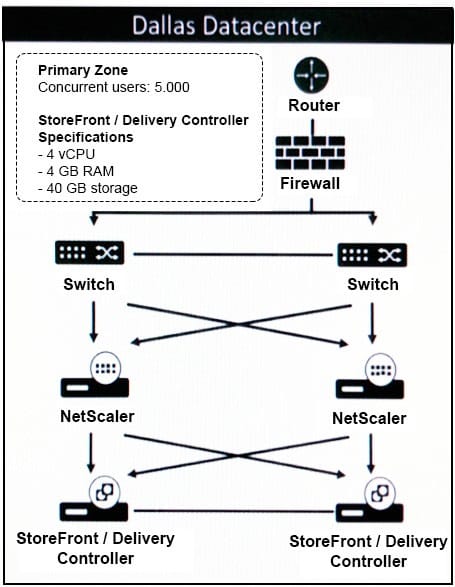
What should the architect change in the current environment to align with Citrix leading practices?
A. A Delivery Controller should be removed from the Site.
B. The Delivery Controller and StoreFront roles should NOT be co-located on the same server.
C. The existing Delivery Controllers should be allocated with an additional 2 GB of RAM each.
D. A Delivery Controller should be added to the Site.
E. The existing Delivery Controllers should be allocated with an additional CPU each.
Questions 8
Scenario: A Citrix Architect needs to design a new XenApp and XenDesktop environment.
The architect has determined the applications and characteristics listed in the Exhibit during the application assessment.
Click the Exhibit button to view the list of applications and characteristics.
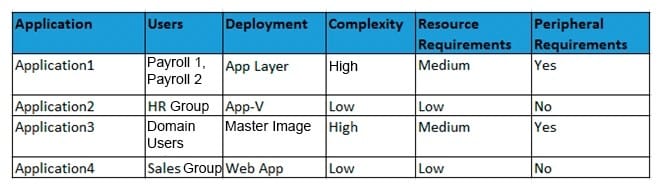
To which application category does Application1 belong, based on the information provided in the Exhibit?
A. Management Apps
B. Common Apps
C. User Apps
D. Departmental Apps
Questions 9
Scenario: A Citrix Architect needs to manage the disaster recovery process for a XenApp and XenDesktop environment. The environment currently consists of an active datacenter which is typically accessed by used and a disaster recovery (DR) datacenter which would be used in the event that a disaster impacts the primary datacenter. The overall environment has been designed to actively replicate user data and application data from the primary datacenter recovery datacenter using Microsoft DFS-R. Management has made it a proirity to minimize the loss of data when failing over between datacenters. Due to an earthquake, the primary datacenter suffers a major outage that affects multiple components. Management has decided to fail over the DR datacenter, and the architect has blocked access to the primary datacenter to prevent new attempts to connect to the XenApp and XenDesktop Site there.
Which three actions must the architect perform to meet the company priorities before enabling access to the DR datacenter? (Choose three.)
A. Complete data replication from the primary datacenter to the DR datacenter.
B. Monitor the automated failover process.
C. Transport backup data repositories to the DR datacanter.
D. Codifier data replication from the DR datacenter to the primary datacenter.
E. Drain existing sessions from the primary datacenter.
F. Evaluate the condition of the XenApp and XenDesktop environment in the primary datacenter.
Questions 10
Scenario: A Citrix Architect needs to design a multi-datacenter XenApp and XenDesktop environment that will use Provisioning Services (PVS) to manage Virtual Delivery Agent (VDA) machine images. Each datacenter will have a separate Provisioning Services farm. During the design discussions, the architect creates a diagram to depict the way vDisk files will be replicated between PVS farms, based on the available storage for the vDisk Stores.
Click the Exhibit button to view the diagram.
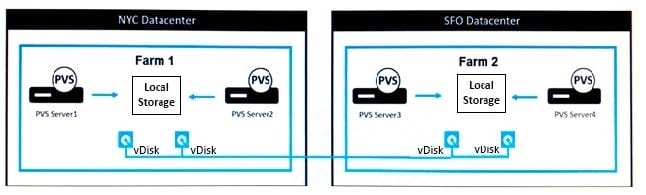
Overall, the customer has identified the following objectives for the image replication process:
Minimize the administrative time required to replicate images between farms Must be usable by storage administrators without PVS farm administrative permissions Can handle network interruptions without administrator intervention
Which method should the architect use to replicate the vDisk files between datacenters?
A. Scheduled robocopy commands
B. vDisk Replicator Tool
C. Microsoft DFS-R
D. Manual copy
E. SAN replication
Questions 11
Scenario: A Citrix Architect must perform a Provisioning Services (PVS) design for a healthcare organization. The initial design places all PVS farm components in the organization's primary datacenter. The customer asks whether the vDisk can be streamed from PVS servers in the primary datacenter to target devices located in a secondary datacenter in another region while maintaining good performance. The datacenters are connected with a 10 GB link with approximately 20 ms of latency.
The architect recommends against the organization pursuing this approach.
Which statement is a relevant reason for the recommendation?
A. The configuration does NOT provide sufficient bandwidth for streaming traffic.
B. This configuration does NOT provide sufficient connectivity between the PVS servers and the farm database
C. This configuration prevents the Subnet Affinity feature from being implemented.
D. This configuration would include too much latency for the streaming traffic.
Questions 12
Scenario: A Citrix Architect is designing a XenApp and XenDesktop environment within a single Site. The IT team is planning to use XenServer 7.x and needs guidance on sizing the resource pools for Virtual Delivery Agent (VDA) machines.
Click the Exhibit button to view the requirements for the environment.
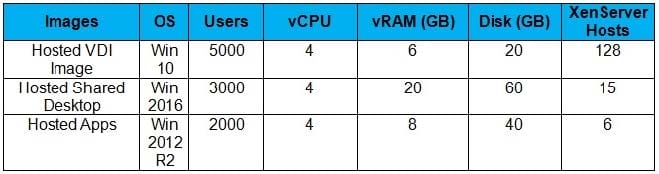
Which minimum number of resource pools should the architect recommend to meet the requirements in the Exhibit?
A. 12
B. 8
C. 16
D. 14
E. 10
Questions 13
Scenario: A Citrix Architect needs to design a new XenApp and XenDesktop environment.
The table in the Exhibit lists details about the requirements of the current user groups and their Virtual
Delivery Agent (VDA) machine workloads.
Click the Exhibit button to view the table.
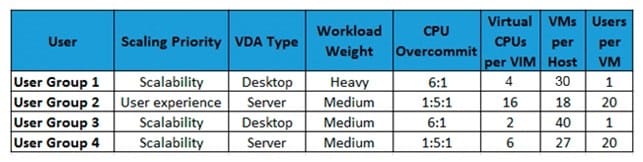
At a minimum, the architect should scale the hardware used to host the VMs for User Group 1___________ GB of RAM.
A. 128
B. 64
C. 384
D. 512
E. 256


Home | About Us | Contact Us | FAQ | Guarantee Policy | Privacy Policy
Any charges made through this site will appear as Global Simulators Limited. All trademarks are the property of their respective owners.
Copyright © 2004-2026 pass2lead.com, All Rights Reserved.