

1Y0-403 Online Practice Questions and Answers
Questions 4
Scenario: A Citrix Architect is designing a new Citrix Virtual Apps and Desktops environment for a
company that maintains branch offices in New York, Chicago, and Miami. Management has described the
following requirements for the environment:
The Citrix Virtual Apps and Desktops Site must be located in the company headquarters in Miami.
All users will only need to access their default local print queue from within their HDX sessions.
Users in Chicago need access to printers hosted on a Citrix Universal Print Server located in New York.
Printing performance and bandwidth usage must be optimized where possible.
The environment must be highly available.
The auto-created client printer models must function with no additional configuration needed.
Click the Exhibit button to review the printing requirements.
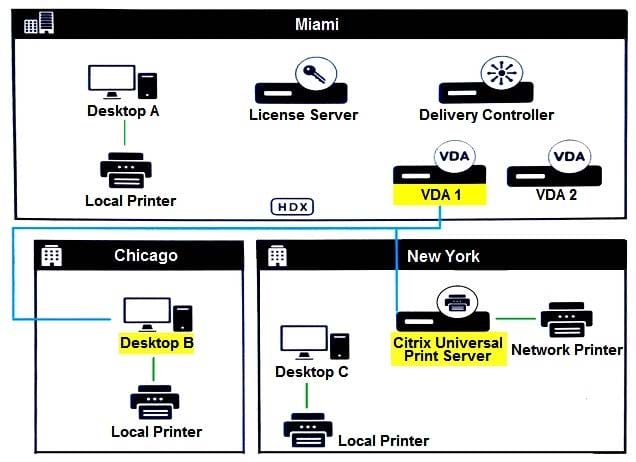
What does the architect need to do to meet the printing requirements for the users in Chicago?
A. Enable the Auto-create client printers policy with `Auto-create all client printers' setting enabled. Enable the Universal print driver usage policy to `Use universal printing only'. Apply the policy to all users. Then, install and configure the Citrix Universal Print Server components and configure the Universal Print Server policy to `Enabled with no fallback to Windows native remote printing'. Last, create a session printer policy, add the network printers that will use the Universal Print Server, and apply the policy to the users in Chicago.
B. Enable the Auto-create client printers policy with `Auto-create all client printers' setting enabled. Enable the Universal print driver usage policy to `Use universal printing only'. Apply the policy to Chicago users. Then, install and configure the Citrix Universal Print Server components and configure the Universal Print Server policy to `Enabled with fallback to Windows native remote printing'. Last, create a session printer policy, add the network printers that will use the Universal Print Server, and apply the policy to all users.
C. Enable the Auto-create client printers policy with `Auto-create all client's default printer only' setting enabled. Enable the Universal print driver usage policy to `Use universal printing only if requested driver is unavailable'. Apply the policy to all users. Then, install and configure the Citrix Universal Print Server components and configure the Universal Print Server policy to `Enabled with fallback to Windows native remote printing'. Last, create a session printer policy, add the network printers that will use the Universal Print Server, and apply the policy to all users.
D. Enable the Auto-create client printers policy with `Auto-create all client's default printer only' setting enabled. Enable the Universal print driver usage policy to `Use universal printing only'. Apply the policy to all users. Then, install and configure the Citrix Universal Print Server components and configure the Universal Print Server policy to `Enabled with fallback to Windows native remote printing'. Last, create a session printer policy, add the network printers that will use the Universal Print Server, and apply the policy to the users in Chicago.
Questions 5
Scenario: A Citrix Architect is designing a new Citrix Virtual Apps and Desktops environment. While assessing the existing infrastructure, the architect determined that a number of users utilize legacy USB print devices that they will continue to need locally and within HDX sessions. The current HDX-optimized print virtual channel will NOT support these devices, so the architect decides that the Generic USB redirection channel should be used.
Which two factors must the architect consider when using Generic USB redirection? (Choose two.)
A. It requires more network bandwidth compared to standard HDX virtual channels.
B. Local access to printers will be lost until the HDX sessions is disconnected or ended.
C. Manufacturer printer drivers will need to be installed on user workstations.
D. The Citrix Virtual Channel Software Development Kit (VCSDK) will be required.
E. It is supported for only USB 3.0 devices and features.
Questions 6
Scenario: A Citrix Architect is designing a Citrix Virtual Desktops environment. The Engineer Group requires NVIDIA hardware with shared virtualized GPUs due to its use of graphical applications. Management wants to use 4 components within the Citrix Virtual Desktops environment to meet these requirements: NVIDIA GRID Tesla P40 GPUs Microsoft Hyper-V Server 2012 R2 Windows 10 virtual machines (VMs) Citrix Virtual Desktops 7
Which component must the architect change to implement this use case?
A. Windows 10 virtual machines
B. Citrix Virtual Desktops 7
C. NVIDIA GRID Tesla P40 GPUs
D. Microsoft Hyper-V Server 2012 R2
Questions 7
Scenario: A Citrix Architect is designing a new Citrix Virtual Apps and Desktops environment. As part of graphics-mode design considerations, the architect discovered that one User Group requires a graphics mode that provides both good performance and high image quality.
Which graphics mode should the architect recommend be configured for this specific group?
A. Visual quality = Build to Lossless
B. Visual quality = Always Lossless
C. Optimize for 3D graphics workload = Disabled
D. Optimize for 3D graphics workload = Enabled
Questions 8
Scenario: A Citrix Architect needs to manage the disaster recovery (DR) process for a Citrix Virtual Apps and Desktops environment. The environment currently consists of an active data center typically accessed by users, and a DR data center used in the event that a disaster impacts the primary data center. Each data center hosts a separate Citrix Virtual Apps and Desktops Site. The overall environment has been designed to actively replicate user data and application data from the primary data center to the DR data center using Microsoft Distributed File System Replication (DFSR). Management has made it a priority to minimize the loss of data when failing over between data centers.
The primary data center suffers an outage that affects multiple components. As a result, management decides to fail over to the DR data center. The architect has blocked access to the primary data center to prevent new attempts to connect to its Citrix Virtual Apps and Desktops Site.
Which two actions must the architect perform to meet company priorities before enabling access to the DR data center? (Choose two.)
A. Drain existing sessions from the primary data center.
B. Complete data replication from the primary data center to the DR data center.
C. Replicate the Site's SQL database backups to the DR data center.
D. Evaluate the condition of the Citrix Virtual Apps and Desktops environment in the primary data center.
E. Transport backup data repositories to the DR data center.
Questions 9
Scenario: A Citrix Architect is designing a pod-based architecture in a Citrix Virtual Apps and Desktops environment. The plan is to create three pods for different Resource Layer types:
-
Windows 10 VDI (non-persistent)
-
Windows Server 2016 hosted shared desktops (non-persistent)
-
Windows 10 VDI (persistent)
Which three components can be shared between the three pods? (Choose three.)
A. Citrix Delivery Controller
B. Citrix StoreFront
C. Citrix License Server
D. Citrix Director
E. Citrix Site Database
Questions 10
Scenario: A Citrix Architect is designing a new Citrix Virtual Apps and Desktops environment. Two Control
Layer security requirements have been identified:
For security reasons, it is unacceptable to use default ports for FlexCast Management Architecture (FMA)
services.
Management access to PowerShell and Citrix Studio should be restricted to management workstations by
granular firewall rules.
Which combination of ports can the architect assign to the listed Citrix services to meet the Control Layer
security requirements?
A. VDA Registration Port: 80 XML SSL Port: 80 SDK Port: 8083
B. VDA Registration Port: 8081 XML SSL Port: 443 SDK Port: 80
C. VDA Registration Port: 8081 XML SSL Port: 8082 SDK Port: 8083
D. VDA Registration Port: 8081 XML SSL Port: 8083 SDK Port: 8083
Questions 11
Scenario: A Citrix Architect has implemented a multi-location profile strategy as part of a large Citrix Virtual
Apps and Desktops solution. The architect needs to implement a single policy that sets the profile path for
all users.
New York users: Server: NYC-FS.company.lan ?Share: NYC-Profiles$
Miami users: Server: MIA-FS.company.lan ?Share: MIA-Profiles$
San Francisco users: Server: SFO-FS.company.lan ?Share: SFO-Profiles$
The architect has proposed the usage of this path for all users:
\\#Loc#-FS.company.lan\#Loc#-Profiles$\#sAMAccountName#\%ProfileVer%\
What does the architect need to define to use the above path for all users as the profile location?
A. A Loc variable using the Current-Location attribute
B. A DFS-ROOT variable per data center that incorporates the user environment variable %homeshare%
C. A new attribute called Loc using Active Directory (AD) Explorer
D. A user environment variable Loc using a login script
Questions 12
Scenario: A Citrix Architect is designing a new Citrix Virtual Apps and Desktops environment. While performing the capabilities assessment for the existing infrastructure, the architect discovered substantial issues with packet loss and latency, and no current Quality-of-Service (QoS) technology is in place to manage these issues.
Which capability risk will the architect need to investigate to address these issues?
A. Access infrastructure
B. Disaster recovery (DR) plan and implementation
C. Network architecture
D. Windows Server and Active Directory (AD) environments
Questions 13
Scenario: A Citrix Architect is implementing a new Citrix Virtual Apps and Desktops environment. The IT team has purchased 1,000 Citrix Virtual Apps and Desktops Advanced licenses.
The company requires the IT team to produce a report of successful and failed connections of Citrix Virtual Apps sessions during the last 30 days.
Which two actions does the architect need to take to produce the report? (Choose two.)
A. Implement Citrix Application Delivery Management
B. Configure `GroomFailuresRetentionDays'
C. Configure `GroomSessionsRetentionDays'
D. Purchase Citrix Gateway Universal licenses
E. Purchase Citrix Virtual Desktops Premium licenses


Home | About Us | Contact Us | FAQ | Guarantee Policy | Privacy Policy
Any charges made through this site will appear as Global Simulators Limited. All trademarks are the property of their respective owners.
Copyright © 2004-2026 pass2lead.com, All Rights Reserved.