


 Printable PDF

Oracle Database 12c: Performance Management and Tuning: 1Z0-064
Want to pass your Oracle Database 12c: Performance Management and Tuning 1Z0-064 exam in the very first attempt? Try Pass2lead! It is equally effective for both starters and IT professionals.
- Vendor: Oracle
- Exam Code: 1Z0-064
- Exam Name: Oracle Database 12c: Performance Management and Tuning
- Certifications: Oracle Certifications
- Total Questions: 119 Q&As( View Details)
- Updated on: Jul 11, 2026
- Note: Product instant download. Please sign in and click My account to download your product.




- Q&As Identical to the VCE Product
- Windows, Mac, Linux, Mobile Phone
- Printable PDF without Watermark
- Instant Download Access
- Download Free PDF Demo
- Includes 365 Days of Free Updates
VCE
- Q&As Identical to the PDF Product
- Windows Only
- Simulates a Real Exam Environment
- Review Test History and Performance
- Instant Download Access
- Includes 365 Days of Free Updates
Passing Certification Exams Made Easy
Everything you need prepare and quickly pass the tough certification exams the first time
- 99.5% pass rate
- 7 Years experience
- 7000+ IT Exam Q&As
- 70000+ satisfied customers
- 365 days Free Update
- 3 days of preparation before your test
- 100% Safe shopping experience
- 24/7 Support
Oracle 1Z0-064 Last Month Results
Free 1Z0-064 Exam Questions in PDF Format
Related Oracle Certifications Exams
1Z0-064 Online Practice Questions and Answers
Questions 1
To investigate the slow response time of queries on the TRANS table, you gathered the table statistics and executed the query:

The table is stored in a tablespace that has Automatic Segment Space Management (ASSM) enabled. The tablespace is created with a standard block size of 8192 bytes.
Which three can be reasons for the slow response time of the queries? (Choose three.)
A. Row size is too large to fit into a single block during insert operations.
B. Row moves from one data block to another data block because the row grows too large to fit in the original block.
C. The table is subject to frequent insert, update, and delete DML activity leading to sparsely populated blocks.
D. The value of PCTUSED is set to a value lower than the default, causing row chaining.
E. The value of PCTFREE is set to a value lower than the default, causing row chaining.
Questions 2
In your database, supporting an OLTP workload, the SALES table is range-partitioned on the SALES_DATE column. A new partition is created every quarter and is frequently used for updates and queries. You recently noticed degraded performance of queries on a new partition due to stale statistics. A local partitioned index exists on the SALES_DATE column.
What would you recommend to improve performance?
A. dropping the local partitioned index and creating a global partitioned index on the SALES_DATE column
B. setting the INCREMENTAL preference to TRUE and the NO_INVALIDATE preference to TRUE for the partitioned table while gathering statistics
C. setting the INCREMENTAL preference to TRUE and the CASCADE preference to FALSE for the partitioned table while gathering statistics
D. setting the INCREMENTAL preference to TRUE and the GRANULARITY preference to AUTO for the partitioned table while gathering statistics
Questions 3
Examine the Load Profile and partial Top 10 Foreground Events by Total Wait Time sections from an AWR report.
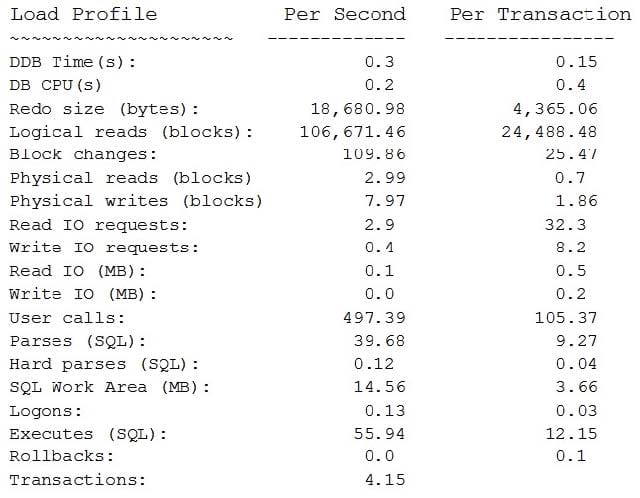
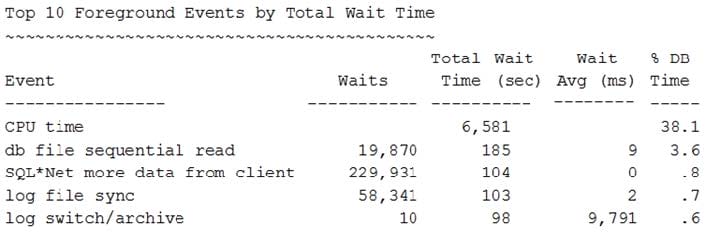
Which two areas should you examine next to identify possible bottlenecks?
A. the application code because of CPU-intensive activities
B. the application code because user calls are performing several queries that require sorting
C. the "SQL ordered by Gets" section of the AWR report to check for excessive logical I/O
D. the "SQL ordered by Reads" section of the AWR report to check for excessive physical reads
Reviews
-
Nathen
 South AfricaPassed today......... Thanks a lot guys! I only Study your manuals and sims. Valid dumps! Good luck to u all~!
 -
Petter
 Russian FederationValid. All questions from the exam, few questions have the different order. So please be careful in the exam,
 -
Zoubesh
 BelgiumThis is very good dumps with almost 100% correct answers, much better than any other dumps. Recommend.
 -
zzz
 United Statesi must recommend this dumps to you for i achieved full score with the help of it. i believe that you can do it like me by using this dumps.
 -
Kevin
 GhanaThe Dumb is valid 100%.
 -
William
 CambodiaYes, i have passed the exam by using this dumps,so you also can try it and you will have unexpected achievements. Recommend to all.
 -
Zwe Thu Ko
 DenmarkTheir dumps is a very recent update. All the new questions are there! Recommend.
 -
JohnS
 MalaysiaValid. Pass with 9XX. Good Luck!!!
 -
Lisa
 Jordanthanks god and thank you all. 100% valid. you can trust on it.
 -
Xt3r
MalaysiaYeah , Get 869/1000 score, this dumps still valid 100% but the some os answer is not correct.



Home | About Us | Contact Us | FAQ | Guarantee Policy | Privacy Policy
Any charges made through this site will appear as Global Simulators Limited. All trademarks are the property of their respective owners.
Copyright © 2004-2026 pass2lead.com, All Rights Reserved.