

1Z0-082 Online Practice Questions and Answers
Questions 4
Which two statements are true about views used for viewing tablespace and datafile information? (Choose two.)
A. Tablespace free space can be viewed in V$TABLESPACE
B. V$TABLESPACE displays information that is contained in the controlfile about tablespaces
C. V$TABLESPACE displays information about tablespaces contained in the data dictionary
D. Tablespace free space can be viewed in DBA_TABLESPACES
E. A datafile can be renamed when the database is in MOUNT state and the new file name is displayed when querying DBA_DATA_FILES after the database is opened
Questions 5
Examine the description of the CUSTOMERS table:
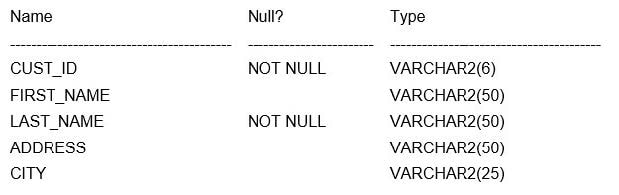
You want to display details of all customers who reside in cities starting with the letter D followed by at least two characters.
Which query can be used?
A. SELECT * FROM customers WHERE city LIKE `D_%';
B. SELECT * FROM customers WHERE city = `%D_';
C. SELECT * FROM customers WHERE city LIKE `D_';
D. SELECT * FROM customers WHERE city = `D_%';
Questions 6
Which three Oracle database space management features will work with both Dictionary and Locally managed tablespaces? (Choose three.)
A. Oracle Managed Files (OMF)
B. Online table segment shrink
C. Online index segment shrink
D. Automatic data file extension (AUTOEXTEND)
E. Capacity planning growth reports based on historical data in the Automatic Workload Repository (AWR)
Questions 7
The SCOTT/TIGER user exists in two databases, BOSTON_DB and DALLAS_DB, in two different locations.
Each database has a tnsnames.ora file defining DALLAS_DB as a service name.
Examine this command:
CREATE DATABASE LINK dblink1 CONNECT TO scott IDENTIFIED BY tiger USING `dallas_db';
How do you execute the command so that only SCOTT in BOSTON_DB can access the SCOTT schema in DALLAS_DB?
A. as SCOTT in DALLAS_DB
B. as SCOTT in BOSTON_DB
C. as SCOTT in BOSTON_DB and SYS in DALLAS_DB
D. as SYS in both the databases
E. as SCOTT in both the databases
Questions 8
Examine the description of the customers table:
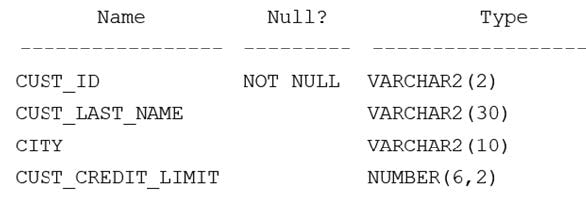
You need to display last names and credit limits of all customers whose last name starts with A or B in lower or upper case, and whose credit limit Is below 1000.
Examine this partial query:
SELECT cust_last_name, cust_credit_limit FROM customers
Which two where conditions give the required result?
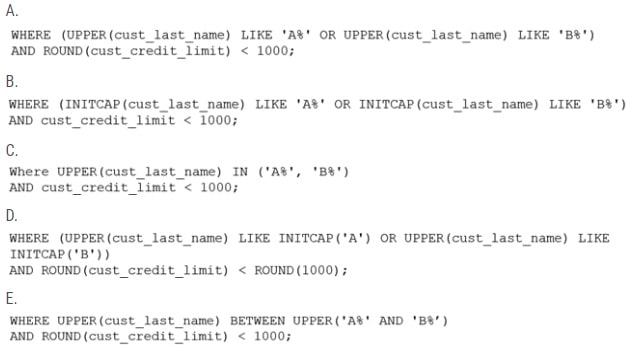
A. Option A
B. Option B
C. Option C
D. Option D
E. Option E
Questions 9
Table EMPLOYEES contains columns including EMPLOYEE_ID, JOB_ID and SALARY.
Only the EMPLOYEE_ID column is indexed.
Rows exist for employees 100 and 200.
Examine this statement:
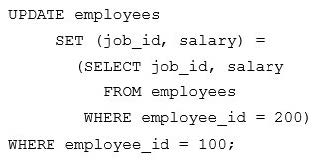
Which two statements are true? (Choose two.)
A. Employee 100 will have SALARY set to the same value as the SALARY of employee
B. Employee 200 will have JOB_ID set to the same value as the JOB_ID of employee 100
C. Employee 200 will have SALARY set to the same value as the SALARY of employee
D. Employee 100 will have JOB_ID set to the same value as the JOB_ID of employee 200
E. Employees 100 and 200 will have the same JOB_ID as before the update command
F. Employees 100 and 200 will have the same SALARY as before the update command
Questions 10
Which two statements are true about UNDO and REDO? (Choose two.)
A. The generation of UNDO generates REDO
B. DML modifies Oracle database objects and only generates UNDO
C. The generation of REDO generates UNDO
D. DML modifies Oracle database objects and only generates REDO
E. DML modifies Oracle database objects and generates UNDO and REDO
Questions 11
Which two statements are true about INTERVAL data types? (Choose two.)
A. INTERVAL DAY TO SECOND columns support fractions of seconds.
B. The YEAR field in an INTERVAL YEAR TO MONTH column must be a positive value.
C. The value in an INTERVAL DAY TO SECOND column can be copied into an INTERVAL YEAR TO MONTH column.
D. INTERVAL YEAR TO MONTH columns only support monthly intervals within a range of years.
E. INTERVAL YEAR TO MONTH columns only support monthly intervals within a single year.
F. INTERVAL YEAR TO MONTH support yearly intervals.
Questions 12
Examine the description of the CUSTOMERS table:
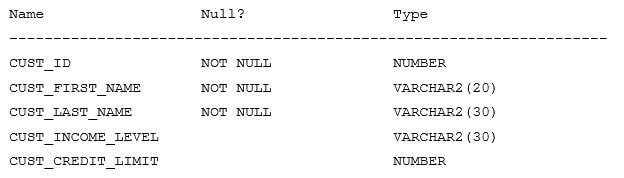
For customers whose income level has a value, you want to display the first name and due amount as 5% of their credit limit. Customers whose due amount is null should not be displayed. Which query should be used?
A. SELECT cust_first_name, cust_credit_limit * .05 AS DUE_AMOUNTFROM customersWHERE cust_income_level IS NOT NULLAND due_amount IS NOT NULL;
B. SELECT cust_first_name, cust_credit_limit * .05 AS DUE_AMOUNTFROM customersWHERE cust_income_level != NULLAND cust_credit_level !=NULL;
C. SELECT cust_first_name, cust_credit_limit * .05 AS DUE_AMOUNTFROM customersWHERE cust_income_level <> NULLAND due_amount <> NULL;
D. SELECT cust_first_name, cust_credit_limit * .05 AS DUE_AMOUNTFROM customersWHERE cust_income_level != NULLAND due_amount != NULL;
E. SELECT cust_first_name, cust_credit_limit * .05 AS DUE_AMOUNTFROM customersWHERE cust_income_level IS NOT NULLAND cust_credit_limit IS NOT NULL;
Questions 13
In the promotions table, the PROMO_BEGIN_DATE column is of data type DATE and the default date format is DD-MON-RR. Which two statements are true about expressions using PROMO_BEGIN_DATE contained in a query? (Choose two.)
A. TO_NUMBER(PROMO_BEGIN_DATE) - 5 will return a number.
B. PROMO_BEGIN_DATE - SYSDATE will return a number.
C. PROMO_BEGIN_DATE - SYSDATE will return an error.
D. PROMO_BEGIN_DATE - 5 will return a date.
E. TO_DATE(PROMO_BEGIN_DATE * 5) will return a date.


Home | About Us | Contact Us | FAQ | Guarantee Policy | Privacy Policy
Any charges made through this site will appear as Global Simulators Limited. All trademarks are the property of their respective owners.
Copyright © 2004-2026 pass2lead.com, All Rights Reserved.