

1Z0-083 Online Practice Questions and Answers
Questions 4
Which three are true about thresholds, metrics, and server-generated alerts? (Choose three.)
A. All metrics are instance related.
B. Cleared stateful alerts are displayed by querying DBA_ALERT_HISTORY.
C. A space usage management alert is automatically cleared after the underlying problem is resolved.
D. They are generated by SMON when a tablespace is 97% full.
E. Metrics are statistical counts for a specific unit.
F. STATISTICS_LEVEL must be set to ALL to generate alerts.
Questions 5
You issued this command:
RMAN> BACKUP RECOVERY FILES; Which two are true? (Choose two.)
A. All Oracle recovery files not in the current FRA that have not been backed up already, are backed up.
B. All non-Oracle files in the current FRA that have not been backed up already, are backed up.
C. All Oracle recovery files in the current FRA that have not been backed up already, are backed up.
D. All Oracle recovery files in the current fast recovery area (FRA) are backed up.
E. These backups can be written to disk or SBT.
Questions 6
Examine this configuration:
1.
CDB1 is a container database.
2.
PDB1 and PDB2 are pluggable databases in CDB1. You execute these commands successfully:

Which two are true? (Choose two.)
A. PDB1 and PDB2 are in MOUNT state.
B. Redo logs are opened.
C. PDB1 and PDB2 are in READ ONLY state.
D. CDB$ROOT is in MOUNT state.
E. PDB$SEED is in READ ONLY state.
Questions 7
Examine these queries and their output:
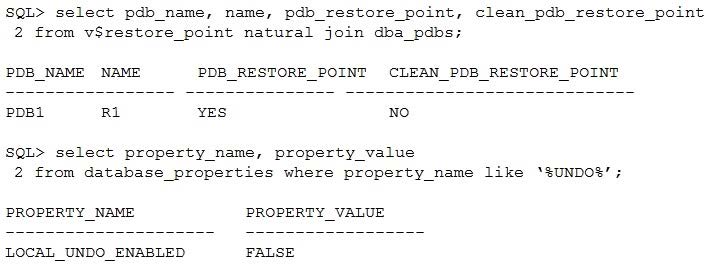
An online RMAN backup of the CDB was taken an hour before Restore Point R1 was created.
You want to recover PDB1 to Restore Point R1.
How do you achieve this?
A. Execute FLASHBACK PLUGGABLE DATABASE PDB1 TO RESTORE POINT R1 by using RMAN while connected to PDB1.
B. Execute FLASHBACK PLUGGABLE DATABASE PDB1 TO RESTORE POINT R1 by using SQL while connected to PDB1.
C. Execute FLASHBACK PLUGGABLE DATABASE PDB1 TO RESTORE POINT R1 by using SQL while connected to CDB$ROOT.
D. Execute FLASHBACK PLUGGABLE DATABASE PDB1 TO RESTORE POINT R1 by using RMAN while connected to CDB$ROOT.
E. This cannot be done due to the lack of a clean restore point.
Questions 8
Which three are true about Oracle Grid Infrastructure for a Standalone Server?
A. It includes both Oracle Restart and Oracle Automatic Storage Management (ASM) software.
B. It creates one disk group during installation.
C. It requires the operating system oracle_base environment variable to be predefined before installation.
D. It requires Oracle ASM Filter Driver (ASMFD) to manage Automatic Storage Management (ASM) disks
E. It requires Oracle ASMLibto manage Automatic Storage Management (ASM) disks.
F. Automatic Storage Management (ASM) requires that O/S groups OSASM and OSDBA be assigned as secondary groups for its installation owner.
Questions 9
You want to create a duplicate database DUP_DB from your production database PROD on the same host. The PROD database uses Automatic Storage Management (ASM) for storage. Regular backups are taken using RMAN connected to a recovery catalog. You create an auxiliary instance and want to execute the command: RMAN> DUPLICATE TARGET DATABASE TO dup_db FROM ACTIVE DATABASE;
What is a prerequisite for the successful execution of this command?
A. RMAN must be connected to the target database instance and the auxiliary instance.
B. A most recent backup set of the PROD database must exist.
C. Flashback must be enabled for the PROD database.
D. The target database must be in MOUNT state.
Questions 10
You want to create a test database as a replica of your production database with minimum intervention from a DBA. Which method would you use?
A. Use DBCA to create a template from the existing database to contain the database structure with data files and then use the same template to create the database in the new location.
B. Use Database Configuration Assistant (DBCA) to create a template from the existing database to contain the database structure.
C. Use DBCA to create a template from the existing database to contain the database structure and then manually copy the data by using Oracle Data Pump.
D. Use DBCA to create a template from the existing database to contain the database structure and then manually copy the data by using Oracle Data Pump.
Questions 11
Which three are true about backing up the control file? (Choose three).
A. It cannot be backed up manually as a binary copy.
B. It gets backed up automatically by RMAN as a trace file containing SQL statements for control file recreation when a database backup occurs.
C. It can be backed up manually as a binary copy.
D. It can get backed up automatically as a binary copy.
E. It gets backed up automatically by RMAN when the BACKUP SPFILE command is used.
F. It can be backed up manually as a trace file containing SQL statements for control file recreation.
Questions 12
Examine the RMAN command:
RMAN> CONFIGURE ENCRYPTION FOR DATABASE ON;
RMAN> BACKUP DATABASE PLUS ARCHIVELOG;
Which prerequisite must be met before accomplishing the backup?
A. The password for the encryption must be set up.
B. Oracle wallet for the encryption must be set up.
C. All the table spaces in the database must be encrypted
D. Oracle Database Vault must be enabled.
Questions 13
You want to transport the UNIVERSITY tablespace from one database to another.
The UNIVERSITY tablespace is currently open read/write.
The source and destination platforms have the same endian format.
Examine this list of steps:
1.
Make the UNIVERSITY tablespace read-only on the source system.
2.
Export the UNIVERSITY tablespace metadata using EXPDP.
3.
Create a cross-platform backup set from the UNIVERSITY tablespace on the source system, using an RMAN command that includes the DATAPUMP clause.
4.
Copy the cross-platform backup sets to the destination system.
5.
Copy the Data Pump dump set from the source to the destination system.
6.
Restore the cross-platform backup set on the destination system using an RMAN command that includes the DATAPUMP clause.
7.
Import the UNIVERSITY tablespace metadata using IMPDP.
8.
Make the UNIVERSITY tablespace read/write on the destination system.
Which are the minimum number of steps required, in the correct order, to transport the UNIVERSITY tablespace?
A. 1, 3, 4, 6, 8
B. 3, 4, 6
C. 1, 2, 3, 4, 5, 6, 7, 8
D. 2, 3, 4, 5, 6, 7


Home | About Us | Contact Us | FAQ | Guarantee Policy | Privacy Policy
Any charges made through this site will appear as Global Simulators Limited. All trademarks are the property of their respective owners.
Copyright © 2004-2026 pass2lead.com, All Rights Reserved.