

1Z0-1003-22 Online Practice Questions and Answers
Questions 4
Which two statements are true about registering Applications in OFSC?
A. A unique Client ID and Client Secret must be entered for each registered Application.
B. Applications support OAuth2 using tokens either from OFSC or external providers such as Oracle Identity CloudService.
C. If the API Access section is left blank, then by default, the Application has read/write access to all available OFSC APIs.
D. Applications support restricting access to a white list of certain IP addresses.
E. Separate Applications must be registered if you will be integrating with both REST and SOAP APIs
Questions 5
A company needs their field workers to be able to install inventory once an activity is in 'Started' status. Which screen configuration option supports this requirement?
A. Enable the 'Install' action within the Start Activity context.
B. Enable the 'Install' action within the Edit/View Activity context.
C. Enable the 'Install' action within the Add/Details Inventory context.
D. Enable the 'Install' action within the Inventory Grid context.
Questions 6
You created an event subscription via the Core API and it returned a page identifier of "170322-439 0" along with the subscription ID.
However, when you run a subsequent "Get Events" request using that subscription ID and same page identifier, the following is returned within the JSON-formatted response:
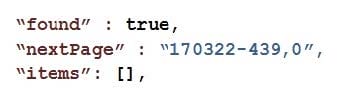
What is a valid reason why the "items" parameter is empty?
A. The Core API "Business Events" parameter is set to "hidden" within the Application beingused for API authentication.
B. There are no new subscription events as of the specified page identifier.
C. The Core API "Collaboration Events" parameter is set to "hidden" within the Application being used for API authentication.
D. No relevant eventswere specified within the body of the request
Questions 7
A customer wants to create a message scenario that, when launched, sends an email to the address of the immediate parent of the resource the activity is assigned to within the Oracle Field Service Cloud (OFSC) organizational hierarchy.
Which describes the correct message scenario configuration to support this requirement?
A. In the Step Info section of the message scenario, select Recipient: 'Resource', Delivery Channel: 'Email1.
B. In the Step Info section of the message scenario, selectRecipient: 'Customer', Delivery Channel: 'Email'.
C. In the Step Info section of the message scenario, select Recipient: 'Dispatcher', Delivery Channel 'Email'.
D. In the Step Info section of the message scenario, select Recipient: 'Use static address', Delivery Channel: 'Email'; In the Message Pattern section, enter the resource's email address property label.
Questions 8
A supervisor notices that some of the actions and status changes of technicians that work an 11 PM - 4 AM shift are being included in the next day'sdaily extract file.
The supervisor must have those actions included in the previous day's daily extract.
What must be configured to enable those actions to be included in the previous day's daily extract?
A. Set the BICS Settings on the Daily Extract screen to reflect the previous day.
B. Add the "Shift" property to the resource daily extract configuration.
C. Set the Overnight work value to 4 hours past midnight on the Business Rules screen.
D. Add the "Activity by Statuses" report to the Schedule Report menu item.
Questions 9
A customer has found that there are some instances where their technicians have recorded either exceptionally short (for example, "one-minute-wonders") or long (for example, they forgot to set the status to "complete") activity durations.
Given the importance of accurate data in a time-based self-learning system, which two constraints are in place and can be modified to ensure that outlier circumstances such as these do not affect future activity duration estimations?
A. "Minimum relevant duration time in minutes" and "Maximum relevant duration time in minutes"
B. "Personalize the estimation of activity duration" and "Initial ratio of activity duration"
C. "Lower limit for personal ratio to calculate duration" and "Upper limit for personal ratio to calculate duration"
D. "Minimum relevant travel time in minutes" and "Maximum relevant travel time in minutes"
Questions 10
Which two statements are true regarding filter functionality within OFSC?
A. Filters can be created where only certain User Types can see and interact with them.
B. Filters can be used in conjunction with activities, resources, and inventory.
C. If an activity filterhas two conditions, then an activity must meet at least one of the conditions in order to be filtered.
D. After a filter has been created and saved, you cannot change the entity to which it is associated.
Questions 11
Your customer does not want to manage work zone assignments for each individual technician resource because all technicians can work in the same areas without bias or preference.
Which two options fulfill that customer requirement?
A. Assign all work zones at the parent level in the Resource Tree.
B. Create a single work zone with no work zone keys and assign it to all resources
C. Deselect "work zone support" in Business Rules to disable routing consideration of zones entirely.
D. Deselect "work zone support" in the routing plan configuration screen for all routing plans.
E. Create a single work zone group, with all zones included in the group, and assign it to the highest level in the resource tree.
Questions 12
A customer is currently closing booking automatically by capacity category within all of their Capacity Areas, but they also want to be abl^to close booking per work zone because some of their work zones require additional work preparations.
Which step is required to enable this functionality?
A. On the Business Rules screen, enable 'Allow closing of booking on work zone level'.
B. If 'Work Zone support' is enabled on the Business Rules screen, there are no additional steps required to enable closure of booking per work zone.
C. On the Quota Configuration screen for each Capacity Area, enable the 'Allowclosing of booking on work zone level' feature.
D. On the Resources screen for each Capacity Area, enable the 'Allow closing of booking on work zone level' feature.
Questions 13
Which two statements are correct regarding String and Integer property types?
A. Both property types can contain alphanumeric characters and punctuation.
B. Both property types can containGeolocation elements.
C. Integer property types can be used for check box elements, whereas String property types can be used for phone numbers or email addresses.
D. Both property types can include regular expressions.


Home | About Us | Contact Us | FAQ | Guarantee Policy | Privacy Policy
Any charges made through this site will appear as Global Simulators Limited. All trademarks are the property of their respective owners.
Copyright © 2004-2026 pass2lead.com, All Rights Reserved.