

1Z0-1056-23 Online Practice Questions and Answers
Questions 4
Which two statements are true when you are using the Intercompany Reconciliation Process? (Choose two.)
A. The Transaction Summary Report shows only transactions with a status of received.
B. The Clearing Company Balancing Lines appear in the Intercompany Reconciliation Summary Report.
C. The Reconciliation Period Summary Report shows the intercompany receivable and the intercompany payable lines generated by the intercompany balancing feature.
D. The ledger balancing lines are generated when theprimary balancing segment value is in balance but either the second balancing segment or the third balancing segment is out of balance.
E. You need to submit the Extract Intercompany Reconciliation Data job.
Questions 5
Which four output file types are available when you run the "Print Receivables Transactions" program?
A. JPG
B. PDF
C. Excel
D. HTML
E. Word
F. Zipped PDFs
Questions 6
Which role provides access to Receivables ?Revenue Adjustments Real Time OTBI Subject area?
A. Revenue Manager
B. Accounts Receivable Manager
C. Accounts Receivable Specialist
D. BillingSpecialist
Questions 7
The process of remitting receipts to a bank results in fund transfer errors.
Identify three corrective actions to resolve this. (Choose three.)
A. receipt reversal
B. clearing payment information
C. credit reversal
D. debit memo reversal
E. change of instrument
Questions 8
The Multifund Accounting feature supports detailed distributions for invoices with revenue recognition rules. For a customer invoice with the distributions below:
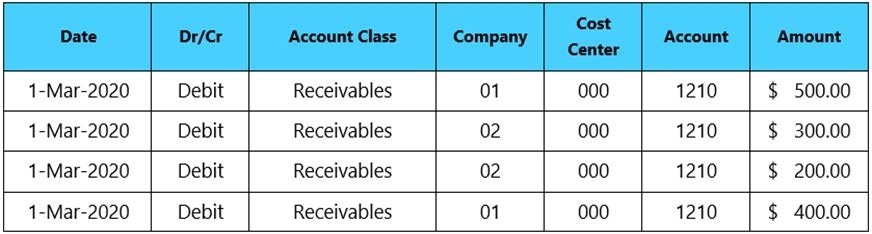
Which unearned revenue accounting entries will the feature generate?
A. Credits of $900 and $600 for companies 01 and 02 respectively
B. Credits of $900 and $500 for companies 01 and 02 respectively
C. Debit of $900 and credit of $500 for companies 01 and 02 respectively
D. Credit of $900 and debit of $500 for companies 01 and 02 respectively
E. Debits of $900 and $500 for companies 01 and 02 respectively
Questions 9
Which statement is true when you create an Implementation Project forOracle Financials Cloud?
A. The Implementation Project is preconfigured and cannot be deleted or changed.
B. You must plan your Implementation Project carefully because you cannot delete it or make changes later.
C. You must select the offering "Financials" and each individual product or option to perform the setup for each product in Oracle Financials Cloud.
D. When you select the offering "Financials," it automatically allows you to perform the setup for all Oracle Financials Cloud products.
E. You needto make only the project name unique, and then you can perform the setup for any product family, such as Financials, Procurement, Human Capital Management, and Supply Chain Management.
Questions 10
What information does the Collector see in the Activities List area of the Collections Dashboard?
A. customer's profile for each assigned customer
B. customer search as per the parameter specified
C. status of processing activitiesfrom the Process Monitor
D. tasks assigned to the Collector, such as follow-up calls
E. summary of aged transactions
Questions 11
What is the initial status of a newly created bill receivable?
A. Pending posting
B. Awaiting approval
C. New
D. Awaiting submission
E. Pending remittance
Questions 12
Your client's legacy system uses a hierarchical parent/child relationship to organize customer information because a single customer may have more than one bank account or payment method.
Does this prevent you from using theOracle Fusion Trading Community Model Data Import program?
A. The program allows the use of parent, child, and grandchild table hierarchies, but it requires multiple Customer Master records for each customer within the hierarchy.
B. The program allows table hierarchies for customer bank accounts, but not for other customer information.
C. No; the program contains parent, child, and grandchild table hierarchies to represent the hierarchy of data in the customer information.
D. Yes; the program specificallyprohibits parent, child, and grandchild table hierarchies to represent the hierarchy of data in the customer information.
E. The use of parent, child, and grandchild table hierarchies is allowed only in Accounts Payable, not Accounts Receivable.
Questions 13
Manage Collectors
Scenario:
You are responsible for defining a new collector. who will perform collection activities across multiple business units.
Task:
Create a new Collector. where:
1.
Name of the collector is (Replace XX with 03. which is your allocated User ID.)
2.
Collector must be available to all business units.
3.
Collector maps to employee FASXX Student (Replace xx with 03, which is your allocated User ID.)
A. See the explanation below for solution.
B. PlaceHolder
C. PlaceHolder
D. PlaceHolder


Home | About Us | Contact Us | FAQ | Guarantee Policy | Privacy Policy
Any charges made through this site will appear as Global Simulators Limited. All trademarks are the property of their respective owners.
Copyright © 2004-2026 pass2lead.com, All Rights Reserved.