

1Z0-1058-20 Online Practice Questions and Answers
Questions 4
Which three steps can be performed by using the Configure Module Objects pages? (Choose three.)
A. Choose display (or hide) configurable options for: results, events, consequences and treatments.
B. Set "object-perspective" association.
C. Create object data import templates.
D. Edit the assessment activity question and guidance text for all assessment types.
E. View assessment response details for all assessment types.
Questions 5
Your client has three operating units.
What are two ways in which you can exclude an operating unit where there are not enough personnel to
allow segregation of duties? (Choose two.)
A. In a model, create a new condition logic filter, select the operating unit attribute, select the operating unit value, and then perform an exclusion though the advanced options check box.
B. Navigate to the Create Access Global Condition page and create a new condition logic filter, select the operating unit attribute, select the operating unit value, and then perform an exclusion though the advanced options check box.
C. Navigate to the Create Access Global Condition page and create a new condition logic filter, select the within same operating unit attribute, select the value yes, and then perform your exclusion though the advanced options check box.
D. In a model, create a new condition logic filter, select the within same operating unit attribute, select the value yes, and then perform your exclusion though the advanced options check box.
E. In a model, create a new condition logic filter, select the operating unit attribute and select the operating unit value.
Questions 6
You have two segregation of duties requirements:
1) a user can access either the supplier creation pages or the invoice pages, but not both.
2) a user can access either the invoice creation pages or the payment creation pages, but not both.
How must these requirements be met in Advanced Access Controls?
A. Construct one model with three condition filters where the Function Name Equals "Create Supplier", "Create Invoice" and "Create Payment"
B. Construct two models, and create controls based on the models: "Create Supplier and Create Invoice", "Create Invoice and Create Payment"
C. Construct three controls, and create controls based on the models: "Create Supplier and Create Invoice", "Create Invoice and Create Payment", "Create Supplier and Create Payment"
D. Construct one model: "Create Supplier and Create Invoice and Create Payment"
E. Construct one entitlement: "Create Supplier and Create Invoice and Create Payment"
Questions 7
How do you identify Financial Reporting Compliance Cloud's key stakeholders?
A. Identify users who need to create and submit expense reports easily.
B. Identify users who will create customer invoices, and receive and apply customer payments.
C. Identify executives who need to certify internal controls for SOX or similar mandates.
D. Identify executives who will manage customer balances and recognize revenue.
Questions 8
Which controls can user A access and manage for the following Control Manager role configuration? See details of perspective trees and control-perspective association below.
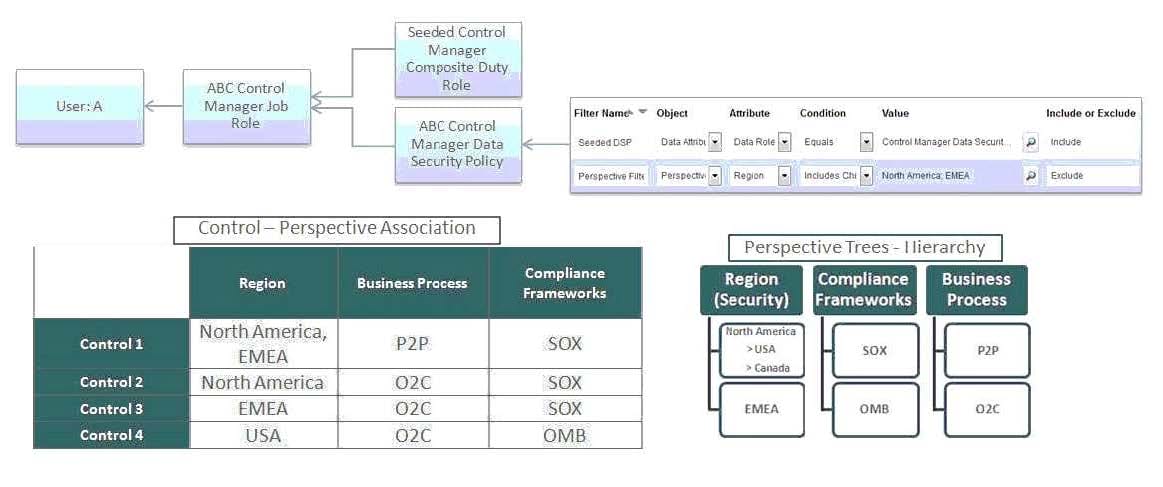
A. None
B. Controls 2 and 3
C. Only Control 1
D. All controls
E. Controls 1, 2, and 3
Questions 9
You want to identify Controls with the most Incidents, with the condition that the identified Controls should
have 80% of all Incidents. To do this, you have imported a custom object that contains the number of
incidents associated with each control, and have added that object to a transaction model.
Which pattern filter must you now apply?
A. Anomaly Detection
B. Mean
C. Pareto
D. Absolute Deviation
E. Clustering
Questions 10
Your client has subscribed to Financial Reporting Compliance and would like to address risks using
treatment plans.
Which option shows the settings that will help in achieving this configuration?
A. Configure Module Perspectives > Edit Financial Reporting Compliance > Risk-Organization mapping set to required, active.
B. Configure Module Objects > Edit Risk Object Configuration > Treatment = Show
C. Configure Module Objects > Edit Risk Object Configuration > Treatment = Hide and Default
D. Configure Module Objects > Edit Control Object Configuration > Result = Show
E. Configure Module Objects > Edit Risk Object Configuration > Result = Show
Questions 11
At the last step of initiating assessments, the assessment manager sees who the assessment participants are (to complete, review, and approve the assessments). If the assessment manager wants to change the participant, who completes the assessment, what should he or she do?
A. Modify the perspective hierarchy in the last step of initiating assessments.
B. Modify the participant list in the last step of initiating assessments.
C. Request the administrator to change the Perspective in Data Security Policy for the Control Manager's job role.
D. It is not possible to change the participants after Data Security Policies are assigned.
E. Request the administrator to assign Data Security Policies with correct perspectives to the Assessor's job role.
Questions 12
The GRC Business owner responsible for reviewing and investigating access incidents related to the "Order to Cash" perspective does not see any worklists for the generated results. You have validated that:
1.
Other business owners are able to view their assigned worklists without any problem
2.
Incidents have been generated for the controls related to Order to Cash
3.
The business owner's assigned roles contain the correct functional privileges and data access to the correct perspective values
What is the reason the business owner cannot see any worklists for the generated incidents?
A. The Result Management Perspective Assignment has not been linked.
B. The underlying model is not linked to Order to Cash.
C. The business owner was recently assigned the role and the worklist needs to be refreshed.
D. Worklist assignment does not include the business owner.
E. The Control Perspectives are not linked to the control.
Questions 13
Which three objects can be related to issues when creating an issue on the Manage Issues page? (Choose three.)
A. Test Plans
B. Assessments
C. Processes
D. Perspectives
E. Risks
F. Controls


Home | About Us | Contact Us | FAQ | Guarantee Policy | Privacy Policy
Any charges made through this site will appear as Global Simulators Limited. All trademarks are the property of their respective owners.
Copyright © 2004-2026 pass2lead.com, All Rights Reserved.