

1Z0-1071-20 Online Practice Questions and Answers
Questions 4
Consider this code snippet:
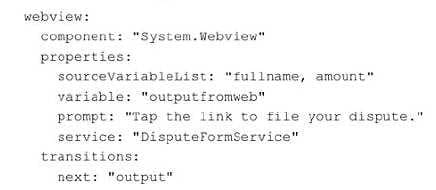
Which two statements about this code are true?
A. The system.webview component acts a gateway to a web app by naming the Webview service,
B. e., DisputeFormService, in the code snippet.
C. If the web app returns any values, the System.webview component will store them in the outputfromweb variable.
D. This code snippet supports only one variable as a return value from the web application. When there are multiple return values, they need to be comma-separated. For example: variable: "outputfromwebl, outputfromweb2 M
E. The web app returns two values and will store them in the fullname and amount variables, respectively.
Questions 5
What is the output of this code?
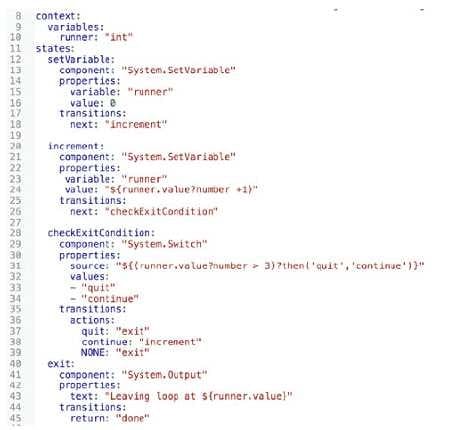
A. "Leaving loop at 3"
B. "Leaving loop at 4"
C. "Leaving loop at 0"
D. "Your session appears to be in infinite loop. Please_try again later''
Questions 6
Assuming that conversation is a reference to the Bots Node SDK, which two sets of code statements to access the custom component's orderid and userAccount input parameters are valid?
A. const order = conversation.properties().orderid; const account = conversation.properties().userAccount;
B. const order = conversation.request().variables[orderid']; const account = conversation.request ().variables['accountName 1);
C. const order = conversation.variable(1 orderid'); const account = conversation.variable('accountName1);
D. const{ orderid } = conversation.properties(); const { accountName> = conversation.properties();
E. const{ orderid } = conversation.variable(); const { accountName } = conversation.variable();
Questions 7
Which statement is FALSE regarding the core function of a digital assistant and how it could respond to user input?
A. It is able to automatically route the conversation to another digital assistant if the request can't be handled by the current digital assistant.
B. It is able to respond to a user request to exit the current conversation.
C. It is able to respond to a help request and return a help message, one that can be specific to one of its skills, or to the digital assistant itself
D. It is able to route the conversation to the start state of a skill that's managed by the digital assistant.
Questions 8
Which statement about digital assistants is FALSE?
A. A digital assistant can be used to manage a set of skills, including skills that you create yourself and skills that you have added from the Skill
B. A digital assistant ensures that a user completes a conversation in one skill before allowing that user to trigger the intent of a different skill
C. A digital assistant can communicate with customers through different messaging platforms.
D. A connection to a back-end service is through a custom component that is used by a skill, rather than one that is used by a digital assistant.
Questions 9
A user is in the middle of a conversation flow with a digital assistant but then triggers the Exit system intent by saying "get me out of here". Which statement is true?
A. Depending on digital assistant routing parameters, the user will be prompted to confirm exiting from the current conversation.
B. The conversation can only be exited if the current context score is lower than the Exit Skill Confirmation digital assistant routing parameter.
C. The conversation can only be exited if the current context score is greater than the Exit Skill Confirmation digital assistant routing parameter.
D. Because the user didn't explicitly specify the invocation name of the skill when exiting, the user will always be prompted to confirm exiting the current conversation.
E. The conversation will resume at a state in the skill defined by a digital assistant parameter.
Questions 10
The agentActions property in the System.AgentInitiation component:
A. Defines the states to which agents can optionally transfer a user when the agent ends the chat.
B. Sets the message to be displayed when an agent is first connected to a chat session.
C. Sets the message to be displayed if an agent refuses a chat request.
D. Sets the agent's post-chat configuration (for example, "ready", "wrap", and so on).
Questions 11
Which statement is true regarding the effect of context pinning on routing?
A. If the input includes an implicit invocation for a skill, the router pins the conversation to that skill.
B. If the user is pinned to a skill and then enters something that doesn't relate to that skill, the router automatically checks other skills for a match.
C. The thresholds that determine whether context pinning will occur or not set at the skill level.
D. For user input that includes an explicit invocation for a skill, but not intent-related utterance, the router pins the conversation to the skill. The next utterance, the router pins the conversation to the skill. The next utterance is assumed to be related to that skill.
Questions 12
View the Exhibit.

You have been asked to review a skill for its readiness for go live. Which four issues would you raise as a priority?
A. The unresolvedlntent has not been trained.
B. The utterances have too much commonality.
C. All utterances should start with an uppercase letter and end with a period.
D. The word "please" may inadvertently skew the results.
E. You should never have single-word utterances.
F. The number of utterances looks to be too low and artificial for a go-live.
Questions 13
Select the FALSE statement regarding confidence levels when routing within a digital assistant.
A. A confidence threshold is a value that's compared to the confidence level by the system, intent component to define the next action.
B. Confidence level is the intent engine's score for utterance classification.
C. All skills within a digital assistant must have the same confidence threshold.
D. If other intents that exceed the confidence threshold have scores that are within that of the top intent by less than the win margin, these intents are also presented to the user.


Home | About Us | Contact Us | FAQ | Guarantee Policy | Privacy Policy
Any charges made through this site will appear as Global Simulators Limited. All trademarks are the property of their respective owners.
Copyright © 2004-2026 pass2lead.com, All Rights Reserved.