

1Z0-1072-22 Online Practice Questions and Answers
Questions 4
Which two statements are true about restoring a volume from a block volume backup in Oracle Cloud Infrastructure Block Volume service?
A. You can restore a volume from any full volume backup but not from an Incremental backup.
B. You can only restore a volume to the same availability domain in which the original block volume resides.
C. You can restore a block volume backup to a larger volume size.
D. You can restore a volume to any availability domain within the same region where the backup is stored.
E. You can restore only one volume from a manual block volume backup.
Questions 5
You have hired a new employee to run reports from the Autonomous Data Warehouse (ADW) and are not
confident in their SQL writing ability.
Into which consumer group will you assign this individual to minimize the impact of their code?
A. Lowest
B. Medium
C. Highest
D. High
E. Low
Questions 6
Your application front end consists of several Oracle Cloud Infrastructure compute instances behind a public load balancer. You have configured the load balancer to perform health checks on these instances. What will happen if an instance fails to pass the configured health checks?
A. The instance is replaced automatically by the load balancer.
B. The instance is terminated automatically by the load balancer.
C. The instance is taken out of the back end set by the load balancer.
D. The load balancer stops sending traffic to that instance.
Questions 7
Which deployment architecture is offered when you deploy the Platform Service Manager based Database Cloud Service (DBCS) onto Oracle Cloud Infrastructure?
A. Two node Primary RAC database leveraging ACFS for the shared file system
B. Single Instance database with a Single Instance Data Guard in Maximum Performance mode
C. Single Instance database with a Single Instance Data Guard in Maximum Protection mode
D. Two node Primary RAC database with a two node RAC Data Guard Standby in Maximum Performance mode
Questions 8
Which is a customer's responsibility on an Oracle Cloud Infrastructure database?
A. patching the database and OS
B. creating the first default database on the DBCS server
C. creating an ASM diskgroup for data file or temp file storage
D. installing the operating system (OS), Grid Infrastructure, and database software
Questions 9
Which two statements about the Oracle File Storage Service (FSS) Security are accurate? (Choose two.)
A. Oracle IAM controls which filesystems are mountable by which instances.
B. Security lists can be used as a virtual firewall to prevent an instance from mounting an FSS mount target within a subnet.
C. Encryption of file storage in FSS is optional.
D. Data in transit to an FSS mount target is encrypted.
E. FSS leverages UNIX user group and permission checking for file access security.
Questions 10
Which two are required parameters to create a public load balancer instance? (Choose two.)
A. certificate
B. load balancer name
C. listener
D. back end set
E. two public subnets
Questions 11
Which two options are true for Autonomous Transaction Processing (ATP) database? (Choose two.)
A. You can add/remove Diskgroup in ATP
B. You can scale storage up or down in ATP
C. You can scale CPU up or down in ATP
D. You can add more Pluggable Database for consolidating multiple databases in ATP
E. You can add new ORACLE_HOME for bringing older versions of on-premises databases to ATP
Questions 12
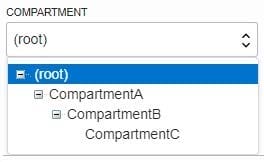
You have the following compartment structure in your tenancy. Root compartment->Training- >Training
subl ->Training-sub2 You create a policy in the root compartment to allow the default admin for the account
(Administrators) to manage block volumes in compartment Training-sub2.
What policy would you write to meet this requirement?
A. Allow group Administrators to manage volume-family in root compartment
B. Allow group Administrators to manage volume-family in compartment Training-sub1 :Training- sub2
C. Allow group Administrators to manage volume-family in compartment Training: Training-sub 1 :Training-sub2
D. Allow group Administrators to manage volume-family in compartment Training-sub2
Questions 13
Which three load-balancing policies can be used with a backend set?
A. throughput
B. least connections
C. IP hash
D. CPU utilization
E. weighted round robin


Home | About Us | Contact Us | FAQ | Guarantee Policy | Privacy Policy
Any charges made through this site will appear as Global Simulators Limited. All trademarks are the property of their respective owners.
Copyright © 2004-2026 pass2lead.com, All Rights Reserved.