

1Z0-1115-23 Online Practice Questions and Answers
Questions 4
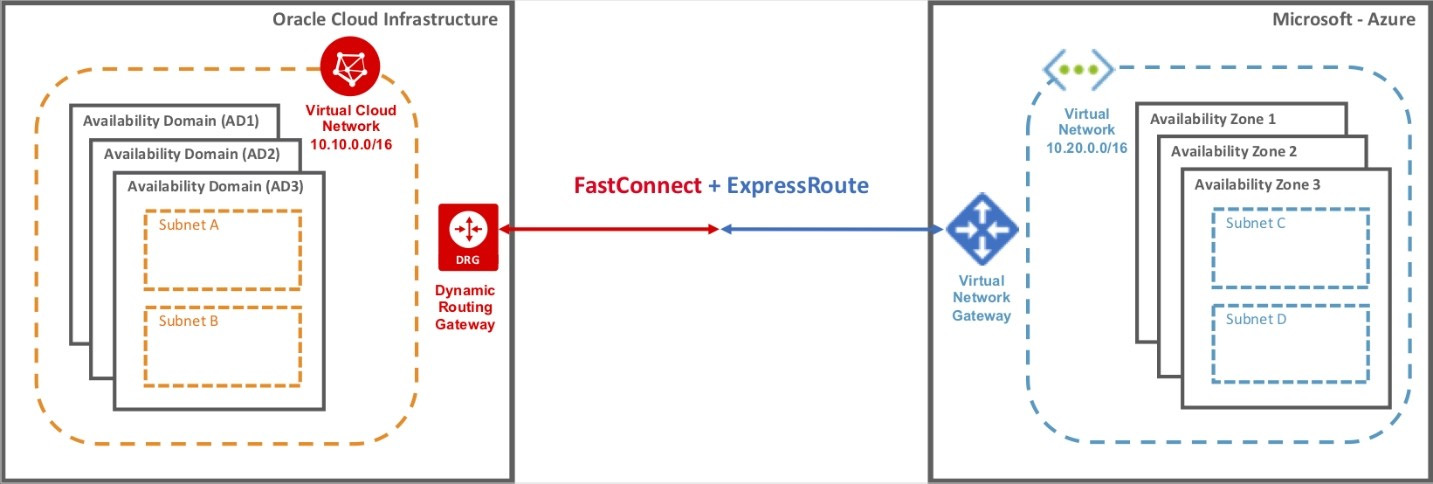
Which components are required to establish a cross-cloud connection between Microsoft Azure and Oracle Cloud Infrastructure?
A. Azure Site-to-Site VPN and OCI Site-to-Site VPN
B. Azure Load Balancer and OCI Load Balancer
C. Azure ExpressRoute circuit and Oracle FastConnect virtual circuit
D. Azure Virtual Network and OCI Virtual Cloud Network
Questions 5
What is the primary Oracle Cloud Infrastructure region associated with an OCI account during Ora-cleDB for Azure setup?
A. The region specified during OracleDB for Azure onboarding
B. The region with the most available resources for OracleDB for Azure
C. The region with the lowest latency for Azure communication
D. The home region of the OCI account
Questions 6
What is NOT required for the OracleDB for Azure setup?
A. Specific roles for the Oracle Database Service (ODS) enterprise application in Azure
B. An OCI tenancy with the necessary admin permissions for the OCI user
C. An existing Azure account with the necessary ARM roles
D. A preprovisioned Azure Virtual Network (VNet)
Questions 7
An organization wants to deploy Oracle Database Service for Azure in the existing Oracle Cloud Infrastructure and Azure tenancies that are in the supported regions. However, they want to have full control over the Azure permissions that should be granted.
Which option should they choose during the sign-up process?
A. Fully automated configuration
B. Guided account linking
C. Fully scripted configuration
D. Auto pilot linking
Questions 8
What is the primary difference between using Oracle FastConnect with an Oracle partner and using FastConnect with colocation with Oracle?
A. The method of establishing the physical connection to Oracle Cloud Infrastructure
B. The number of available redundancy models
C. The type of virtual circuits supported
D. The geographical locations available for connections
Questions 9
What encryption protocol is used to secure data transmission in an OCI Site-to-Site VPN connec-tion?
A. Transport Layer Security (TLS)
B. Datagram Transport Layer Security (DTLS)
C. Secure Sockets Layer (SSL)
D. Internet Protocol Security (IPSec)
Questions 10
A company has deployed a multi-tier application in Oracle Cloud Infrastructure (OCI), with web servers in a public subnet and database servers in a private subnet. The database servers need to ac-cess data from OCI Object Storage, and the company wants to ensure that this communication is secure and not exposed to the public internet. Which OCI feature should be used to achieve this objective?
A. Use a Local Peering Gateway to peer with the Object Storage subnet.
B. Use a Service Gateway to establish a secure connection to Object Storage.
C. Use a NAT Gateway to enable private access to Object Storage.
D. Use a VPN Gateway to create an encrypted tunnel to Object Storage.
Questions 11
Which is a database service that CANNOT be provisioned in the Oracle Public Cloud?
A. Autonomous Database on Dedicated Infrastructure
B. Exadata Database Service on Shared Infrastructure
C. Autonomous Database on Shared Infrastructure
D. Exadata Database Service on Dedicated Infrastructure
Questions 12
An enterprise has a workload running in a VNet in Microsoft Azure and a database running in a VCN in Oracle Cloud Infrastructure. The enterprise wants to set up a private, secure, and isolated network connection between the two clouds to enable traffic flow between the workload and the database. Which option can be used to achieve this requirement?
A. Use public internet to establish connectivity between the Microsoft Azure VNet and the OCI VCN.
B. Use Azure VPN and Oracle FastConnect to establish a private and secure tunnel be- tween the Azure VNet and the OCI VCN.
C. Use Azure Private Link to create a private connection between the workload and the database.
D. Use Azure ExpressRoute and Oracle FastConnect to create a private interconnection between the Azure VNet and the OCI VCN.
Questions 13
How does Oracle Database Service for Azure simplify cross-cloud deployments for customers?
A. By allowing customers to manually create cross-cloud deployments using the Intercon- nect
B. By providing more storage and computing resources than any other cloud service pro- vider
C. By offering more database types than any other cloud service provider
D. By using an automated service璪ased approach for cross-cloud deployment


Home | About Us | Contact Us | FAQ | Guarantee Policy | Privacy Policy
Any charges made through this site will appear as Global Simulators Limited. All trademarks are the property of their respective owners.
Copyright © 2004-2026 pass2lead.com, All Rights Reserved.