

1Z0-149 Online Practice Questions and Answers
Questions 4
Examine this table in the SH schema:
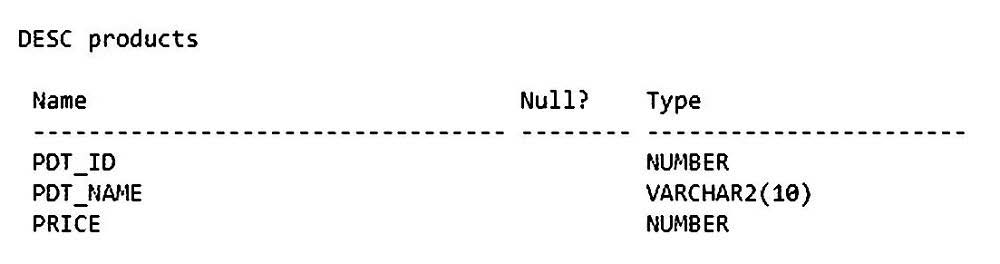
Now, examine this code:
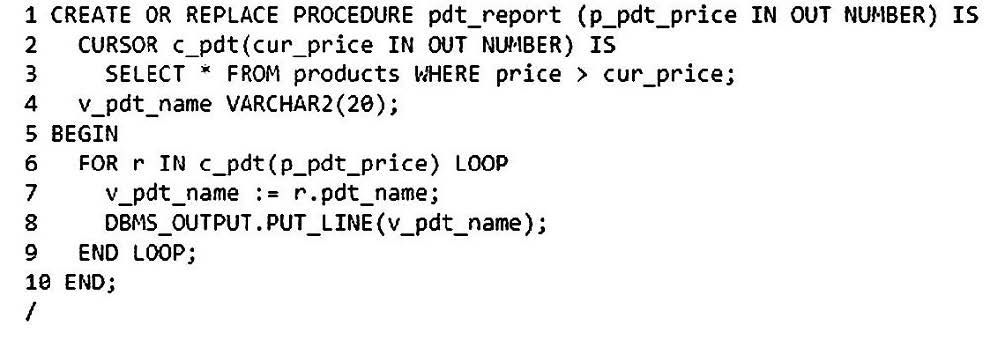
Which two changes are required to ensure that PDT_REPORT executes successfully? (Choose two.)
A. In line 1, change IN OUT mode to IN mode.
B. In line 2, change IN OUT mode to IN mode.
C. In line 3, replace CUR_PRICE with P_PDT_PRICE in the query condition.
D. In line 1, add the default parameter DEFAULT 2000.
E. In line 6, replace P_PDT_PRICE parameter name with CUR_PRICE.
F. In line 2, add the default parameter DEFAULT 2000.
Questions 5
Which three statements are true about Implicit Cursor and Explicit Cursor? (Choose three.)
A. Implicit cursor returns only one record.
B. Explicit cursor can return more than one record.
C. %Isopen, %Rowtype, %Notfound, and %Found are the attributes of Explicit Cursor.
D. %Isopen, %Rowcount, %Notfound, and %Found are the attributes of Explicit Cursor.
E. %Isopen, %Type, %Notfound, and %Found are the attributes of Explicit Cursor.
F. %Isopen is always false in Explicit Cursor.
G. %Isopen is always false in Implicit Cursor.
Questions 6
Which three are true about user-defined functions? (Choose three.)
A. They can be used in ORDER BY and GROUP BY clauses.
B. They can be executed as standalone commands.
C. They must be defined with at least one parameter.
D. They need not return any values.
E. They can appear in the select list of a SELECT statement.
F. Functions can call only other functions.
G. They can be used in CONNECT BY and START WITH clauses.
Questions 7
The SH schema contains the PRODUCTS table with column PDT_NAME defined as VARCHAR2(10). Which two blocks of code execute successfully when invoked by user SH? (Choose two.)

A. Option A
B. Option B
C. Option C
D. Option D
E. Option E
Questions 8
Which two are true about packages? (Choose two.)
A. Variables and cursors defined in a package specification are visible to all subprograms in the same schema that has the package.
B. Modifications to a packaged procedure's body automatically cause recompilation of subprograms that invoke the procedure.
C. Package specifications can be compiled without their bodies.
D. Standalone subprograms that reference a package can be compiled only after both the package specification and body are compiled.
E. A package definition must have a specification and body.
Questions 9
Which three are true about anonymous blocks and subprograms? (Choose three.)
A. Named subprograms cannot be called from other packages.
B. PROCEDURE subprograms can accept parameters.
C. A FUNCTION subprogram must return one or more values.
D. Anonymous blocks cannot use packaged variables.
E. Named subprograms are stored in the database server.
F. Anonymous blocks must always start with the Declare keyword.
G. FUNCTION subprograms must be called and passed through one or more parameters.
Questions 10
Which three are true about DDL triggers? (Choose three.)
A. They cannot include the WHEN clause.
B. They must be created in an enabled state.
C. They can be fired when a table is truncated.
D. They fire only when a DDL statement is executed by the owner of the trigger.
E. They can be fired either before or after a DDL statement executes.
F. They can be fired when a privilege is granted to a user.
G. They must be created in a disabled state.
Questions 11
Which two statements are true about using the OR REPLACE clause when creating named subprograms? (Choose two.)
A. Function based indexes remain usable when replacing the function on which the index depends.
B. Object privileges to execute a replaced function must be regranted to those users who had the privilege.
C. This clause can be used only for procedures and functions.
D. A function definition can be modified without dropping and re-creating it.
E. Object privileges to execute a replaced function are retained by those users who had the privileges.
Questions 12
Examine the SH.PRODUCTS table:
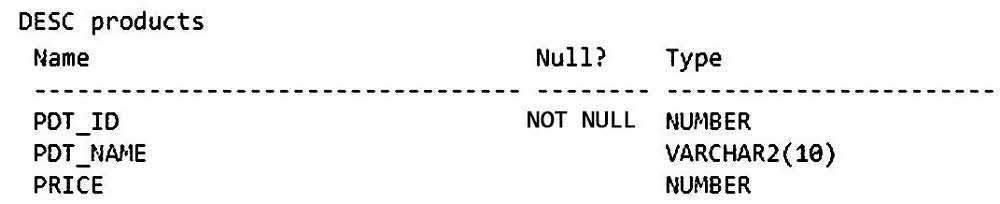
A row exists in SH.PRODUCTS with PDT_ID = 1. Now, examine this code and output executed by SH:
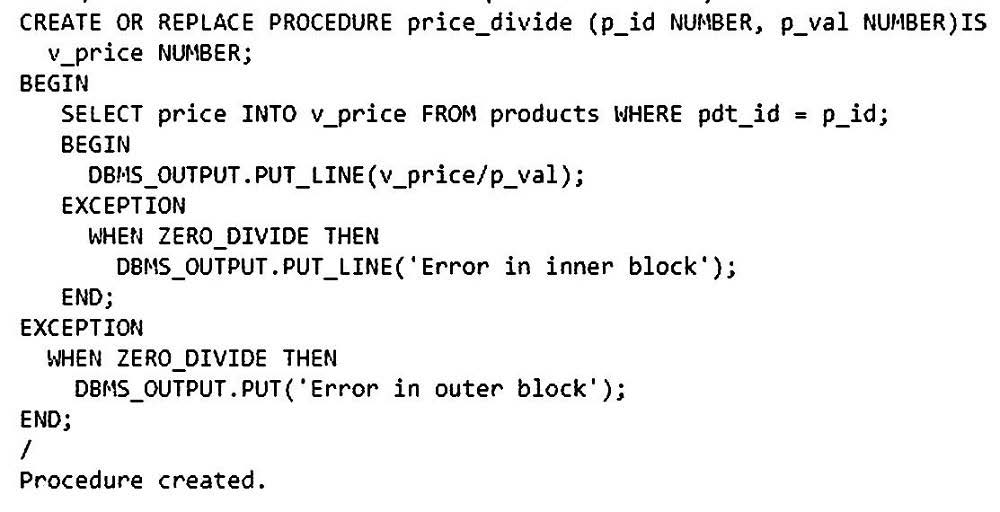
Now, examine this block of code:
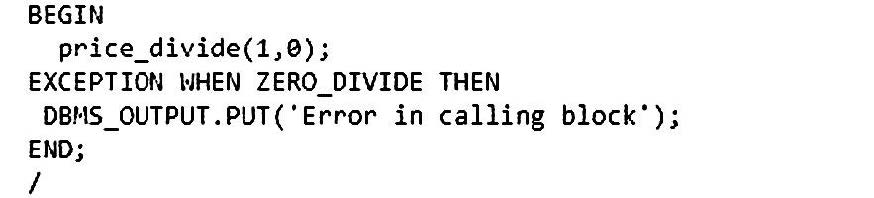
Which error message(s) does it display on execution by user SH?
A. Error in inner block
B. Error in inner block Error in outer block
C. Error in inner block Error in calling block
D. Error in inner block Error in outer block Error in calling block
Questions 13
In which type of trigger can :OLD and :NEW identifiers be used?
A. ROW
B. AFTER SUSPEND
C. AFTER STATEMENT
D. BEFORE STATEMENT


Home | About Us | Contact Us | FAQ | Guarantee Policy | Privacy Policy
Any charges made through this site will appear as Global Simulators Limited. All trademarks are the property of their respective owners.
Copyright © 2004-2026 pass2lead.com, All Rights Reserved.