

1Z0-419 Online Practice Questions and Answers
Questions 4
you access a page in your auh application mat reters to Dinaings caning auh business components.
Which statement is true at run time about the ADF Business Component application module? (Choose the best answer.)
A. An application module is automatically instantiated (or each user session and allocated to that user for the life of their session.
B. The programmer must instantiate an application module in a JSF managed bean and carry the application module for the life of the user session.
C. One application module bean is instantiated and shared by all user sessions.
D. An application module instance is checked out of the application module pool and given to the user session for at least that request, or longer depending
Questions 5
You want to configure an application so that users can shop for products anonymously without authentication, and must then authenticate after they enter the checkout process How would you enable this requirement? (Choose the best answer)
A. Grant roles access rights to the task flow containing the checkout process
B. Ensure the task flow containing the shopping process is unbounded
C. Remove ADF Security for the application and replace it with Java EE Security for the task flow containing the checkout process
D. Add a view containing a login form to the task flow containing the checkout process
Questions 6
Which statement is true about creating a method at the application module level? (Choose the best answer.)
A. You cannot create methods at the application module level.
B. Application module methods provide an interface for the view layer to call custom business logic that may work across multiple data views.
C. Application module methods are best suited to writing validation logic for entity objects.
D. Methods in an application module allow you to manipulate Ul components in the ViewController project
E. Because ADF provides no way at run time to automatically create or delete view object records, you must create application module methods to do this.
Questions 7
Consider a development organization divided into two teams, one developing ADF Business Components and related methods, and one developing the view and controller layers. What two steps would the Business Components team perform to deliver the results of their work to the other team'? (Choose two.)
A. Share the root ApplicationModulelmpI file on the file system or other shared location.
B. Create an ADF Library JAR file for the model project
C. Create a path to the ADF Library JAR file in Tools > Manage Libraries
D. Add the ADF Library JAR to the ViewController project
E. Share the ADF Library JAR file on the file system or other shared location
Questions 8
View the Exhibit

Which two modifications would you make in the task flow so that RegisterRouter displays the appropriate page depending on the user type and subsequently displays the confirmation page? (Choose two.)
A. Define the isCustomer outcome in RegisterRouter
B. Create a global control flow rule pointing to CustomerPage
C. Create a control flow rule from EmployeePaqe to Confirmation
D. Change the default activity from Register to RegisterRouter.
E. Set the isEmployee outcome to #{FALSE}.
Questions 9
Which option represents the expression you would use to determine if a user belongs to the administrator role? (Choose the best answer.)
A. #{securityContext.userinRolefadministrator']}
B. adf.context.securityContext.role.administrator
C. #{securityContextuserGrantedResource [administrator1]}
D. sfadfSecurity.userlnRolefadministrator']}
E. adf.context.secuhtyContext.userlnRole.administrator
Questions 10
Consider a bounded task flow input parameter called employeeld of type oracle jbo.domain.Number. When defining the parameter in the bounded task flow, if you do not define a value (destination) for the parameter, where does it get written to? (Choose the best answer.)
A. #(employeeld)
B. #{employee.employeeld}
C. #{pageFlowScope employeeld}
D. #{pageFlowScope employee employeeld)
E. #{backingBeanScope employeeld)
F. #{backingBeanScope employee.employeeld)
Questions 11
View the Exhibit You have defined a compare validation rule on the CommissionPct attnbute of the Employees entity object such that Commission must be greater than zero. How would you define that the validation rule applies only to those with the Jobld "SA_MAN" using the declarative features of ADF Business Components? (Choose the best answer.)
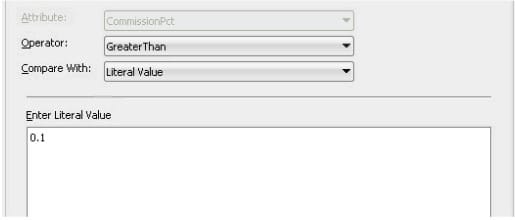
A. Remove the current validator and, instead, write a method validator in Java and use an if statement to check the value of JoblD.
B. Remove the current validator and, instead, write a script validator using Groovy and use an if statement to check the value of JoblD.
C. Remove the current validator and, instead, write a regular expression validator to check the value of JobID
D. The entity object has a Validation Execution tab and you use this to set a conditional execution expression Jobld = "SA_MAN".
E. Change the literal value in the current validation rule to be if Jobld = SA_MAN then return 0.1 else return null.
Questions 12
Which two statements are true about an af:panelStretchl_ayout component? (Choose two.)
A. a component placed in the center facet dynamically spaces out vertically to fill out the page height.
B. if the top facet has more content then fits vertically, it automatically adds a vertical scroll bar.
C. Facets without content in them do not show up at run time.
D. Components placed in the center facet stretch to fill the horizontal space regardless of their containing layout container.
E. You cannot include another panelStretchLayout component in the bottom facet.
F. You can specify the vertical size for the top facet in pixels.
Questions 13
View the Exhibit Which option represents the steps to add a relationship between OrdVO and ItemVO and create a master-detail hierarchy for the same in the data model? (Choose the best answer.)
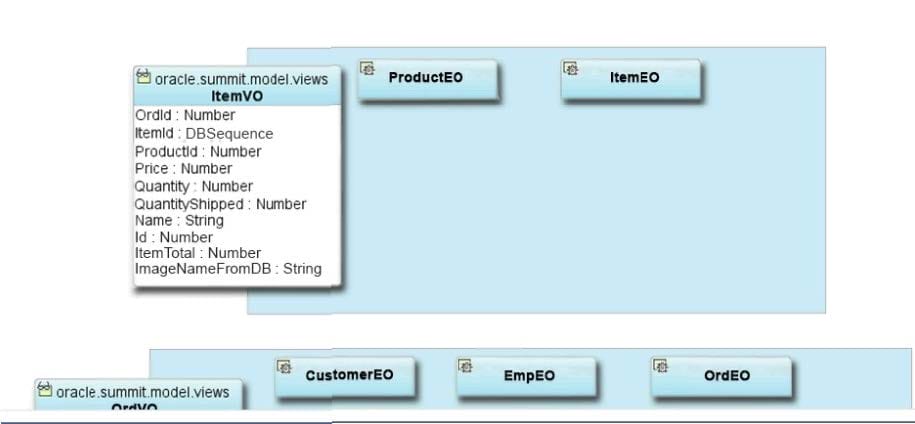
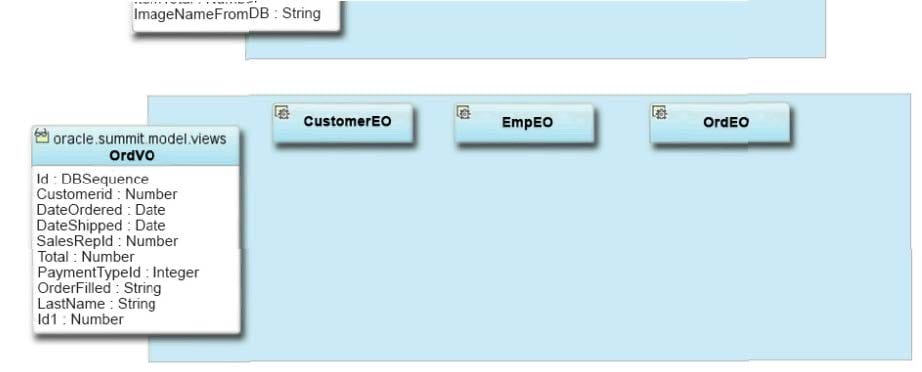
A. Select View Link from the Components window and draw a line on the diagram from ItemVO to OrdVO. Use the Application Module Editor to define the data model for the hierarchy.
B. Create a view link with OrdVO as the source and ItemVO as the destination and define the linked attributes Use the Application Module Editor to define the data model for the hierarchy.
C. Create a view link with ItemVO as the source and OrdVO as the destination and define the linked attributes. Use the Application Module Editor to nest the OrdVO instance beneath the ItemVO instance.
D. Select Association from the Components window and draw a line on the diagram from OrdEO to ItemEO diagram and select Generate View Link


Home | About Us | Contact Us | FAQ | Guarantee Policy | Privacy Policy
Any charges made through this site will appear as Global Simulators Limited. All trademarks are the property of their respective owners.
Copyright © 2004-2026 pass2lead.com, All Rights Reserved.