

1Z0-750 Online Practice Questions and Answers
Questions 4
Which four tasks can you perform using the Shared Components section in Application Builder? (Choose four.)
A. Edit the No Data Found messages for multiple report regions in the application
B. Manage translatable text messages for the application
C. Review debug messages generated by the application
D. Change the application alias
E. Manage application upgrade scripts
F. Change navigational components of the application
G. Add different application roles and configure their role assignment
H. Delete multiple application pages
Questions 5
What is the least error-prone way to split a long list into two lists?
A. Create an empty second list, copy selected list items from the first list to the second list, and then remove the copied list items from the first list.
B. Create two new lists, copy list items from the initial list to the first list, copy the remaining list items from the initial list to the second list, and then delete the initial list.
C. Create an empty second list, manually re-create the needed list entries, and then remove the matching list entries from the first list.
D. Copy the entire list, grid edit the copied list and remove entries that are not needed, and then grid edit the first list and remove the entries that are now in the second list.
Questions 6
When testing the Data Load Wizard pages, you realize that you forgot to add a transformation rule. What should you do to add the transformation rule?
A. Update the existing generated pages.
B. Update Data Load Definition.
C. Delete Data Load Definition and re-create it manually.
D. Use the Create Page Wizard to re-create the pages.
Questions 7
Which best describes how Session State Protection works?
A. saves sensitive data in Oracle Application Express session state tables in encrypted form, stopping users from tampering with the data
B. adds checksums to Page Access Protection attributes and Session State Protection item attributes to prevent alteration of session state
C. saves data in Oracle Application Express session state tables in encrypted form and uses the Page Access Protection attributes and the Session State Protection item attributes with checksums to prevent alteration of session state
D. encrypts the values supplied in the URL to prevent reading of the values
Questions 8
Jim has developed a form page. When running the page, the data displayed is not what he expected. Therefore, he wants to review the information in session state while debugging the form.
How can Jim accomplish this?
A. View page source information in the browser.
B. Click the Session button on the Developer toolbar.
C. Add a debug flag to the URL and rerun the page.
D. Click the View Debug button on the Developer toolbar.
E. Edit the page and update session state items to "Display Only".
Questions 9
Kyle is developing a page with an interactive report, called Employees, using this query:
SELECT EMPNO, ENAME, JOB, DEPTNO FROM EMP WHERE DEPTNO = nvl(:P3_DEPTNO, DEPTNO)
On the page, Kyle adds a select list, called P3_DEPTNO, using this query:
SELECT dname, deptno FROM dept;
He creates a dynamic action on change of P3_DEPTNO, with a true action of "Refresh" against the Employees region.
Kyle then runs the page and selects ACCOUNTING in the P3_DEPTNO item. However, the report still shows employees from all departments.
What must Kyle do to correctly display only employees from the department selected?
A. Add a computation set to P3_DEPTNO
B. Add an additional true action of Set Value by using Static Assignment in Dynamic Action
C. Set a column on the DEPTNO column
D. Set "Page Items to Submit" to P3_DEPTNO in the report
Questions 10
Francisco has been tasked with creating a Frequently Asked Questions (FAQ) page. The page security requirements are defined as:
Anyone who can access the application, in any capacity, shall also be able to view the new FAQ page. Which page level Authorization Scheme and Authentication options should Francisco choose?
A. Authorization Scheme: Reader Rights; Authentication: Page Requires Authentication
B. Authorization Scheme: Null; Authentication: Page is Public
C. Authorization Scheme: {Not Reader Rights}; Authentication: Page Is Public
D. Authorization Scheme: Must Not Be Public User; Authentication: Page Requires Authentication
Questions 11
Trillian wants to pass an item value, which includes a comma, such as the value Donuts, Coffee, in the URL when calling another page.
How can Trillian escape the item value so that the comma is interpreted correctly?
A. /Donuts,Coffee/
B. \Donuts,Coffee\
C. Donuts\,Coffee
D. "Donuts,Coffee"
Questions 12
A City Administration app has two select lists (LOVs). P1_STATE is based on "STATE" and P1_CITY is based on "CITY".
The CITIES table includes both the STATE and CITY columns. When a state is selected, the application should display only cities within the selected state, not all cities.
How can you limit the cities to display only those for the selected state?
A. Write a Set Value dynamic action against P1_STATE to require the P1_CITY based on the selected STATE.
B. Add P1_STATE to the "Page Items to Submit" property in P1_CITY.
C. In P1_CITY, set the "Cascading LOV Parent Item(s)" to P1_STATE.
D. Write an Execute PL/SQL Code dynamic action against P1_CITY to select the correct cities based on P1_STATE.
Questions 13
Molly has created a multi-series chart on the EMP table that shows the average salary per job in each department.
The chart below is not showing the data correctly because there are no Analysis or Salesmen In Department 10.
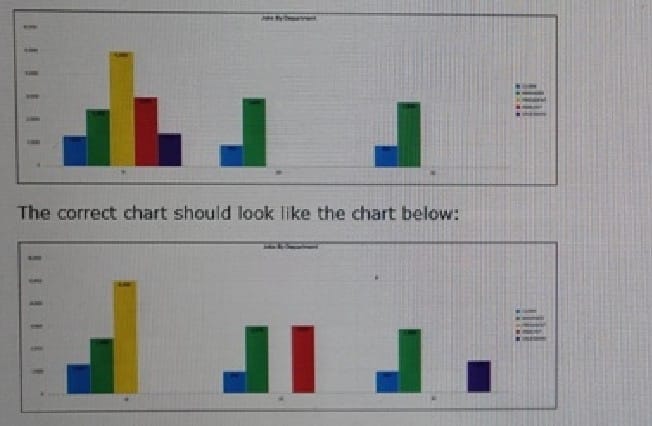
How must Molly update the chart to correctly display the data?
A. Update the Series Column Mapping for Series Nameto DEPTNO.
B. Set Fill Gaps in Chart Data to "Yes."
C. Update group by In the chart SQL Query.
D. Update the x-axis Baseline Scaling to "Fixed."


Home | About Us | Contact Us | FAQ | Guarantee Policy | Privacy Policy
Any charges made through this site will appear as Global Simulators Limited. All trademarks are the property of their respective owners.
Copyright © 2004-2026 pass2lead.com, All Rights Reserved.