

1Z0-902 Online Practice Questions and Answers
Questions 4
How is Exadata Secure RDMA Fabric isolation used in X9M-2 with virtualization enabled?
A. With Secure Fabric isolation, each Storage Server runs multiple KVM guests each dedicated to a Database VM cluster using a dedicated network partition and VLAN ID. This provides security and isolation between multiple tenants or VM clusters.
B. With Secure Fabric isolation, each Database VM Guest uses a dedicated network partition and VLAN ID for client networking between application servers. This improves security by preventing man in the middle attacks.
C. With Secure Fabric isolation, each Database VM Cluster uses a dedicated network partition and VLAN ID for Data Guard networking between the primary and disaster recovery Exadata racks. This improves security by isolating data guard traffic onto an encrypted network between data centers.
D. With Secure Fabric isolation, each Database VM cluster uses a dedicated network partition and VLAN ID for cluster networking between the database servers in the VM Cluster. This provides security and isolation between multiple tenants or VM clusters.
Questions 5
Which two statements are true about the initial storage configuration after the standard (non-virtualized) deployment of a new Exadata Database Machine with High Capacity storage servers?
A. The sparse_
B. There is free space available on the hard disks inside the database servers for possible extension of the /uoi file system.
C. The DATA_
D. There is free space available on flashdisks inside the Exadata storage servers for possible use for storage indexes.
E. There is free space available on flashdisks inside the Exadata storage servers to configure Exadata Smart Flash Logs.
Questions 6
You are adding a disk expansion kit to a running Exadata X8M Database Machine's Database Servers, and have a filesystem layout that includes:
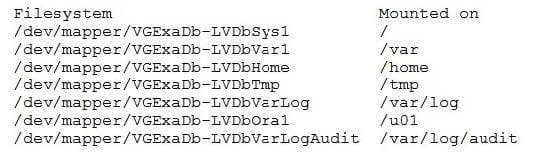
After running the following commands, which command needs to be run to add 20G of space to the filesystem mounted on /u01?

A. # lvextend -L +20G --verbose /dev/mapper/VGExaDb-LVDbOral
B. # xfs_growfs /uOl +20G
C. # resize2fs +20G /dev/VGExaDb/LVDbOral
D. # lvextend -L +20G --verbose /dev/VGExaDb/LVDbOral
Questions 7
Your customer needs to ensure that their data is available on the Exadata machine during updates. The customer wants to be able to update one server at a time but still be protected against single-node server failure.
What ASM redundancy level should they use?
A. Normal
B. Sparse
C. High
D. External
E. Extended
Questions 8
You have a script with several CELLCLI commands that must be executed on each cell in your Exadata full rack. The script must run on each cell simultaneously. How must you achieve this?
A. Copy and execute the script on all storage servers using the EXACLI command.
B. Copy the script to all storage servers using the dcli command and manually execute it on all storage servers using the EXACLI command.
C. Copy and execute the script on all storage servers using the dcli command.
D. Copy the script to all storage servers using the dcli command and manually execute it on each storage server using the DCLI command.
E. Copy the script to all storage servers using the CELLCLI command and execute it on all storage servers in parallel using the CELLCLI command.
Questions 9
You must drop all celldisks on all the storage servers in an X9M-2 quarter rack as part of a reconfiguration project.
Which three statements describe the account on the storage servers which you should use and the tool that may be used to drop the celldisks?
A. to the CELLADMIN account by calling CELLCLI on all cells using DCLI
B. to an administrator-created storage server user with appropriate privileges on celldisk objects by calling CELLCLI on all cells using exadcli
C. to the CELLMONITOR account using cellcli interactively on each storage server
D. to an administrator-created storage server user with appropriate privileges on celldisk objects by calling EXACLI on all cells using exadcli
E. to the CELLMONITOR account calling CELLCLI on all cells using DCLI
F. to the CELLADMIN account using cellcli interactively on each storage server
Questions 10
You have been tasked with replacing a memory module of an Exadata Storage Server and need to power off the affected storage server. Which two commands must you execute to safely power off the storage server in an Exadata X9M Database Machine?
A. CeLLCLI> alter cell shutdown SERVICES all on the affected storage server
B. CeLLCLI> list GRIDDISK where status != 'inactive' on the affected storage server
C. 'crsct1 stop cluster -all' on one of the database servers
D. CellCLI LIST GRIDDISK ATTRIBUTES name WHERE asmdeactivationoutcome != 'Yes' on the affected Storage server
E. CellCLI alter GRIDDISK all inactive on the affected storage server
F. shutdown -h now' on the affected storage server
Questions 11
Which two Exadata security features would you configure to control which databases can access which griddisks, when multiple databases share space on your storage servers in an unpartitioned storage grid?
A. Exadata storage realms using ASM-scoped security mode
B. File permissions on the griddisks in each database server
C. Using EXADCLI instead of CELLCLI to create the griddisks
D. File permissions on the griddisks in each storage server
E. Exadata storage realms using database-scoped security mode
Questions 12
Which two sections of the AWR report shows statistics for X9M Persistent Memory Cache?
A. PMEM Pool cache Read Hits in the Cache Sizes portion of the Report Summary
B. PMEM Pool Misses in the Exadata Outlier Summary
C. cell PMEM cache Read Hits in the Database IOs portion of the Performance Summary
D. PMEM Cache section within Memory Statistics
E. PMEM Cache section within Exadata Smart Statistics
Questions 13
Which are two correct statements about backing up Exadata Database Machine?
A. Backup of the Oracle Cluster Registry, which also contains Voting Disk information, is automatically maintained on the file system of the first database server.
B. Backing up Exadata Storage Server Software is critical for restoration.
C. For high availability, system area can be on the first two disks and M.2 devices.
D. The M.2 disk is hot pluggable and can be replaced when the power is on, but you will have to restore the system data manually.
E. Use a snapshot-based backup of an Oracle Exadata Database Machine database server software.


Home | About Us | Contact Us | FAQ | Guarantee Policy | Privacy Policy
Any charges made through this site will appear as Global Simulators Limited. All trademarks are the property of their respective owners.
Copyright © 2004-2026 pass2lead.com, All Rights Reserved.