

1Z0-958 Online Practice Questions and Answers
Questions 4
Which controls can user A manage for the following Control Manager role Configuration? See details of perspective trees and control-perspective association below.
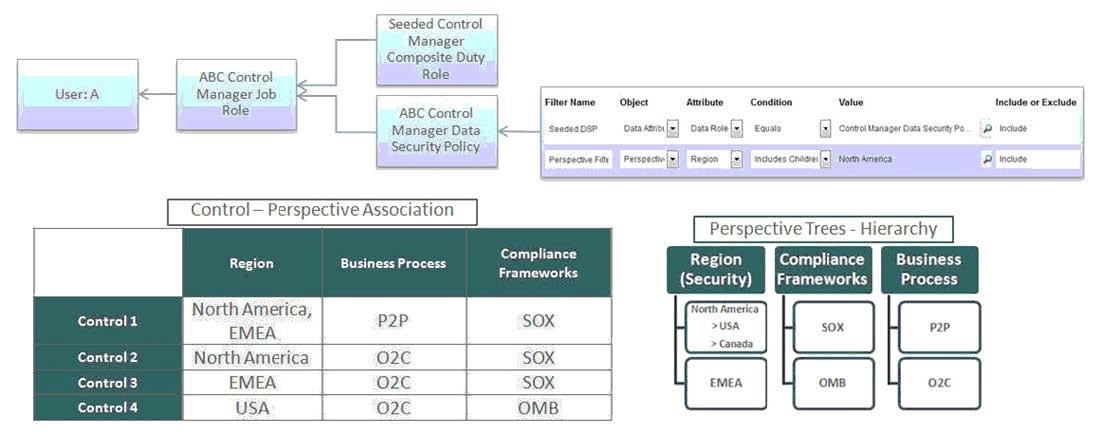
A. All controls
B. Controls 2 and 4
C. Controls 1, 2, and 4
D. None
E. Controls 1 and 2
Questions 5
You are advising your client on design and configuration related to how access incident results will be viewed and managed. The client has provided a list of business requirements: Incident results can be viewed by Department Groups of investigators receive assigned incidents based on Department Must ensure systematically that no incident is unassigned to an investigator
Which three must be configured to support these requirements? (Choose three.)
A. Worklist assignment Result Investigator should be set to specific users.
B. Custom perspective for Department linked to the Results object with Required set to "No"
C. Custom perspective for Department linked to the Results object with Required set to "Yes"
D. Investigators are assigned job roles with custom Department perspective data roles attached. Other incident users receive job roles which only allow viewing of incidents.
E. Investigators are assigned job roles with custom Department perspective data roles attached for managing incidents. Other incident users are assigned job roles with custom Department perspective data roles attached for viewing only.
F. Worklist assignment Result Investigator should be set to "All Eligible Users"
Questions 6
During an assessment, an issue was created. Your job as the Issue Manager is to review the issues and
validate them. If it is determined that they are not valid issues, you need to close them. You have found an
issue that is not valid and with Status: Open and State: Reported.
Identify the correct step to close this issue.
A. On the Manage Issues page, highlight the issue and click the Close button.
B. The assessment associated to the issue must be completed before closing the issue. Only then can you close the issue.
C. After you have completed the remediation plan, click the Close button on the Remediation Plan page.
D. Ensure that the issue status is In Edit, and then from the Actions menu, select Close Issue.
Questions 7
You are gathering requirements on how your client performs control assessments. Which three tasks should you complete to set up assessments in Financial Reporting Compliance? (Choose three.)
A. Identify the type of assessments included in each assessment cycle.
B. Understand the sample size for each audit test.
C. Determine if control assessments are planned ahead of time or are run impromptu.
D. Determine the main objectives of deploying the control.
E. Determine whether assessments templates, plans, and completed assessments need to go through a review and approve workflow.
Questions 8
You need to schedule the report "Access Violations by User." Which two steps do you take to create the saved parameters for the report schedule? (Choose two.)
A. Navigate to Administration Reports.
B. Highlight the report name and click Run Now.
C. Navigate to Scheduling under Setup and Administration.
D. Click Save Report Parameters to create saved settings.
E. Select Display Scheduled Reports.
Questions 9
You have two segregation of duties requirements:
1) a user can access either the supplier creation pages or the invoice pages, but not both.
2) a user can access either the invoice creation pages or the payment creation pages, but not both.
How must these requirements be met in Advanced Access Controls?
A. Construct one model with three condition filters where the Function Name Equals "Create Supplier", "Create Invoice" and "Create Payment"
B. Construct two models, and create controls based on the models: "Create Supplier and Create Invoice", "Create Invoice and Create Payment"
C. Construct three controls, and create controls based on the models: "Create Supplier and Create Invoice", "Create Invoice and Create Payment", "Create Supplier and Create Payment"
D. Construct one model: "Create Supplier and Create Invoice and Create Payment"
E. Construct one entitlement: "Create Supplier and Create Invoice and Create Payment"
Questions 10
You are helping your client identify and define their controls. You have determined that your client requires two perspectives: Business Units and Regulatory Standards. The controls are going to be secured by the business unit, and you want to ensure that when the client defines new controls, it is mandatory to assign a Business Units perspective to the control. You are going to set the "Required" field to "yes" for the Control-Business Units association.
Where do you do this in the product?
A. The Create Control screen
B. The Manage Object Perspectives screen
C. The Import template
D. The Create Perspectives screen
E. The Manage Module Perspectives screen
Questions 11
You can relate objects in Financial Reporting Compliance. Which statement is true about editing or creating related objects in the Related Objects section on the Risk Definition page?
A. You can relate only process objects.
B. You can relate a new process and a new control.
C. You can relate only control objects.
D. You can relate only an existing control, but not a new control.
Questions 12
Your client has asked you to define a transaction model to identify duplicate invoices based on Invoice
Numbers and Invoice Amounts.
Which two standard filters can be combined to accomplish this? (Choose two.)
A. The "Payables Invoice" object's "Supplier ID" does not equal itself.
B. The "Payables Invoice" object's "Invoice ID" is similar to the "Payables Invoice" object's "Invoice Number".
C. The "Payables Invoice" object's "Invoice Amount" is equal to itself.
D. The "Payables Invoice" object's "Invoice Number" is equal to the "Payables Invoice" object's "Invoice ID."
E. The "Payables Invoice" object's "Invoice Number" is equal to itself.
Questions 13
The GRC Business owner responsible for reviewing and investigating access incidents related to the "Order to Cash" perspective does not see any worklists for the generated results. You have validated that:
1.
Other business owners are able to view their assigned worklists without any problem
2.
Incidents have been generated for the controls related to Order to Cash
3.
The business owner's assigned roles contain the correct functional privileges and data access to the correct perspective values
What is the reason the business owner cannot see any worklists for the generated incidents?
A. The Result Management Perspective Assignment has not been linked.
B. The underlying model is not linked to Order to Cash.
C. The business owner was recently assigned the role and the worklist needs to be refreshed.
D. Worklist assignment does not include the business owner.
E. The Control Perspectives are not linked to the control.


Home | About Us | Contact Us | FAQ | Guarantee Policy | Privacy Policy
Any charges made through this site will appear as Global Simulators Limited. All trademarks are the property of their respective owners.
Copyright © 2004-2026 pass2lead.com, All Rights Reserved.