

1Z0-997-21 Online Practice Questions and Answers
Questions 4
You have an Oracle database system in a virtual cloud network (VCN) that needs to be accessible on port
1521 from your on-premises network CIDR 172.17.0.0/24.
You have the following configuration currently.
Virtual cloud network (VCD) is associated with a Dynamic Routing Gateway (DRG), and DRG has an
active IPSec connection with your on-premises data center.
Oracle database system is hosted in a private subnet
The private subnet route table has the following configuration The private subnet route table has following
configuration.
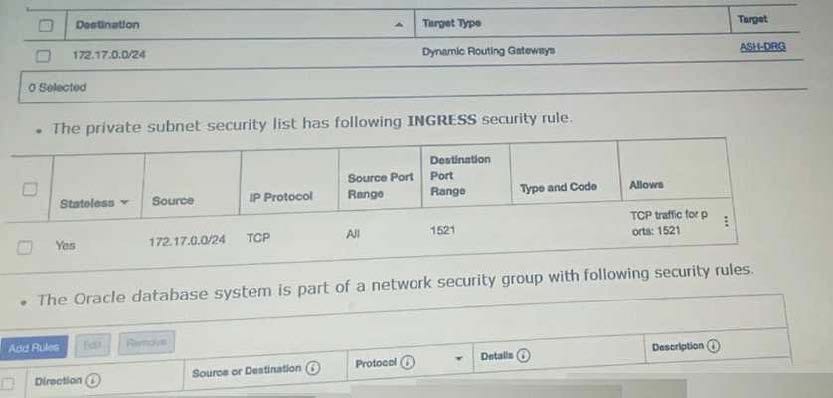
However, you are still unable to connect to the Oracle Database system. Which action will resolve this issue?
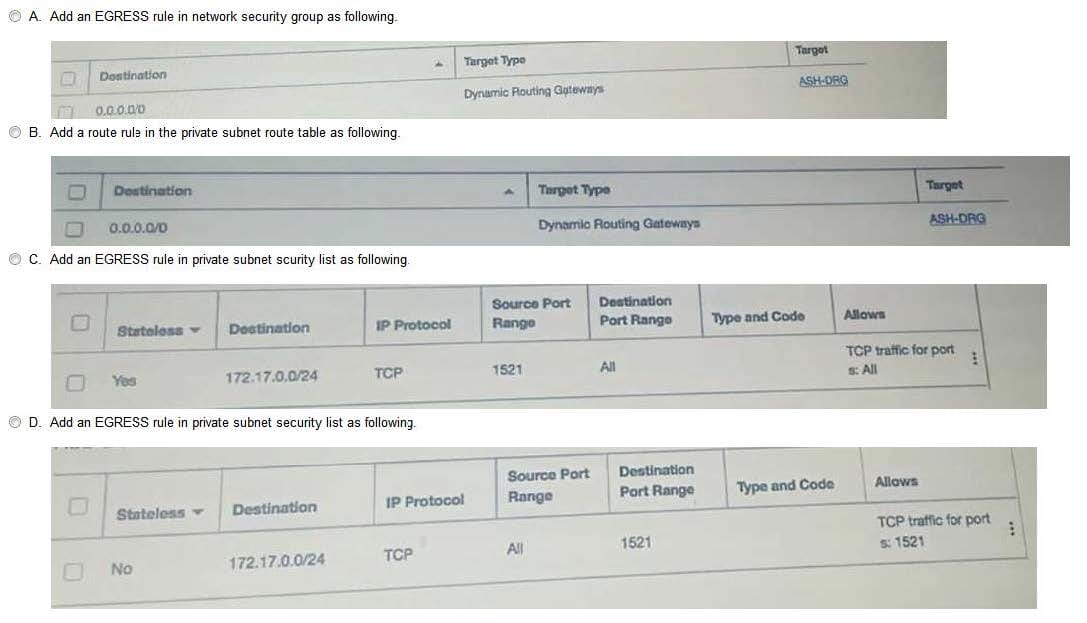
A. Option A
B. Option B
C. Option C
D. Option D
Questions 5
You are working as a cloud consultant for a major media company. In the US and your client requested to
consolidate all of their log streams, access logs, application logs, and security logs into a single system.
The client wants to analyze all of their logs In real-time based on heuristics and the result should be
validated as well. This validation process requires going back to data samples extracted from the last 8
hours.
What approach should you take for this scenario?
A. Create an auto scaling pool of syslog-enabled servers using compute instances which will store the logs In Object storage, then use map reduce jobs to extract logs from Object storage, and apply heuristics on the logs.
B. Create a bare-metal instance big enough to host a syslog enabled server to process the logs and store logs on the locally attached NVMe SSDs for rapid retrieval of logs when needed.
C. Set up an OCI Audit service and ingest all the API arils from Audit service pragmatically to a client side application to apply heuristics and save the result in an OCI Object storage.
D. Stream all the logs and cloud events of Events service to Oracle Streaming Service. Build a client process that will apply heuristics on the logs and store them in an Object Storage.
Questions 6
You are the Solution Architect that designed this Oracle Cloud Infrastructure (OCI) compartment layout for your organization:
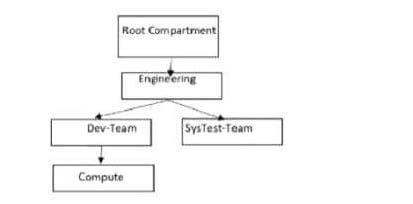
The development team has deployed quite a few instances under 'Compute' Compartment and the operations team needs to list the Instances under the same compartment for their testing. Both teams, development and operations are part of a group called 'Eng-group' You have been looking for an option to allow the operations team to list the instances without access any confidential information or metadata of resources. Which IAM policy should you write based on these requirements?
A. Allow group Eng-group to inspect instance-family in compartment Dev-Team:Compute and attach the policy to `Engineering' Compartment
B. Allow group Eng-group to inspect instance-family in compartment Dev-Team: Compute and attach the policy to 'SysTest Team' Compartment
C. Allow group Eng-group to read instance-family in compartment Compute and attach the policy to 'Engineering' Compartment.
D. Allow group Eng-group to read instance-family in compartment Dev-Team-.Compute and attach the policy to'Dev-Team'
Questions 7
You are working as a security consultant with a global insurance organization which is using Microsoft Azure Active Directory (AD) as identity provided to manager user login/passwords. When a user logs in to Oracle Cloud infrastructure (OCI) console, it should get authenticated by Azure AD. Which set of steps are required to configure at OCI side in order to get it enabled?
A. Setup Azure AD as an Enterprise Application, map Azure AD users and groups and policies to OCI groups and users
B. Setup Azure AD as an Identity Provider, Import users and groups from Azure AD to OCI, set up IAM policies to govern access to Azure AD groups
C. Setup Azure AD as an Enterprise Application, configure OCI for single sign-on, map Azure AD groups to OCI groups, set up the IAM policies to govern access to Azure AD groups
D. Setup Azure AD as an Identity Provider, map Azure AD groups to OCI groups, set up the IAM policies to govern access to Azure AD groups
Questions 8
A startup company is looking for a solution for processing of data transmitted by the IOT devices fitted to transport vehicles that carry frozen foods. The data should be consumed and processed in real time. The processed data should be archived to OCI Object Storage bucket. and use Autonomous Data warehouse (ADW) to handle analytics. Which architecture will help you meet this requirement?
A. Use OCI Streaming Service to collect the incoming biometric data. Use an open source Hadoop cluster to analyze the data horn streaming service. Store the results to OCI Autonomous Data warehouse (ADW) to handle complex analytics
B. Use OCI Streaming Service to collect the incoming biometric data. Use Oracle Functions to process the date and show the results on a real-time dashboard and store the results lo OCI Object Storage Store the data In OCI Autonomous Data warehouse (ADW) to handle analytics.
C. Create an OCI Object Storage bucket to collect the incoming biometric data from the smart pet collar Fetch the data horn OC\ Object storage to OCI Autonomous Data Warehouse (ADW) every day and run analytics Jobs with it
D. Launch an open source Hadoop cluster to collect the Incoming biometrics data Use an Open source Fluentd cluster to analyze the- data me results to OCI Autonomous Transaction Processing (ADW)to handle complex analytics
Questions 9
You are part of a project team working in the development environment created in OCI. You have realized that the CIDR block specified for one of the subnet in a VCN is not correct and want to delete the subnet. While deleting you are getting an error indicating that there are still resources that you must delete first. The error includes the OCID of the VNIC that is in the subnet. Which of the following action you will take to troubleshoot this issue?
A. Use OCI CLI to call "GetVnic" operation to find out the parent resource of the VNIC
B. Copy and Paste OCID of the VNIC in the search box of the OCI Console to find out the parent resource of the VNIC
C. Use OCI CLI to delete the VNIC first and then delete the subnet
D. Use OCI CLI to delete the subnet using --force option
Questions 10
You want to automate the processing of new image files to generate thumbnails. The expected rate is 10
new files every hour.
Which of the following is the most cost effective option to meet this requirement in Oracle Cloud
Infrastructure (OCI)?
A. Upload all files to an Oracle Streaming Service (OSS) stream. Setup a cron job to invoke a function in Oracle Functions to fetch data from the stream. Invoke another function to process the image files and generate thumbnails. Store thumbnails in another OSS stream.
B. Upload files to an OCI Object storage bucket. Every time a file is uploaded, an event is emitted. Write a rule to filter these events with an action to trigger a function in Oracle Functions. The function processes the image in the file and stores the thumbnails back in an Object storage bucket.
C. Build a web application to ingest the files and save them to a NoSQL Database. Configure OCI Events service to trigger a notification using Oracle Notification Service (ONS). ONS invokes a custom application to process the image files to generate thumbnails. Store thumbnails in a NoSQL Database table.
D. Upload files to an OCI Object storage bucket. Every time a file is uploaded, trigger an event with an action to provision a compute instance with a cloud-init script to access the file, process it and store it back in an Object storage bucket. Terminate the instance using Autoscaling policy after the processing is finished.
Questions 11
Which of the below options is true regarding Oracle Cloud Infrastructure's load balancing service?
A. You can dynamically change the load balancer shape to handle more incoming traffic.
B. The public load balancer applies a floating public IP address to the primary load balancer.
C. When you create a private load balancer, the service requires 2 or more subnets to host both the primary and standby load balancers.
D. A public load balancer is Availability Domain specific in scope.
Questions 12
An online gaming application is deployed to multiple Availability Domains in the Oracle Cloud Infrastructure (OCI) us-ashburn-1 region. Considering the high volume of traffic that the gaming application handles, the company has hired you to ensure that the data stored by the application is scalable, highly available, and disaster resilient. In the event of failure, the Recovery Time Objective (RTO) and Recovery Point Objective (RPO) must be less than 2 hours. Which Disaster Recovery strategy should be used to achieve the RTO and RPO requirements in the event of a system failure?
A. Configure hourly block volumes backups using the OCI Command Line Interface (CLI).
B. Create a user defined backup policy with a schedule of generating daily backups for block volumes.
C. Configure hourly block volumes backups through the OCI Storage Gateway service.
D. Create a user defined backup policy with a schedule of generating hourly backups for block volumes.
Questions 13
You work for a retail company and they developed a Microservices based shopping application that needs to access Oracle Autonomous Database from the application. As an Architect, you have been tasked to treat all of the application components as Kubernetes native objects, such as the microservices, Oracle Autonomous database, Kubernetes services, etc. What should you do to make sure that you can use Kubernetes constructs to manage the life cycle of the application components, including Oracle Autonomous Database? (Choose the best answer.)
A. Create an Oracle Cloud Infrastructure (OCI) Service Gateway and connect to the Oracle Autonomous Database using the private IP address from the microservice.
B. Provision an Oracle Autonomous Database and then use OCI Service Broker to access the database as a native component to your Kubernetes cluster.
C. Create a service from the Kubernetes cluster and point to the Oracle Autonomous Database using its FQDN.
D. Install and secure the OCI Service Broker for Kubernetes. Then provision and bind to the required Oracle Cloud Infrastructure services.


Home | About Us | Contact Us | FAQ | Guarantee Policy | Privacy Policy
Any charges made through this site will appear as Global Simulators Limited. All trademarks are the property of their respective owners.
Copyright © 2004-2026 pass2lead.com, All Rights Reserved.