

1Z0-997-22 Online Practice Questions and Answers
Questions 4
A global media organization is working on a project which lets users upload their videos to the site. After upload is complete, the video should be automatically processed by an Al algorithm. The algorithm will try to recognize certain actions in the videos so that it can be used to show related advertisements in future. The development team wants to focus on writing Al code and not worry about underlying infrastructure for high availability, scalability, security and monitoring.
Which Oracle Cloud Infrastructure (OCI) services would meet these requirements?
A. OCI Object Storage, OCI Events service and OCI Functions.
B. Oracle Container Engine for Kubernetes, OCI Notifications and OCI Object Storage.
C. OCI Events, Oracle Container Engine for Kubernetes and OCI Digital Assistant.
D. OCI Resource Manager, OCI Functions and OCI Events service.
Questions 5
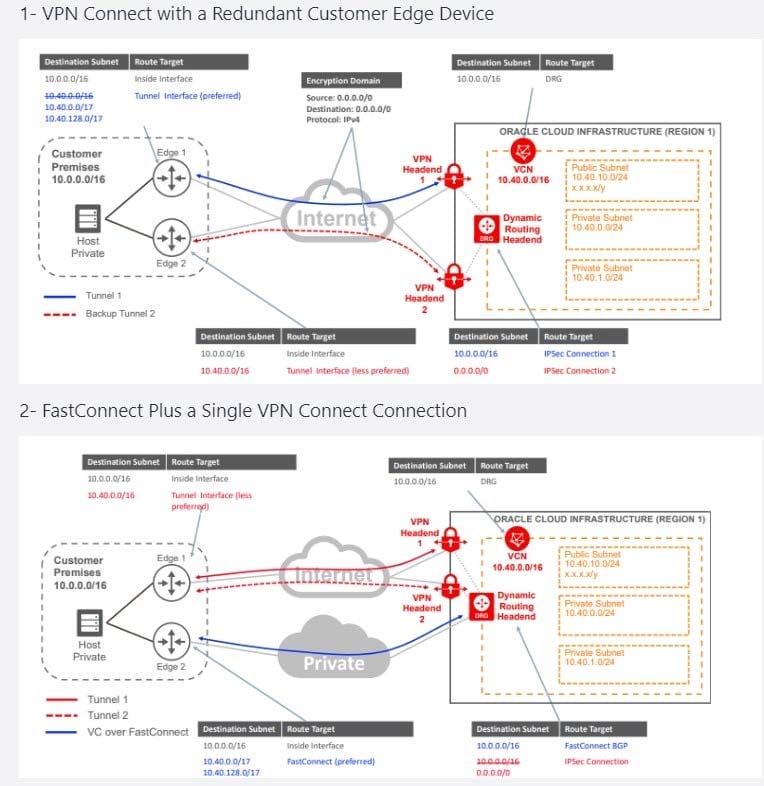
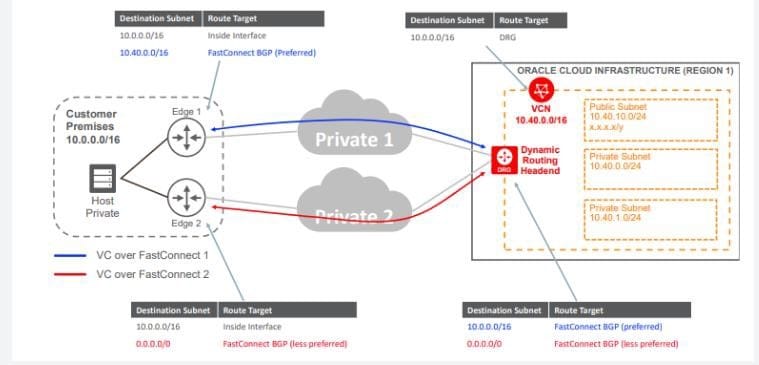
A retail company has recently adopted a hybrid architecture. They have the following requirements for their end-to-end Connectivity model between their on-premises data center and Oracle Cloud Infrastructure (OC1) region
*
Highly available connection with service level redundancy
*
Dedicated network bandwidth with low latency
Which connectivity setup is the most cost effective solution for this scenario?
A. Setup IPsec VPN as your primary connection, and a FastConnect virtual circuit as a backup connection. Use separate edge devices in your on-premises data canter for each connection from your edge devices, advertise more specific routes IPSec VPN, and specific routes through the backup FastConnect virtual circuit.
B. Setup FastConnect virtual circuit as your primary connection, and a second FastConnect virtual circuit as a backup connection. Use separate edge devices in your FastConnect physical connectivity is redundant Use a single edge device in your on premises data center for each connection From yc device, advertise more specific routes via primary FastConnect virtual circuit, and less specific routes through t backup FastConnect circuit.
C. Setup FastConnect virtual circuit as your primary connection, and an IPSec VPN as a backup connection. Use separate edge devices in your on-premises data center for each connection. From your edge devices, advertise more specific routes through FastConnect virtual circuit, and more specific routes through the backup IPSec VPN path.
D. Setup IPSec VPN as your primary connection, and a second IPSec VPN as a backup connection. Use separate edge devices in your on p data center for each connection. From your edge devices, advertise more specific routes via primary IPSec VPN. and less specific rod the backup IPSec VPN.
Questions 6
Your Oracle database is deployed on-premises and has produced 100 TB database backup locally. You have a disaster recovery plan that requires you to create redundant database backups in Oracle Cloud Infrastructure (OCI).
Once the initial backup is completed, the backup must be available for retrieval in less than 30 minutes to support the Recovery Time Objective (RTO) of your solution.
Which is the most cost effective option to meet these requirements?
A. Setup an IPsec VPNConnect between on-premises data center and OCI. Then to use OCI CLI command to upload database backups to OCI Object Storage Archive tier as the final destination.
B. Use OCI Storage Gateway to transfer the backup files to OCI Object Storage Archive tier as the final destination.
C. Setup a FastConnect connection between on-premises data center and OCI. Then to use OCI CLI command to upload database backups to OCI Object Storage Standard tier as the final destination.
D. Use OCI Storage Gateway to transfer the backup files to OCI Object Storage Standard tier as the final destination.
Questions 7
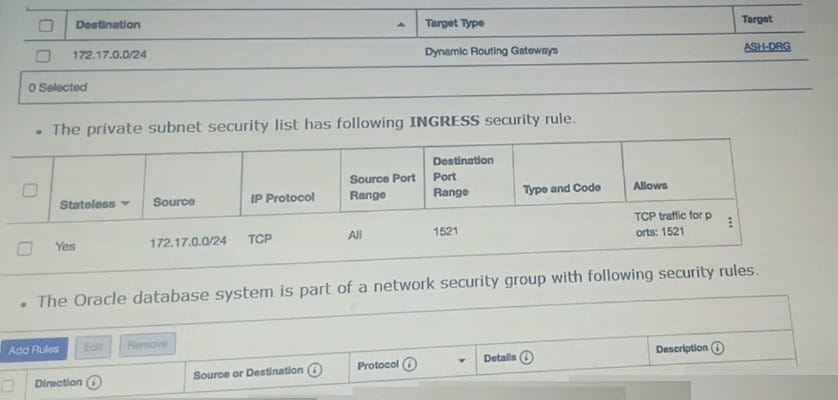
You have an Oracle database system in a virtual cloud network (VCN) that needs to be accessible on port 1521 from your on-premises network CIDR 172.17.0.0/24.
You have the following configuration currently.
Virtual cloud network (VCD) is associated with a Dynamic Routing Gateway (DRG), and DRG has an active IPSec connection with your on-premises data center.
Oracle database system is hosted in a private subnet
The private subnet route table has the following configuration
The private subnet route table has following configuration.
However, you are still unable to connect to the Oracle Database system. Which action will resolve this issue?
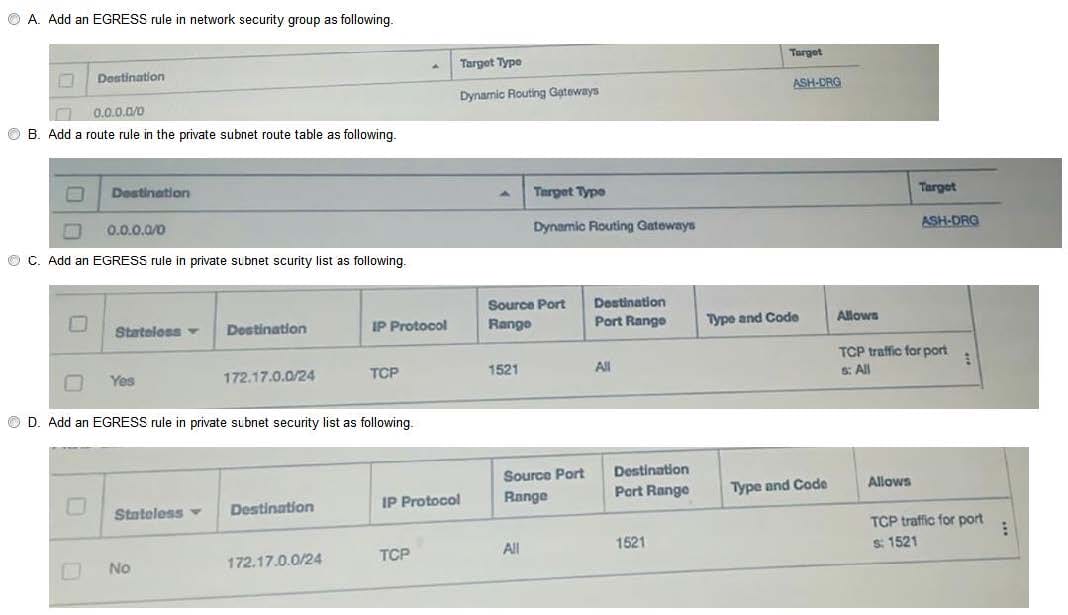
A. Option A
B. Option B
C. Option C
D. Option D
Questions 8
You are trying to troubleshoot the configuration of your Oracle Cloud Infrastructure (OCI) Load Balancing service. You have a backend HTTP service for which you have created a backend set in the load balancer. You have configured health checks for the backend set. Although the health checks appear good, customers sometimes experience transaction failures.
Which of the following options will definitely lead to this problem?
A. You are NOT using regional subnets in your Virtual Cloud Network. With Availability Domain (AD) specific subnet. the compute instances of the backend service running in the subnet have issues when the AD is down.
B. You are using OCI Domain Name System. You have misconfigured the 'A' record with the wrong IP address leading to requests not getting routed correctly.
C. You are using iSCI for block volume attachment to the compute instances in your backed HTTP service. TCP/IP configuration of your block volume attachment is not configured correctly, leading to issues in your backend service.
D. You are running a TCP-level health check against your HTTP service. The TCP handshake can succeed and indicate that the service is up even when the HTTP service has issues.
Questions 9
You are running a mission-critical database application in Oracle Cloud Infrastructure (OCI). You take regular backups of your DB system to OCI Object Storage. Recently, you notice a failed database backup status in the console.
What troubleshooting action can you perform to determine the cause of the backup failure?
A. Ensure that the database is not active and running while the backup is in progress.
B. Ensure that your database host can connect to OCI Object Storage.
C. Ensure that the dcsagent program is not restarted in case of a stop/waiting status.
D. Ensure the database archiving mode is set to NOARCHIVELOG.
Questions 10
You are currently working for a public health care company based in the United Stats. Their existing patient records runs in an on-premises data center and the customer is sending tape backups offsite as part of their recovery planning.
You have developed an alternative archival solution using Oracle Cloud Infrastructure (OCI) that will save the company a significant amount of mom on a yearly basis. The solution involves storing data in an OCI Object Storage bucket After reviewing your solution with the customer global Compliance (GRC) team they have highlighted the following security requirements:
All data less than 1 year old must be accessible within 2 hour. All data must be retained for at least 10 years and be accessible within 48 hours AH data must be encrypted at rest No data may be transmitted across the public Internet
Which two options meet the requirements outlined by the customer GRC team?
A. Provision a FastConnect link to the closest OCI region and configure a private peering virtual circuit.
B. Create an OCI Object Storage Standard tier bucket Configure a lifecycle policy to archive any object that Is older than 365 days
C. Create a VPN connection between your on premises data center and OCI. Create a Virtual Cloud Network (VCN) along with an OCI Service Gateway for OCI Object Storage.
D. Provision a FastConnect link to the closest OCI region and configure a public peering virtual circuit
E. Create an OCI Object Storage Standard tier bucket. Configure a lifecycle policy to delete any object that is older than 7 years
Questions 11
A consulting company that employs Oracle Cloud Infrastructure (OCI) architects has successfully completed resource migration from Microsoft Azure to OCI, and no longer requires the OCI FastConnect circuit to Azure. The project manager has asked you to delete all resources involved in this inter-cloud connectivity. From the Azure side, you delete the Resource Group. After a while, you notice that all Azure resources have been deleted, except for the Azure ExpressRoute circuit.
What could be a potential reason for this issue?
A. You need to first delete the OCI FastConnect circuit for the ExpressRoute circuit to be decommissioned, and then you can delete the ExpressRoute virtual circuit.
B. Your bill from the OCI side needs to be paid in full before you can remove the Azure ExpressRoute circuit.
C. You need to remove all routes that point to the inter-cloud connection on both OCI and Azure before you can delete the circuit.
D. You need to remove the Azure ExpressRoute Partner Service Key from the OCI FastConnect circuit, and then you can delete the ExpressRoute virtual circuit.
Questions 12
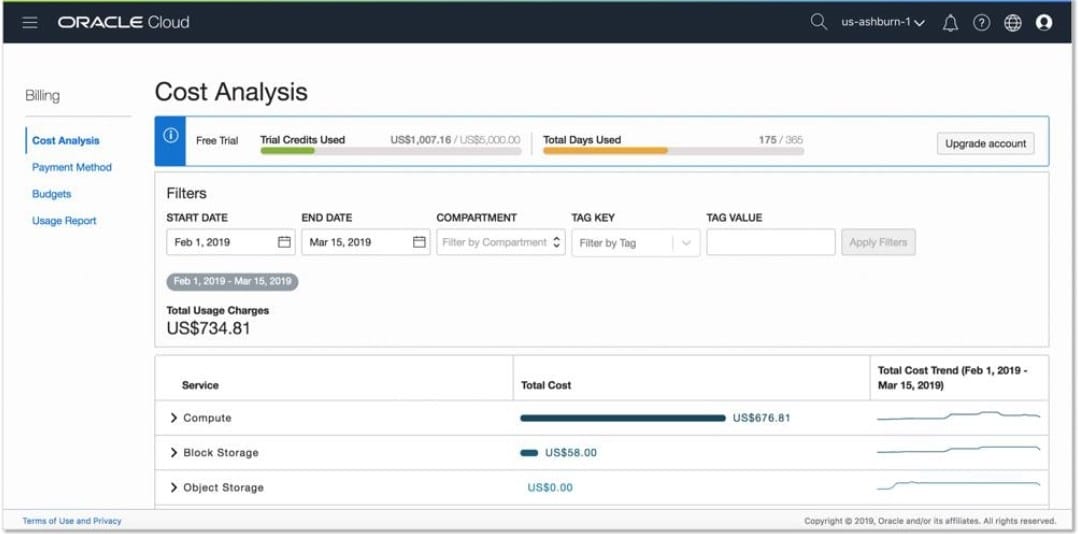
Multiple departments In your company use a shared Oracle Cloud Infrastructure (OCI) tenancy to Implement their projects. You are in charge of managing the cost of OCI resources in the tenancy and need to obtain better Insights Into department's usage.
Which three options can you implement together to accomplish this?
A. Create a budget that matches your commitment amount and an alert at 100 percent of the forecast
B. Set up a consolidated budget tracking lags to analyze costs in ,1 granular manner
C. Set up different compartments for each department then track and analyze cost per compartment
D. Use the billing cost tracking report to analyze costs
E. Set up a tag default that automatically applies tags to all specified resources created In a compartment then use these tags for cost analysis.
Questions 13
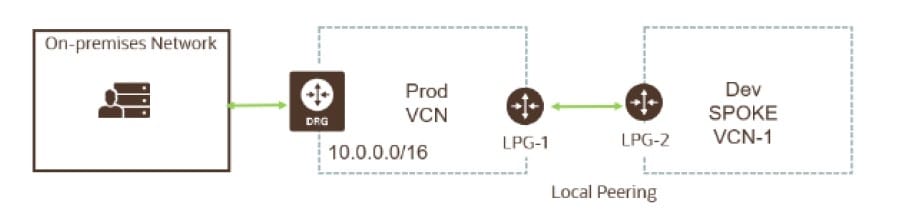
Your customer recently ordered for a 1-Gbps Fast Connect connection In ap-tokyo-1 region of Oracle Cloud Infrastructure (OCI). They will us this to one Virtual cloud Network (VCN) in their production (OC1) tenancy and VCN In their development OC1 tenancy
As a Solution Architect, how should yon configure and architect the connectivity between on premises and VCNs In OCI?
A. Create two private virtual circuits on the FastConnect link. Create two Dynamic Routing Gateways, one for each VCNs. Attach the virtual circuits to the dynamic routing gateways.
B. You cannot achieve connectivity using single FastConnect link as the production and the development VCNs-are in separate tenancies. Request one more FastConnect connection.
C. Create a single private virtual circuit over FastConnect and attach fastConnect to either of the VCN's Dynamic Routing Gateway. Use Remote Peering to peer production and development VCNs.
D. Create a hub-VCN that uses Dynamic Routing Gateway (DRG) to communicate with on- premises network over FastConnect. Connect the hub-VCN to the production VCN spoke and with development VCN spoke, each peered via their respective local Peering Gateway (LPG)


Home | About Us | Contact Us | FAQ | Guarantee Policy | Privacy Policy
Any charges made through this site will appear as Global Simulators Limited. All trademarks are the property of their respective owners.
Copyright © 2004-2026 pass2lead.com, All Rights Reserved.