

1Z0-997 Online Practice Questions and Answers
Questions 4
You have an Oracle database system in a virtual cloud network (VCN) that needs to be accessible on port
1521 from your on-premises network CIDR 172.17.0.0/24.
You have the following configuration currently.
Virtual cloud network (VCD) is associated with a Dynamic Routing Gateway (DRG), and DRG has an
active IPSec connection with your on-premises data center.
Oracle database system is hosted in a private subnet
The private subnet route table has the following configuration The private subnet route table has following
configuration.
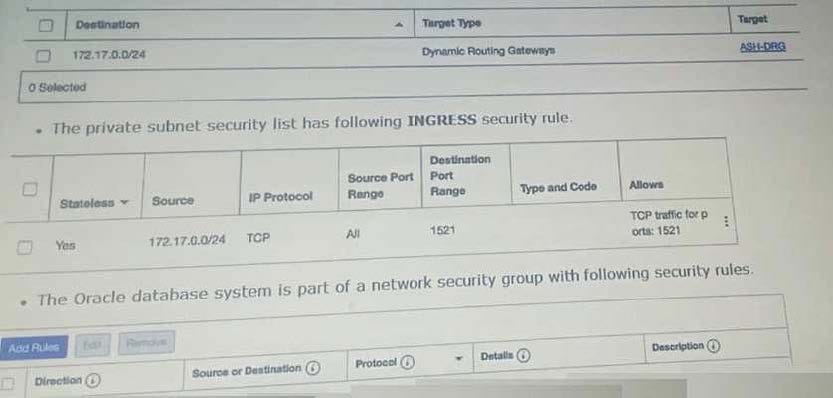
However, you are still unable to connect to the Oracle Database system. Which action will resolve this issue?
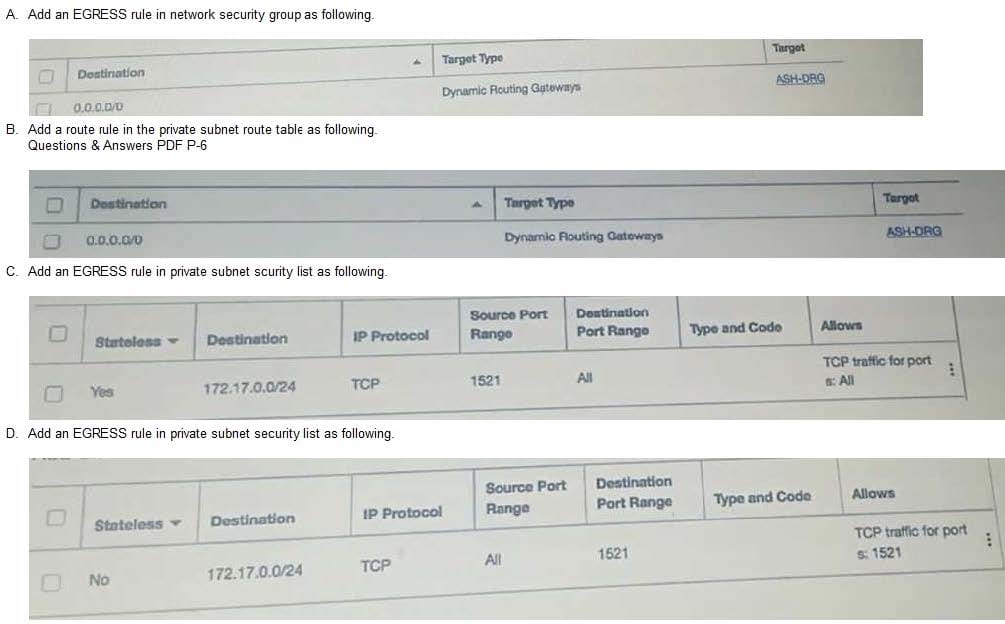
A. Option A
B. Option B
C. Option C
D. Option D
Questions 5
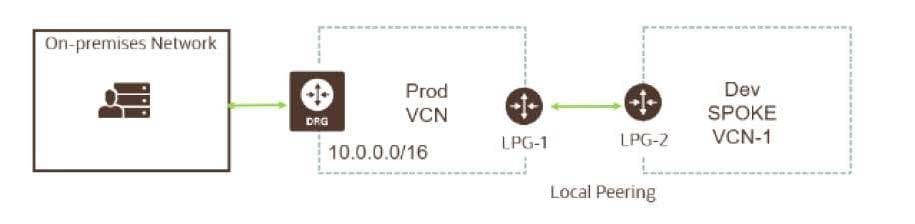
Your customer recently ordered for a 1-Gbps Fast Connect connection In ap-tokyo-1 region of Oracle Cloud Infrastructure (OCI). They will us this to one Virtual cloud Network (VCN) in their production (OC1) tenancy and VCN In their development OC1 tenancy As a Solution Architect, how should yon configure and architect the connectivity between on premises and VCNs In OCI?
A. Create two private virtual circuits on the FastConnect link. Create two Dynamic Routing Gateways, one for each VCNs. Attach the virtual circuits to the dynamic routing gateways.
B. You cannot achieve connectivity using single FastConnect link as the production and the development VCNs-are in separate tenancies. Request one more FastConnect connection.
C. Create a single private virtual circuit over FastConnect and attach fastConnect to either of the
D. Create a hub-VCN that uses Dynamic Routing Gateway (DRG) to communicate with on-premises network over FastConnect. Connect the hub-VCN to the production VCN spoke and with development VCN spoke, each peered via their respective local Peering Gateway (LPG)
Questions 6
A large London based eCommerce company is running Oracle DB System Virtual RAC database on Oracle Cloud Infrastructure (OCI) for their eCommerce application activity. They are launching a new product soon, which is expected to sell in large quantities all over the world. The application architecture should have minimal cost, no data loss, no performance impacts during the database backup windows and should have minimal downtime.
A. Launch a new VM RAC database in another availability domain, launch a compute instance, deploy Oracle GoldenGate on it and then configure it to replicate the data from the eCommerce Database over to the new RAC database using GoldenGate. Take backups from the new VM RAC database.
B. Turn off automated backups from the eCommerce database, implement Oracle Data Guard with the Standby database deployed on another availability domain, take backups from the standby database.
C. Launch a new VM RAC database in another availability domain, launch a compute instance, deploy Oracle GoldenGate on it and then configure bi-directional replication from the eCommerce Database over to the new VM RAC database using GoldenGate. Take backups from the new VM RAC database.
D. Turn off automatic backups from the eCommerce database, implement Oracle Active Data Guard with the standby database deployed on another availability domain, and take backups from the standby database.
Questions 7
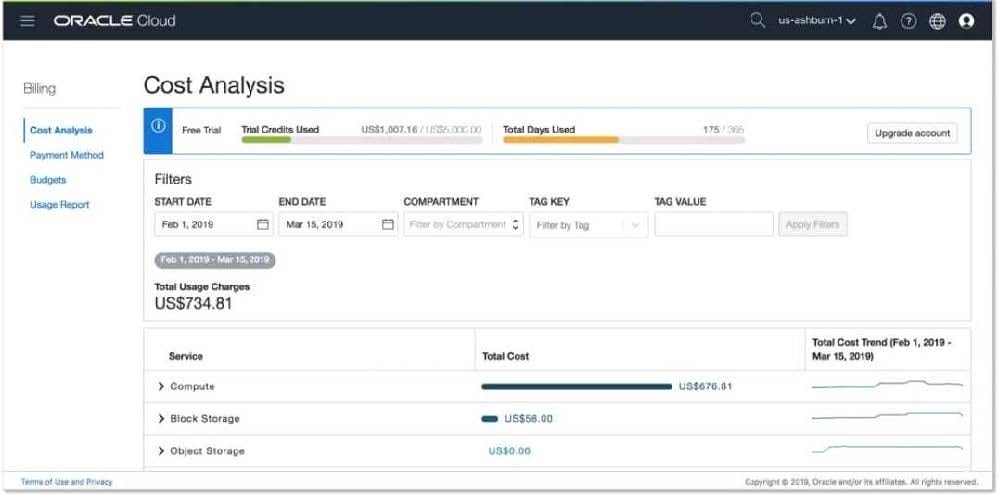
Multiple departments In your company use a shared Oracle Cloud Infrastructure (OCI) tenancy to Implement their projects. You are in charge of managing the cost of OCI resources in the tenancy and need to obtain better Insights Into department's usage. Which three options can you implement together to accomplish this?
A. Create a budget that matches your commitment amount and an alert at 100 percent of the forecast
B. Set up a consolidated budget tracking lags to analyze costs in ,1 granular manner
C. Set up different compartments for each department then track and analyze cost per compartment
D. Use the billing cost tracking report to analyze costs
E. Set up a tag default that automatically applies tags to all specified resources created In a compartment
then use these tags for cost analysis.
Questions 8
You work for a German company as the Lead Oracle Cloud Infrastructure architect. You have designed a highly scalable architecture for your company's business critical application which uses the Load Balancer service auto which uses the Load Balancer service, autoscaling configuration for the application servers and a 2 Node VM Oracle RAC database. During the peak utilization period of the- application yon notice that the application is running slow and customers are complaining. This is resulting in support tickets being created for API timeouts and negative sentiment from the customer base. What are two possible reasons for this application slowness?
A. Autoscaling configuration for the application servers didn't happen due to 1AM policy that's blocking access to the application server compartment
B. The Load Balancer configuration is not sending traffic to the listener of the application servers.
C. Autoscaling configuration for the application servers didn't happen due to compartment quota breach of the VM shapes used by the application servers.
D. Autoscaling configuration for the application servers didn't happen due to service limit breach of the VM shapes used by the application servers E. The Load Balancer doesn't have a Network Security Group to allow traffic to the application servers.
Questions 9
You are responsible for migrating your on premises legacy databases on 11.2.0.4 version to Autonomous Transaction Processing Dedicated (ATP-D) In Oracle Cloud Infrastructure (OCI). As a solution architect, you need to plan your migration approach. Which two options do you need to implement together to migrate your on premises databases to OCI?
A. Use Oracle Data Guard to keep on premises database always active during migration
B. Retain changes to Oracle shipped privileges, stored procedures or views In the on-premises databases.
C. Use Oracle GoldenGate replication to keep on premises database online during migration.
D. Convert on-premises databases to PDB, upgrade to 19c, and encrypt Migration.
E. Retain all legacy structures and unsupported features (e.g. taw U>Bs) In the onuses databases for migration.
Questions 10
You are the Solution Architect that designed this Oracle Cloud Infrastructure (OCI) compartment layout for your organization:
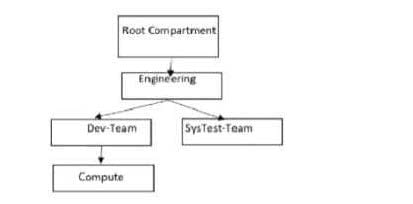
The development team has deployed quite a few instances under 'Compute' Compartment and the operations team needs to list the Instances under the same compartment for their testing. Both teams, development and operations are part of a group called 'Eng-group' You have been looking for an option to allow the operations team to list the instances without access any confidential information or metadata of resources. Which IAM policy should you write based on these requirements?
A. Allow group Eng-group to inspect instance-family in compartment Dev-Team:Compute and attach the policy to `Engineering' Compartment
B. Allow group Eng-group to inspect instance-family in compartment Dev-Team: Compute and attach the policy to 'SysTest Team' Compartment
C. Allow group Eng-group to read instance-family in compartment Compute and attach the policy to 'Engineering' Compartment.
D. Allow group Eng-group to read instance-family in compartment Dev-Team-.Compute and attach the policy to'Dev-Team'
Questions 11
An Oracle Cloud Infrastructure (OCI) Public Load Balancer's SSL certificate is expiring soon. You noticed
the Load Balancer is configured with SSL Termination only. When the certificate expires, data traffic can
be interrupted and security compromised.
What steps do you need to take to prevent this situation?
A. Add the new SSL certificate to the Load Balancer, update backend servers to work with a new certificate and edit listeners so they can use the new certificate bundle.
B. Add the new SSL certificate to the Load Balancer, update listeners and backend sets so they can use the new certificate bundle.
C. Add the new SSL certificate to the Load Balancer and implement end to end SSL so it can encrypt the traffic from clients all the way to the backend servers.
D. Add the new SSL certificate to the Load Balancer and update backend servers to use the new certificate bundle.
E. Add the new SSL certificate to the Load Balancer and update listeners to use the new certificate bundle.
Questions 12
You are helping a customer troubleshoot a problem. The customer has several Oracle Linux servers in
Based on cost considerations, which option will fix this Issue?
A. Create a Public Load Balancer In front of the servers and add the servers to the Backend Set of the Public Load Balancer.
B. Create another Internet Gateway and configure it as route target for the private subnet.
C. Implement a NAT instance In the public subnet of the VCN and configure the NAT instance as the route target for the private subnet.
D. Create a NAT gateway in the VCN and configure the NAT gateway as the route target for the private subnet.
Questions 13
A manufacturing company is planning to migrate their on-premises database to OCI and has hired you for
the migration. Customer has provided following information regarding their existing onpremises database:
Database version, host operating system and version, database character set, storage for data staging,
acceptable length of system outage.
What additional information do you need from customer in order to recommend a suitable migration
method? Choose two
A. Elapsed time since database was last patched
B. On-premises host operating system and version
C. Number of active connections
D. Data types used in the on-premises database
E. Top 5 longest running queries


Home | About Us | Contact Us | FAQ | Guarantee Policy | Privacy Policy
Any charges made through this site will appear as Global Simulators Limited. All trademarks are the property of their respective owners.
Copyright © 2004-2026 pass2lead.com, All Rights Reserved.