

201 Online Practice Questions and Answers
Questions 4
A BIG-IP Administrator configures a Virtual Server. Users report that they always receive a TCP RST packet to the BIG-IP system when attempting to connect to it. What is the possible reason for this issue?
A. The virtual server Type is set to Internal
B. The virtual server Type is set to Reject
C. The virtual server Type is set to Drop
D. The virtual server Type is set to Stateless
Questions 5
Assuming that systems are synchronized, which action could take place if the fail over cable is connected correctly and working properly, but the systems cannot communicate over the network due to external network problems?
A. If network failover is enabled, the standby system will assume the active mode.
B. Whether or not network failover is enabled, the standby system will stay in standby mode.
C. Whether or not network failover is enabled, the standby system will assume the active mode.
D. If network failover is enabled, the standby system will go into active mode but only until the network recovers.
Questions 6
A standard virtual server has been associated with a pool with multiple members. Assuming all other settings are left at their defaults, which statement is always true concerning traffic processed by the virtual server?
A. The client IP address is unchanged between the client side connection and the serverside connection.
B. The server IP address is unchanged between the client side connection and the serverside connection.
C. The TCP ports used in the client side connection are the same as the TCP ports serverside connection.
D. The IP addresses used in the clientside connection are the same as the IP addresses used in the serverside connection.
Questions 7
A VLAN has the following objects configured: Self-IP 10.10.10.100 with port lockdown set to Allow default Virtual server 10.10.10.100:443 with UDP profile enabled Virtual server 10.10.10.0/24 port forwarding virtual server Global destination NAT forwarding 10.10.10.100 to internal server 172.168.10.100 Which object will process this request when https://10.10.10.100 is entered into a browser?
A. self-IP 10.10.10.100 with port lockdown set to Allow default
B. virtual server 10.10.100/24 port o forwarding virtual server
C. global destination NAT forwarding 10.10.10.100 to internal server 172.168.10.100
D. virtual server 10.10.10.100.443 with UDP profile enabled
Questions 8
The incoming client IP address is 195.64.45.52 and the last five connections have been sent to members A, C, E, D and B. Given the virtual server, pool, and persistence definitions and statistics shown in the above graphic, which member will be used for the next connection?

A. 10.10.20.1:80
B. 10.10.20.2:80
C. 10.10.20.3:80
D. 10.10.20.4:80
E. 10.10.20.5:80
F. It cannot be determined with the information given.
Questions 9
In the BIG-IP Configuration Utility, a user requests a single screen view to determine the status of all Virtual Servers and associated pool members, as well as any iRules in use. Where should the BIG-IP Administrator instruct the user to find this view?
A. Local Traffic > Monitors
B. Local Traffic > Virtual Servers
C. Local Traffic > Network Map
D. Statistics
Questions 10
On the VCMP system, a BIG-IP host administrator imports a new ISO image into the host's /shared/images folder. The new ISO images that reside on the vCMP host are available for installation on the guest. How should the BIG-IP Administrator install one image from within the guest?
A. Install the new software on the host and wait for it to automatically be installed on all guests.
B. Run the following command on guest tmsh install sys software block-device-image image_name volume < volume_name>
C. Run the following command on guest tmsh install sys software image image_name volume < volume_name>
D. Run the following command on host tmsh install sys software block-device-image image_name volume < volume_name>
Questions 11
Refer to the exhibit.
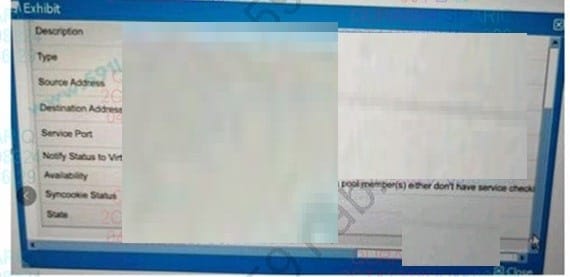
A BIG-IP Administrator configures the Virtual Server to pass HTTP traffic. Users report that they are unable to access the application What should the administrator do to resolve this issue?
A. Change the Virtual Server name
B. Disable .he State
C. Reconfigure the Source Address
D. Reconfigure the Pool Members
Questions 12
A BIG-IP Administrator runs the initial configuration wizard and learns that the NTP servers were invalid. In which area of the Configuration Utility should the BIG-IP Administrator update the list of configured NTP servers?
A. System > Configuration
B. System > Services
C. System > Preferences
D. System > Platform
Questions 13
A virtual server is listening at 10.10.1.100:80 and has the following iRule associated with it:
when HTTP_REQUEST { if { [HTTP::header UserAgent] contains "MSIE" }
{ pool MSIE_pool }
else { pool Mozilla_pool }
If a user connects to http://10.10.1.100/foo.html and their browser does not specify a UserAgent, which pool will receive the request?
A. MSIE_pool
B. Mozilla_pool
C. None. The request will be dropped.
D. Unknown. The pool cannot be determined from the information provided.


Home | About Us | Contact Us | FAQ | Guarantee Policy | Privacy Policy
Any charges made through this site will appear as Global Simulators Limited. All trademarks are the property of their respective owners.
Copyright © 2004-2026 pass2lead.com, All Rights Reserved.