

2V0-21.23 Online Practice Questions and Answers
Questions 4
An administrator can attach a baseline to which two inventory objects? (Choose two.)
A. Resource pools
B. Data centers
C. Datastores
D. Templates
E. ESXi hosts
Questions 5
Refer to the exhibit.
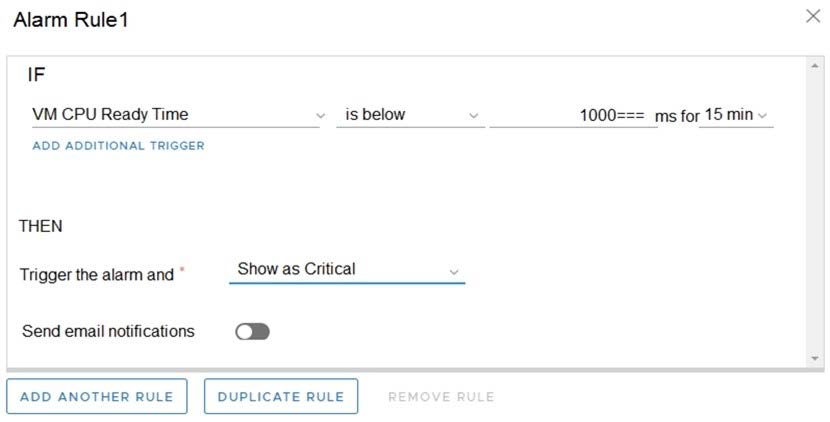
An administrator is consistently receiving an alarm regarding a CPU performance issue; however, there is NO CPU issue identified.
What can the administrator do to make sure the alarm is triggered when there is an actual CPU performance issue? (Choose the best answer.)
A. Change `VM CPU Ready Time' to `VM Memory Usage.'
B. Change `Show as Critical' to `Show as Warning.'
C. Change `VM CPU Ready Time' to `VM CPU Usage.'
D. Change `is below' to `is above.'
Questions 6
An administrator is tasked with planning an upgrade of a VMware vSphere environment to version 7.0. The platform consists of 80 ESXi hosts, logically divided into 10 clusters. The tasks will be completed by another operations team within
the company.
The hardware is consistent and a single embedded vCenter Server 6.7 appliance is managing the environment.
Which statement is true regarding a suitable upgrade approach? (Choose the best answer.)
A. The vCenter Server can be upgraded using a pre-configured customized JSON template.
B. The ESXi hosts can only be upgraded using the Graphical User Interface Installer.
C. Auto-deploy must be used to upgrade the large scale environment.
D. A new Platform Services Controller must be deployed first.
Questions 7
Refer to the exhibit.

After removing an ESXi host from a cluster for maintenance, a number of virtual machines have encountered the warning seen in the exhibit. After re-adding the ESXi, the issue is resolved. Which step should the administrator take to move the triggered alarm to its normal state?
A. Ignore
B. Reset to Green
C. Acknowledge
D. Disable
Questions 8
An administrator is tasked with installing VMware vCenter. The vCenter Server Appliance must support an environment of:
400 hosts 4000 virtual machines Which two resources must be allocated, at a minimum, to meet the requirements? (Choose two.)
A. 16 vCPUs
B. 30 GB Memory
C. 4 vCPUs
D. 8 vCPUs
E. 20 GB Memory
Questions 9
To keep virtual machines (VMs) up and running at all times in a vSphere cluster, an administrator would like VMs to be migrated automatically when the host hardware health status becomes degraded. Which cluster feature can be used to meet this requirement?
A. Predictive DRS
B. Proactive HA
C. vSphere HA Orchestrated Restart
D. vSphere Fault Tolerance
Questions 10
An administrator plans to bring VMware vCenter offline in order to perform hardware mainte-nance on the host where the vCenter Server Appliance is running. Which vSphere feature must be configured to ensure that vCenter users experience minimal downtime?
A. vSphere Distributed Resource Scheduler
B. Hybrid Linked Mode
C. vCenter Server High Availability
D. Enhanced Linked Mode
Questions 11
Following a merger with another company, an administrator is tasked with configuring an identity source for VMware vCenter so that all vSphere administrators can authenticate using their existing Active Directory accounts. Each company
has user accounts in their own Active Directory forests.
The following additional information has been provided:
The corporate policy states that only Windows-based machine accounts are allowed in Active Directory.
Which action should the administrator take to configure vCenter Single Sign-On (SSO) to meet this requirement?
A. Configure SSO to use Active Directory over LDAP as the identity source.
B. Configure SSO to use OpenLDAP as the identity source.
C. Join the vCenter Server Appliance to the LDAP domain.
D. Configure SSO to use Active Directory (Integrated Windows Authentication) as the identity source.
Questions 12
An administrator is attempting to configure Storage I/O Control (SIOC) on five datastores within a vSphere environment. The administrator is being asked to determine why SIOC configuration completed successfully on only four of the datastores.
What are two possible reasons why the configuration was not successful? (Choose two.)
A. The datastore contains Raw Device Mappings (RDMs).
B. SAS disks are used for the datastore.
C. The datastore has multiple extents.
D. The datastore is using ISCSI.
E. The administrator is using NFS storage.
Questions 13
Which step is completed during Stage 1 of the vCenter Server Appliance deployment?
A. Join a vCenter Single Sign-On domain
B. Create a new vCenter Single Sign-On domain
C. Select the deployment size
D. Configure SSH access


Home | About Us | Contact Us | FAQ | Guarantee Policy | Privacy Policy
Any charges made through this site will appear as Global Simulators Limited. All trademarks are the property of their respective owners.
Copyright © 2004-2026 pass2lead.com, All Rights Reserved.