

A00-212 Online Practice Questions and Answers
Questions 4
This item will ask you to provide a segment of missing code.
Given the input data set shown on the left and the output data set shown on the right:
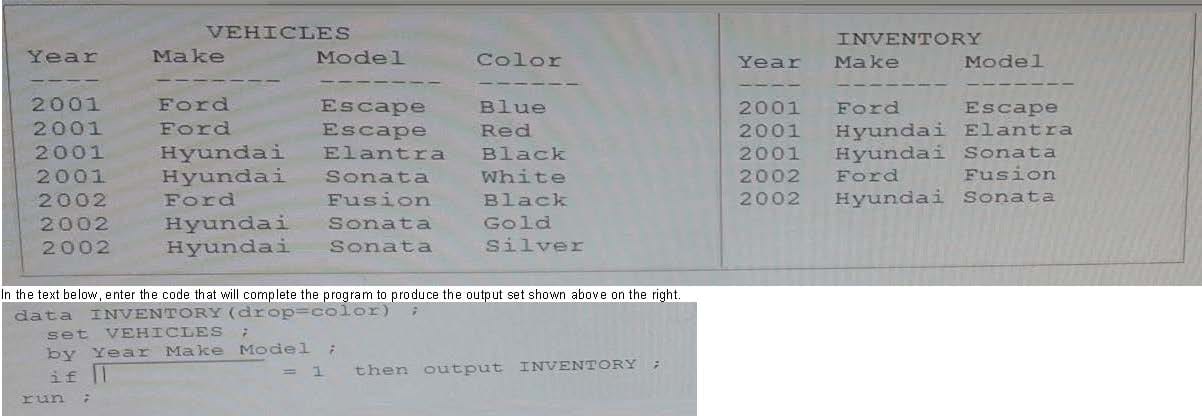
In the text below, enter the code that will complete the program to produce the output set shown above on the right.
Case is ignored and standard SAS syntax rules apply.
Questions 5
Which one of the following statements is true regarding a SAS DATA step view?
A. It allows write capabilities.
B. It contains global statements.
C. It contains data and a descriptor portion.
D. It contains a partially compiled DATA step.
Questions 6
The following SAS program is submitted: data new (bufsize = 6144 bufno = 4); set old; run;
Which one of the following describes the difference between the usage of BUFSIZE= and BUFNO= options?
A. BUFSIZE= specifies the size of the input buffer in bytes; BUFNO= specifies the number of input buffers.
B. BUFSIZE= specifies the size of the output buffer in bytes; BUFNO= specifies the number of output buffers.
C. BUFSIZE= specifies the size of the output buffer in kilobytes; BUFNO= specifies the number of input buffers.
D. BUFSIZE= specifies the size of the output buffer in kilobytes; BUFNO= specifies the number of output buffers.
Questions 7
The following SAS program is submitted:
%let var = chicago, 1;
data a;
var = 'new york, 2';
newvar = %scan(andvar,2,%str());
run;
Which one of the following explains why the program fails to execute?
A. The %STR() is invalid syntax.
B. The %SCAN function does not exist.
C. The %SCAN function has too many arguments.
D. The macro variable VAR does not get created properly.
Questions 8
Given the following SAS program:
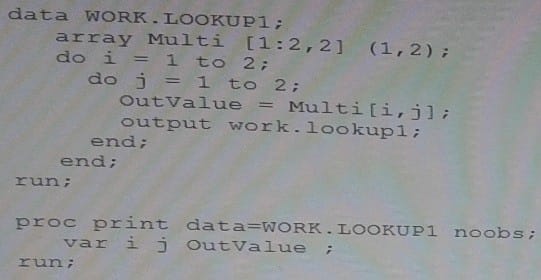
What will be the output from the PRINT Procedure?
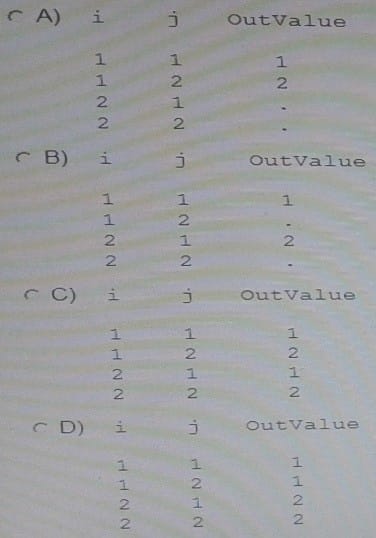
A. Option A
B. Option B
C. Option C
D. Option D
Questions 9
Which SAS procedure changes the name of a permanent format for a variable stored in a SAS data set?
A. DATASETS
B. MODIFY
C. FORMAT
D. REGISTRY
Questions 10
Given the following SAS data set ONE:
ONE NUM VAR 1 A 2 B 3 C Which one of the following SQL programs deletes the SAS data set ONE?
A. proc sql; delete table one; quit;
B. proc sql; alter table one drop num, var; quit;
C. proc sql; drop table one; quit;
D. proc sql; delete from one; quit;
Questions 11
The following SAS program is submitted:
%macro test(var);
%let jobs = BLACKSMITH WORDSMITH SWORDSMITH;
%let type = %index(andjobs,andvar);
%mend;
%test(SMITH)
Which one of the following is the resulting value of the macro variable TYPE?
A. 0
B. 3
C. 6
D. null
Questions 12
Given the following SAS data set ONE: ONE CATEGORY AGE SALARY BONUS
M 28 200 .
M 25 100 10
F 18 100 50
F 25 200 10
The following SAS program is submitted:
proc sql;
create table two as
select category, salary + bonus as EARNINGS
from one; quit;
Which one of the following represents the data values stored in the data set TWO?
A. CATEGORY EARNINGS M 200 M 110 F 150 F 210
B. CATEGORY EARNINGS
M .
M 110
F 150
F 210
C. CATEGORY SALARY BONUS EARNINGS M 200 . 200 M 100 10 110 F 100 50 150 F 200 10 210
D. CATEGORY SALARY BONUS EARNINGS M 200 . . M 100 10 110 M 200 . 200 M 100 10 110 F 100 50 150 F 200 10 210
Questions 13
The following SAS program is submitted:
proc datasets lib = testdata;
modify one;
label num = 'Number';
format num 4.;
quit;
Which one of the following SQL programs produces the same results as the above DATASETS procedure?
A. proc sql; modify table testdata.one num format = 4. label = 'Number'; quit;
B. proc sql; alter table testdata.one modify num format = 4. label = 'Number'; quit;
C. proc sql; modify table testdata.one alter num format = 4. label = 'Number'; quit;
D. proc sql; alter table testdata.one modify num (format = 4. label = 'Number'); quit;


Home | About Us | Contact Us | FAQ | Guarantee Policy | Privacy Policy
Any charges made through this site will appear as Global Simulators Limited. All trademarks are the property of their respective owners.
Copyright © 2004-2026 pass2lead.com, All Rights Reserved.