

C2040-911 Online Practice Questions and Answers
Questions 4
Wendy's theme was recently installed on a server. A colleague provided her with theme components to deploy, which given design requirements, is packaged as an EAR file inside a compressed ZIP file. Which of the following is a valid option for deploying these components?
A. Use the web-dav-deploy-zip-file to deploy the compressed file. Use the IBM WebSphere Integrated Solutions console or scripts to deploy theEAR file. Use XMLAccess to import the components into the IBM WebSphere Portal server.
B. Use the web-dav-deploy-zip-file to deploy the compressed file. Use the webdav-expand-ear command to unpackage the EAR on the server,then register the new EAR on the WebSphere Integrated Solutions console.
C. Use the web-dav-deploy-zip-file to deploy the compressed file and use the XMLAccess command to run the script. Use the WebSphereIntegrated Solutions console to add the runtime configuration.
D. EAR files must be deployed using the WebSphere Integrated Solutions console, so she must remove it from the ZIP archive and install itdirectly.
Questions 5
Bill is developing a portlet that uses AJAX to retrieve information from the server. In the serveResource() method first he is setting "AdminName" request attribute and then forwarding control to a JSP for generating markup. Using best practices, how should he print the "AdminName" attribute inside the JSP?
A. <%=resourceRequest.getAttribute("AdminName")%>
B. <%=renderRequest.getAttribute("AdminName")%>
C. ${requestScope.AdminName}
D. ${portalRequest.AdminName}
Questions 6
PreferencePortlet is Portlet Specification 2.0-compliant and the system is running IBM WebSphere Portal 8.0.
What is the output of the following code?
public PreferencePortlet extends GenericPortlet{ protected void processAction(ActionRequest actionRequest, ActionResponse){ actionRequest.getPreferences().setValue("test","ViewModePreferenceValue"); actionRequest.getPreferences ().store(); } protected void doView(RenderRequest renderRequest, RenderResponse renderResponse) throws PortletException, IOException { // Generate action URL }
A. The container throws java.lang.IllegalStateException because it is not allowed to change preferences in the processAction() method.
B. The code compiles and executes fine. It stores a "test" preference at the end of the processAction() method call.
C. The container throws javax.portlet.ReadOnlyException because it is only allowed to view preferences in the processAction() method.
D. This code results in a compiler error because PortletPreference does not have the store() method.
Questions 7
The following code sample is an excerpt from an implementation of a custom ExplicitLoginFilter.
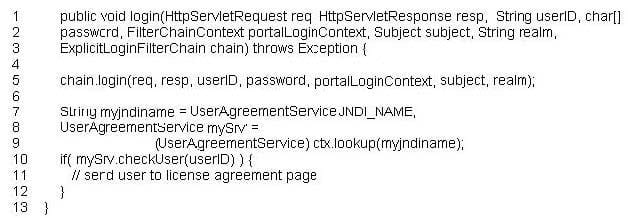
Evan needs to implement custom logic to check whether the user needs to accept an updated user agreement. Which one of the following lines of code allows the user to be sent the friendly IBM WebSphere Portal URL 'acceptAgreement,' if the checkUser method returns true?
A. resp.sendRedirect("/wps/myportal/acceptAgreement");
B. portalLoginContext.setRedirectURL("/wps/myportal/acceptAgreement");
C. RequestDispatcher rd = req.getRequestDispatcher("/wps/myportal/acceptAgreement"); rd.forward(req, resp);
D. RequestDispatcher rd = req.getRequestDispatcher("/wps/myportal/acceptAgreement"); rd.include(req, resp);
Questions 8
Which of the following statements is not a true statement about the Portlet Login service?
A. The login service can be used to trigger a form-based login to IBM WebSphere Portal from any portlet.
B. The login service can be used to retrieve a com.ibm.portal.um.User object representing the current user and providing the current user'sprofile attributes.
C. The login service can be used to propagate information to the WebSphere Portal login, for example, in the javax.security.auth.Subject objectpassed on to the JAAS login.
D. The login service can be used to change the default behavior in reaction to particular errors that might occur during the login, such asredirecting the user to a change password page if the user's password is expired.
Questions 9
On an ongoing basis, Ken wants to track status messages from an application that he is writing. Which one of the following options should he use as a best practice to make the status messages available?
A. He should write messages to to SystemOut.log since it is the easiest to implement.
B. He should write them to SystemError.log since they are status messages and could be considered errors.
C. He should use the standard Java logger at an "info" level since "info" is the default trace level for IBM WebSphere Portal server.
D. He should use the standard Java logger at an "error" level since they are status messages and could be considered errors.
Questions 10
Sanjeev wants to add a Help mode to his iWidget. At a minimum, what changes will he need to make to his iWidget definition XML so that IBM WebSphere Portal will enable a Help option for it?
A. Add an iw:content element with a mode attribute of 'help' in the iw:widget element.
B. Add 'help' to the supportedModes attribute of the iw:widget element. Add an iw:content element with a mode attribute of 'help' in the iw:widgetelement.
C. Add 'help' to the supportedModes attribute of the iw:widget element. Add an iw:content element with a mode attribute of 'help' in the iw:widgetelement. Add an 'onhelp' Javascript method.
D. No change needs to be made. All iWidgets in WebSphere Portal already have a Help mode.
Questions 11
Steve wants to hide a menu item in the action menu. This menu item may be needed for later use. What is the best way to accomplish this?
A. Declare the menu item as not visible in the server-side feed. Declare the menu item as visible in the client-side code, and then stop and restartthe custom theme application.
B. Declare the menu item as visible in the server-side feed then override in the client-side's visibilityFn.
C. Use the IBM WebSphere Integrated Solutions console to edit the Dynamic Content Spot to update the menu definition and restart the customtheme application.
D. Update the shelfActions.json using the WebDAV located inside the menuDefinitions folder and then register the changes inside the theme.js filelocated inside the js folder.
Questions 12
Mr. Mosby is developing several different custom themes for the different brands his company offers. He's developed a custom theme WAR that provides the JSPs to be shared among the different themes. He has a JSP named brandNav.jsp and created a brandNav dynamic content spot that points to this JSP. However, for one particular theme he needs to use a different brandNav.jsp. Which one of the following is not a valid option?
A. Create an override in the themes metadata:key=com.ibm.portal.theme.brandNav value="res:/CustomThemeContext/themes/html/MyTheme/custombrandNav.jsp"
B. Modify the theme_xx.html so that the html directly points to the new JSP:
C. Create a new Dynamic Content Spot pointing to the customBrandNav.jsp. Then modify the theme_xx.html to use this new dynamic content spot.
D. Include the new JSP directly in the theme_xx.html and bypass the dynamic content spot mapping: <@include file="res:/CustomThemeContext/themes/html/MyTheme/custombrandNav.jsp" %>
Questions 13
What is the outcome if a non-deferred module has a requirement on a deferred module?
A. The server-side combiner framework promotes the deferred module to be non-deferred.
B. The server-side combiner framework will ignore both the non-deferred and the deferred module.
C. The server-side combiner framework demotes the non-deferred module to be deferred.
D. The server-side combiner framework will ignore the dependency on the deferred module.


Home | About Us | Contact Us | FAQ | Guarantee Policy | Privacy Policy
Any charges made through this site will appear as Global Simulators Limited. All trademarks are the property of their respective owners.
Copyright © 2004-2026 pass2lead.com, All Rights Reserved.