

C2180-279 Online Practice Questions and Answers
Questions 4
A developer has prepared a Worklight mobile application for deployment to a production Worklight Server environment and generated the .war, .wlapp and .adapter files for it. How should the developer deploy the application files to the production Worklight Server environment?
A. Use the Worklight console to deploy the .war, .wlapp and .adapter files.
B. Use the production application server's deployment tools to deploy the .war, .wlapp and .adapter files.
C. Use the production application server's deployment tools to deploy the .war file, and the Worklight console to deploy the .wlapp and.adapter files.
D. Use the production application server's deployment tools to deploy the .war and .adapter files, and the Worklight console to deploy the.wlapp file.
Questions 5
A developer has deployed a Worklight mobile application to a remote Worklight Server environment using a context root of app1 and wants to update one of the application's server-side components. Which Worklight console should the developer use to re-deploy the component?
A. The Worklight console on the remote server accessed through the URL: http://remoteServerHostName:portNumber/console.
B. The Worklight console in the local development environment accessed through the URL: http://localHostName:portNumber/console.
C. The application-specific Worklight console on the remote server accessed through the URL:http:// remoteServerHostName:portNumber/app1/console.
D. The application-specific Worklight console in the local development environment accessed through the URL:http://localHostName:portNumber/app1/console.
Questions 6
As a part of the application design, the developer needs to handle the scenario where the user sends the application to the background and then opens it again. How should the developer do this?
A. Add an event listener to the foreground event and handle the return to the foreground.
B. Add an event listener to WL.Events.WORKLIGHT_IS_CONNECTED and handle the callback.
C. Add an event listener to the background event and handle the return to the background, without forgetting to reconnect to the backend.
D. Use WL.Device.getNetworkInfo() to check if the application is in the foreground or background and handle the return to the foreground.
Questions 7
A cross-platform mobile application has the following file structure: What happens when the application is deployed to an Android device and the function getPlatform() is invoked?
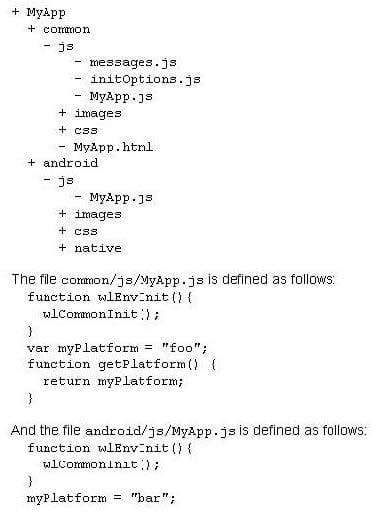
A. The invocation will return the value bar because the Android version of MyApp.js is appended to the common version of MyApp.js.
B. The invocation will fail with a JavaScript error because the function getPlatform() was not defined in the Android version of the MyApp.js.
C. The invocation should return the value bar, but it will return the value foo because the assignment myPlatform = "bar"; is declared ona local scope (missing the var definition).
D. The invocation will return the value foo because the Android version of MyApp.js does not declare a getPlatform() function andWorklight will fallback to the common implementation.
Questions 8
A developer wants to use an Apache Cordova plugin to invoke native code in a Worklight mobile application targeted to run on an Android platform. After writing the native code class, which additional steps must the developer perform to complete the plugin?
A. Write a HTML page to use to invoke the plugin and define the plugin in the project's Cordova plugin definition file.
B. Write a JavaScript wrapper for the native code and define the plugin in the project's Cordova plugin definition file.
C. Write a JavaScript wrapper for the native code and set the
D. Define the plugin in the project's Cordova plugin definition file and set the
Questions 9
The
Which additional element must be defined as part of the

A.
B.
C.
D.
Questions 10
A Worklight application does not need to connect to a server on startup. However, when previewing the application on the device emulator, it is throwing a server connection error on start up. What is the consequence if the connection error is resolved using the WL.Client.init({connectOnStartup:false}) API to disable the connection to the server on application startup?
A. The application will not be able to subsequently connect to the server.
B. Server features other than the Remote Disable or Direct Update will be disabled.
C. Any server features the application uses will only be available when it connects to the server.
D. There will be no potential consequences as the runtime will safely disable server connectivity errors.
Questions 11
Which of the following invocationData properties are mandatory? (Choose two)
A. "invocation"
B. "adapter"
C. "procedure"
D. "parameters"
Questions 12
Which mobile environments use the native implementation of a busy indicator? (Choose three)
A. iOS
B. Android
C. BlackBerry
D. Windows Phone
Questions 13
Which SQL servers are supported by theWorklight SQL adapter?
A. MySQL
B. Oracle 11g
C. DB2
D. All of the above


Home | About Us | Contact Us | FAQ | Guarantee Policy | Privacy Policy
Any charges made through this site will appear as Global Simulators Limited. All trademarks are the property of their respective owners.
Copyright © 2004-2026 pass2lead.com, All Rights Reserved.