

E20-329 Online Practice Questions and Answers
Questions 4
A customer is using Data Protection Advisor (DPA) to perform system monitoring of both Microsoft Windows and Solaris clients. When deciding where to place the Collector(s) in the environment, what is a consideration?
A. The Collector installed on the DPA server host can monitor all hosts in the environment.
B. A Collector installed on one of the Windows hosts can monitor other Windows hosts.
C. A Collector must be installed on each Windows host.
D. One Collector is required to monitor Windows hosts and one Collector is required to monitor Solaris hosts.
Questions 5
A customer is piloting an EMC Data Domain system.
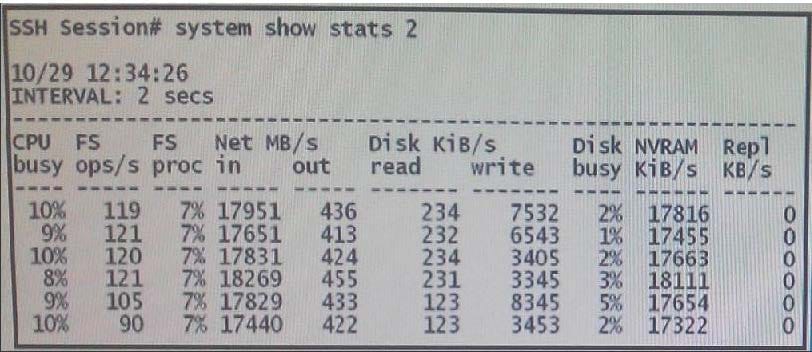
Based on the Data Domain statistics shown in the exhibit, which type of data is being backed up?
A. New data
B. DD Boost backups
C. Redundant data
D. Replicated data
Questions 6
An EMC NetWorker customer is considering capacity-based licensing. What can be used to determine the capacity size they would need to license?
A. Asset Management and Planning appliance
B. NetWorker License Conformance Report
C. NetWorker Management Console Status reports
D. Combined capacity of all NetWorker devices
Questions 7
A customer has decided on EMC Avamar as a solution. They are trying to decide on the amount of nodes to purchase. They want maximum storage capacity.
What is a recommended maximum number of data nodes for an initial Avamar server configuration?
A. 7
B. 8
C. 14
D. 16
Questions 8
You are performing a Data Deduplication Assessment for a customer. Which tool is used to test and tune network connections?
A. iperf
B. DDA:A
C. DDA:B
D. DPA
Questions 9
A customer is currently using EMC Data Protection Advisor (DPA) 5.8 SP1. They want to upgrade to DPA
6.0 and retain their data and configuration information. What does the customer need to understand about the upgrade?
A. Analysis rules and datamine maintenance plans cannot be migrated
B. DPA migration tool will perform the upgrade
C. All data and configuration information will be migrated using the DPA migration tool
D. DPA 5.8 services will be stopped during the migration
Questions 10
A customer who is using a third-party product wants to move to an enterprise product with the following
requirements:
Less than 100 clients but three clients have a dense file system with over 4 million files. Requirements
dictate backups go to tape for storage at the disaster recovery site weekly.
Reduce the backup time of dense clients.
Which EMC products will address the requirements and proposed design?
A. NetWorker with two DSNs and Data Domain as DD Boost devices
B. NetWorker with two DD Boost devices and Data Domain
C. Data Domain, Replication Manager, and Avamar Extended Retention
D. Avamar, AVE at the remote offices, and Avamar Extended Retention
Questions 11
Scenario
A customer with a fully virtualized environment has four ESX 4.1 servers in a cluster with a SAN solution for storage. Each ESX server is hosting 40 virtual machines and all virtual machines have the same local disk configurations:
Disk1 = 50 GB Disk2 = 100 GB Disk3 = 256 GB
In addition, the environment includes a NAS filer. The average time to fully backup all virtual machines on one ESX server using EMC DD Boost is three hours.
The customer is interested in implementing an EMC NetWorker solution with Data Domain as a backup device. The backup server, storage nodes, and proxies are SAN-attached.
Refer to Scenario .
When using VADP backups with EMC NetWorker, which transport mode is recommended for virtual machines with IDE virtual disks?
A. NBD
B. Hotadd
C. SAN
D. RDM
Questions 12
You are designing an EMC Data Protection Advisor (DPA) solution for a large NetWorker customer using both DPA clustering and replication. What is a consideration when determining the server layout for
application and datastore servers in this virtual environment?
A. Install the master and slave datastores on different physical hosts
B. Implement the master application and datastore servers on the same virtual host
C. Connect a DPA datastore to each cluster VLAN in the solution
D. Configure a spare server to have both standby datastore and application roles
Questions 13
A customer wants to know why their backup performance to an EMC Avamar multi-node server has decreased. Initially they were seeing an ingest rate of approximately 5 to 7 GB/hr/node. Recently they estimated that the ingest rate has slowed to around 3 to 5 GB/hr/node.
What is a probable cause for the decrease in the average ingest rate?
A. Stripes contain more data, and steady state has been achieved.
B. HFS check has found errors and has not been completing successfully.
C. A large number of backups have expired, causing new stripes to be created.
D. Garbage collection is not running, causing new stripes to be created.


Home | About Us | Contact Us | FAQ | Guarantee Policy | Privacy Policy
Any charges made through this site will appear as Global Simulators Limited. All trademarks are the property of their respective owners.
Copyright © 2004-2026 pass2lead.com, All Rights Reserved.