

E20-377 Online Practice Questions and Answers
Questions 4
Refer to the exhibit. A database server has its logs stored on a volume on the log source Symmetrix V-Max array and its data stored on a volume on the data source Symmetrix V-Max array. Both source Symmetrix V-Max array frames replicate data to the target Symmetrix V-Max array at the Remote site. There are two device groups that have been defined: One group for the data volume on the Symmetrix containing the data LUNs One group for the log volume on the Symmetrix containing the log LUNS What happens if the SRDF inks between the Symmetrix contain the data LUNs and the target Symmetrix were to fail?

















A. The R2 data in the database remains consistent because Enginuity Consistency Assist (RDF-ECAJ technology would ensure data consistency).
B. The data in the database becomes inconsistent at the Remote site.
C. An SRDF failover would be initiated on all volumes and processing will automatically be switched over to the Remote site
D. The R2 volumes in the Symmetrix V-Max containing the log LUNs would become write-disabled to the database server
Questions 5
Open Replicator pull will be used to move data between a third party array and a Symmetrix V-Max array. What is recommended before starting the Open Replicator session?
A. Ensure that the remote devices are Host read/write enabled
B. Ensure that the control devices are Not Ready
C. Ensure that the remote devices are Host inaccessible
D. Ensure that the control devices are Write Disabled
Questions 6
What is recommended before creating a TimeFinder/Mirror replica?
A. Ensure that the production application using the source devices is shut down
B. Ensure that all writes from the production application using the source devices are paused!
C. Ensure that the BCVs are not being actively accessed
D. Set the BCVs to a Not Ready state
Questions 7
Diagnostic messaging for the GNS daemon is written to which file?
A. /7SYMAPI/emc/storgnsd .log0
B. /SYMAPI/log/storgnsd.log0
C. /SYMAPl/usr/storgnsd log0
D. /SYMAPl/bin/storgnsd log0
Questions 8
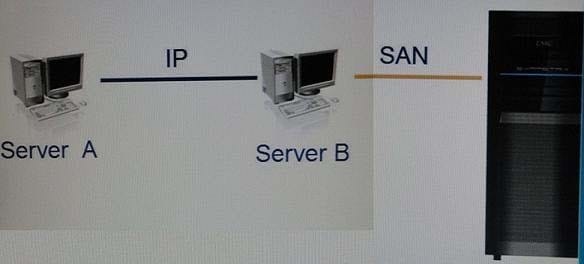
Refer to the exhibit.
You are in the process of implementing Symmetrix Management Console in the configuration shown in the
exhibit Server A can access Server B over an IP network, Server B has access to the Symmetrix array
over the SAN.
Which licenses key(s) should you implement on Server A?
A. SMC key only
B. Base, SMC, and SYMAPI server keys
C. Base and SYMAPI server keys
D. Base and SMC keys
Questions 9
Open Replicator will be used to move data from a Symmetrix V-Max array to a CLARiiON array. The CLARiiON has NOT been discovered by the host on which the Open Replicator commands are issued. Which information has to be specified in the Open Replicator device file?
A. The CLARiiON Array ID and LUN ID
B. The WWN of the CLARiiON LUN
C. The CLARiiON Array ID and WWN of the CLARiiON LUN
D. The WWN and LUN ID of the CLARiiON LUN
Questions 10
Which Solutions Enabler daemon provides for centralized gatekeeper device management for all applications requiring access to Symmetrix arrays?
A. Base daemon (storapid)
B. GNS daemon (storgnsd)
C. RDF daemon (storrdfd)
D. Event daemon (storevntd)
Questions 11
A symclone create command is issued and the clone session has not yet been activated. The storage administrator wants to know the state of the clone target device. What would it be at this time?
A. Read Write enabled (RW)
B. Read Only enabled (RO)
C. Not Ready (NR)
D. Write Disabled (WD)
Questions 12
What is the result of performing a TimeFinder/Mirror consistent split operation against a device group?
A. All BCV devices in the group are consistent point-in-time copies.
B. All standard devices in the group are consistent point-in-time copies.
C. BCV devices are write-disabled and ready for synchronization with standard devices.
D. All standard devices are write-disabled and ready for synchronization with BCV devices.
Questions 13
TimeFinder/Snap virtual devices will be used as the control devices in an Open Replicator implementation. What should be the state of the virtual devices to create an Open Replication session?
A. Held
B. Not Ready
C. Read Write
D. Write Disabled


Home | About Us | Contact Us | FAQ | Guarantee Policy | Privacy Policy
Any charges made through this site will appear as Global Simulators Limited. All trademarks are the property of their respective owners.
Copyright © 2004-2026 pass2lead.com, All Rights Reserved.