

FM0-305 Online Practice Questions and Answers
Questions 4
Consider a FileMaker Pro 11 database with the following tables and fields: Assuming only the above relationships between table occurrences, using sorting if necessary, which two actions can be performed? (Choose two.)
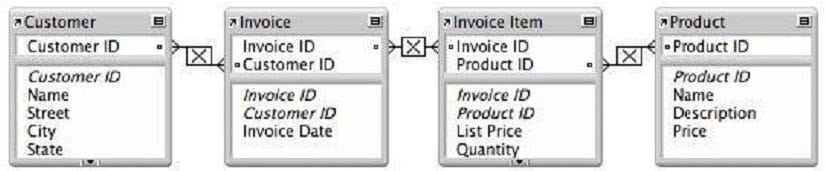
A. create a value list that shows all Invoices for a chosen Customer
B. create a value list on a Product layout which displays all Customers
C. find all of the Customers who have ever ordered a specific Product
D. create a portal to display each Product that has been ordered by a Customer
E. display all records from the Customer table in a portal on a layout for an Invoice Item record
Questions 5
Given the following Relationships Graph for a FileMaker 11 database, where Employee, Manager, and Trainer are all table occurrences sharing the same source table:

The database has the following layout, based on the Trainer table occurrence:
If a developer adds the following fields to the portal:
Class::Class Name
Employee::Name
Manager::Name
Which data is shown in the portal?
A. each of the trainer's classes, the first employee enrolled in each class, and the trainer as manager for that employee
B. each of the trainer's classes, the first employee enrolled in each class, and the first related manager for each employee
C. the first class each employee is enrolled in, all employees managed by the trainer, and the trainer as manager for each employee
D. the first class each employee is enrolled in, all employees enrolled in any of the trainer's classes, and the first related manager for each employee
E. the first of the trainer's classes in all rows, all employees enrolled in any of the trainer's classes, and the first related manager for each employee
Questions 6
The field exampleField has a script trigger set to activate OnObjectKeystroke and run the following script:
Allow User Abort [Off]
Set Error Capture [On]
If [Length (File::exampleField)= 7]
Exit Script [Result: 0]
Else
Set Field [File::exampleField File::Field and ""]
Exit Script []
End If
The field exampleField has the value of 111111.
At the end of the string a 9 is entered.
What is the resulting value in the field after the script trigger has processed?
A. 0
B. 111111
C. 111111
D. 1111110
E. 1111119
Questions 7
For which two actions will FileMaker Pro 11 automatically preserve sort order for a found set of records by reordering or resorting the found set following the action? (Choose two.)
A. Import records using Update matching records in found set to modify some values in a field used as a sort key.
B. Use Replace Field Contents... on a field used as a sort key to change its values for all the records in the found set.
C. Edit a value list, when that value list is currently defining a field's sort order (i.e. Sort Records using Custom order based on value list).
D. A script run in another user session includes the Set Field By Name script step and modifies the value of a sort key field in one of the records of the current user's found set.
Questions 8
Which two could generate a line chart that contains multiple lines? (Choose two.)
A. set the chart to Use Data From: Related Records and specify multiple data series, each based on a related number field
B. set the chart to Use Data From: Current Record (delimited data) and specify multiple data series, each of which references a summary field
C. set the chart to Use Data From: Current Found Set and specify multiple data series, each referencing a single number field
D. set the chart to Use Data From: Current Found Set and specify a single data series that contains a return delimited list of values
Questions 9
What is a reason to use the Let() function in a formula for a FileMaker Pro 11 calculation field?
A. to set a variable $$status that can be displayed on a layout
B. to limit the iterations of a Loop() function used in the formula
C. to modify data in a text field referenced elsewhere in the formula
D. to define a custom function that can be used in other calculation formulas
Questions 10
While in a FileMaker Pro 11 database on a layout based on the Invoice table occurrence, the following script is run: Show All Records Go to Record/Request/Page [First] Loop If [Invoice::Status = "Sent"] Omit Record Else Go to Record/Request/Page [Next Exit after last] End If End Loop
Which two statements are true at the conclusion of the script? (Choose two.)
A. All "Sent" invoices have been omitted from the found set.
B. The loop will never end if every invoice has a status of "Sent."
C. The last record will not be omitted if it has a status of "Sent."
D. The found set will consist of all records if there are no "Sent" invoices.
Questions 11
Which two statements are true when FileMaker Server 11 is set to Secure connections to FileMaker Server? (Choose two.)
A. Secure Sockets Layer (SSL) is used by FileMaker Pro 11 client connections.
B. Connections between FileMaker Server 11 and FileMaker Pro 11 are encrypted.
C. Connections between FileMaker Server 11 Advanced and XML clients are encrypted.
D. Connections between FileMaker Server 11 Advanced and ODBC clients are encrypted.
E. Connections between FileMaker Server 11 Web Publishing Engine and the web server are encrypted.
Questions 12
Which two are required to make a FileMaker Pro database accessible to remote applications using JDBC? (Choose two.)
A. The database is hosted using FileMaker Server 11 Advanced.
B. A properly configured DSN is installed on the computer hosting the database.
C. The ISAPI Filters must be enabled on Windows IIS (Internet Information Server).
D. A Java Virtual Machine (JVM) must be installed on the computer hosting the database.
E. The database has the [fmxdbc] extended privilege enabled in at least one privilege set associated with an active account.
Questions 13
Which formula returns the calendar quarter (1, 2, 3, 4) of a date contained in a field called myDate?
A. Int ( Month ( myDate ) / 3 )
B. Mod ( Month ( myDate ) 3 ) + 1
C. Ceiling ( Month ( myDate ) / 3 )
D. Let ( m = Month ( myDate ) Case ( m > 0 1 m > 3 2 m > 6 3 4) )
E. Let ( m = Month ( myDate ) Choose ( m 1 1 1 2 2 2 3 3 3 4 4 4 ) )


Home | About Us | Contact Us | FAQ | Guarantee Policy | Privacy Policy
Any charges made through this site will appear as Global Simulators Limited. All trademarks are the property of their respective owners.
Copyright © 2004-2026 pass2lead.com, All Rights Reserved.