

JN0-643 Online Practice Questions and Answers
Questions 4
-- Exhibit
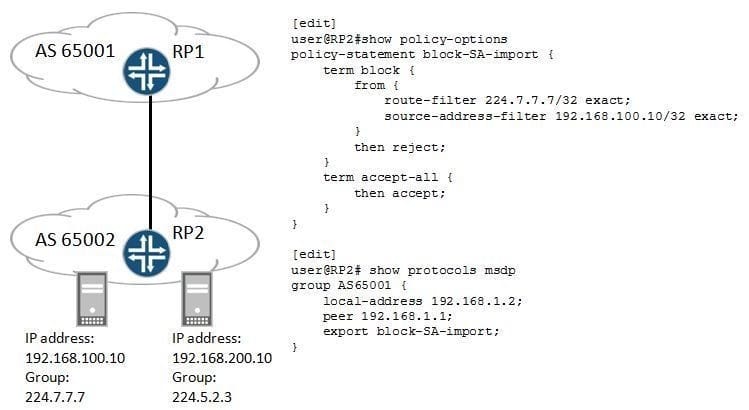
-- Exhibit -
Click the Exhibit button.
Referring to the configuration shown in the exhibit, which statement is true?
A. RP2 stops sending all SA messages to its peer.
B. RP1 stops sending all SA messages to its peer.
C. RP2 stops sending SA messages for the group 224.7.7.7 from source 192.168.100.10 to RP1.
D. RP1 stops sending SA messages for the group 224.7.7.7 from source 192.168.100.10 to RP2.
Questions 5
You are a service provider and have multiple customers in a building. You are installing a new switch that can host all of your customers. However, you would like to ensure that one customer cannot see or broadcast to another customer. You would also like to have them use a common gateway IP address from the building.
What should be used to provide this access?
A. VLAN
B. private VLAN
C. filter-based VLAN
D. Layer 2 tunneling
Questions 6
-- Exhibit -user@switch> show spanning-tree bridge
STP bridge parameters Context ID : 0 Enabled protocol : MSTP
STP bridge parameters for CIST Root ID : 32768.00:19:e2:55:1a:01 Root cost : 0 Root port : ge-0/0/10.0 CIST regional root : 32768.00:19:e2:55:1a:01 CIST internal root cost : 20000 Hello time : 2 seconds Maximum age : 20 seconds Forward delay : 15 seconds Hop count : 19 Message age : 0 Number of topology changes : 2 Time since last topology change : seconds Topology change initiator : ge-0/0/10.0 Topology change last recvd. from : 00:19:e2:55:24:8c Local parameters Bridge ID : 32768.b0:c6:9a:73:27:90
Extended system ID : 0 Internal instance ID : 0
STP bridge parameters for MSTI 1 MSTI regional root : 4097.b0:c6:9a:73:27:90 Hello time : 2 seconds Maximum age : 20 seconds Forward delay : 15 seconds Number of topology changes : 2 Time since last topology change : seconds Topology change initiator : ge-0/0/1.0 Topology change last recvd. from : b0:c6:9a:73:39:81 Local parameters Bridge ID : 4097.b0:c6:9a:73:27:90 Extended system ID : 0 Internal instance ID : 1
STP bridge parameters for MSTI 2 MSTI regional root : 4098.b0:c6:9a:73:39:90 Root cost : 20000 Root port : ge-0/0/1.0 Hello time : 2 seconds Maximum age : 20 seconds Forward delay : 15 seconds Hop count : 19 Number of topology changes : 2 Time since last topology change : seconds Topology change initiator : ge-0/0/1.0 Topology change last recvd. from : b0:c6:9a:73:39:81 Local parameters Bridge ID : 8194.b0:c6:9a:73:27:90 Extended system ID : 0 Internal instance ID : 2 -- Exhibit -
Click the Exhibit button.
Referring to the exhibit, which two statements are correct about the MSTP configuration? (Choose two.)
A. The local switch is not the root bridge for MSTI 1.
B. The local switch is the root bridge for MSTI 1.
C. The local switch is the root bridge for MSTI 2.
D. The local switch is not the root bridge for MSTI 2.
Questions 7
-- Exhibit -user@switch-1> show spanning-tree bridge
STP bridge parameters Context ID : 0 Enabled protocol : MSTP
STP bridge parameters for CIST ...
STP bridge parameters for MSTI 1 MSTI regional root : 4097.b0:c6:9a:73:27:90 Hello time : 2 seconds Maximum age : 20 seconds Forward delay : 15 seconds Number of topology changes : 4 Time since last topology change : 42 seconds Topology change initiator : ge-0/0/10.0 Topology change last recvd. from : 00:19:e2:55:24:8c Local parameters Bridge ID : 4097.b0:c6:9a:73:27:90 Extended system ID : 0 Internal instance ID : 1
STP bridge parameters for MSTI 2 MSTI regional root : 8194.b0:c6:9a:73:27:90 Hello time : 2 seconds Maximum age : 20 seconds Forward delay : 15 seconds Number of topology changes : 4 Time since last topology change : 42 seconds Topology change initiator : ge-0/0/10.0 Topology change last recvd. from : 00:19:e2:55:24:8c Local parameters Bridge ID : 8194.b0:c6:9a:73:27:90 Extended system ID : 0 Internal instance ID : 2
user@switch-1> show spanning-tree mstp configuration MSTP information Context identifier : 0 Region name : my-mstp-config Revision : 1 Configuration digest : 0x91ee8012e6851d931adae71da4060690
MSTI Member VLANs 0 0,400-4094 1 1-199 2 200-399
user@switch-2> show spanning-tree bridge
STP bridge parameters Context ID : 0 Enabled protocol : MSTP
STP bridge parameters for CIST ... STP bridge parameters for MSTI 1 MSTI regional root : 8193.b0:c6:9a:73:39:90 Hello time : 2 seconds Maximum age : 20 seconds Forward delay : 15 seconds Number of topology changes : 3 Time since last topology change : 320 seconds Topology change initiator : ge-0/0/9.0 Topology change last recvd. from : b0:c6:9a:73:27:81 Local parameters Bridge ID : 8193.b0:c6:9a:73:39:90 Extended system ID : 0 Internal instance ID : 1
STP bridge parameters for MSTI 2 MSTI regional root : 4098.b0:c6:9a:73:39:90 Hello time : 2 seconds Maximum age : 20 seconds Forward delay : 15 seconds Number of topology changes : 3 Time since last topology change : 320 seconds Topology change initiator : ge-0/0/9.0 Topology change last recvd. from : 00:19:e2:55:24:8d Local parameters Bridge ID : 4098.b0:c6:9a:73:39:90 Extended system ID : 0 Internal instance ID : 2
user@switch-2> show spanning-tree mstp configuration MSTP information Context identifier : 0 Region name : my-mstp-config Revision : 10 Configuration digest : 0x91ee8012e6851d931adae71da4060690
MSTI Member VLANs 0 0,400-4094 1 1-199 2 200-399 -- Exhibit -
Click the Exhibit button.
A colleague recently implemented MSTP in your Layer 2 network and is having trouble determining why it is not working properly. You are asked to review the outputs provided in the exhibit to determine the cause.
Referring to the exhibit, what is causing the issue?
A. The region name is configured the same on both devices.
B. The VLAN mapping is configured incorrectly.
C. The MSTP revision is configured incorrectly.
D. The bridge priority has not been configured correctly.
Questions 8
You are asked to set up 802.1X port authentication for all access ports on your EX Series switch. You must ensure that only one user is allowed to authenticate per port and all other attempts are denied.
Which supplicant mode must be used?
A. single mode
B. single-secure mode
C. default mode
D. multiple mode
Questions 9
A network routes IPv4 traffic only. You want to add IPv6 to the network, but you must use a single IGP for both IPv4 and IPv6 traffic.
Which protocol meets this requirement?
A. OSPFv2
B. BGPv4
C. ES-ISv1
D. OSPFv3
Questions 10
You must configure your access switch with more than 3000 VLANs and you want the ability to load- balance across them.
Which spanning-tree approach has the least impact on control-plane performance?
A. Configure your access switch with a load-balancing policy and apply it under [edit protocols rstp].
B. Configure your access switch for Rapid-PVST+.
C. Configure your access switch for MSTP, incorporating the use of MSTIs.
D. Configure your access switch for both VSTP and RSTP.
Questions 11
A Layer 2 transparent firewall separates two OSPFv3 routers. For the two OSPFv3 routers to form an adjacency, which protocol must be permitted on the firewall?
A. IPv4 protocol 89
B. IPv6 protocol 89
C. TCP port 89
D. UDP port 89
Questions 12
You need to enable authentication for your multiarea OSPF network. In this scenario, which three statements are correct? (Choose three)
A. MDS and simple authentication types are mutually exclusive
B. IPsec is only supported on OSPFv3
C. OSPF authentication is performed at the area level, and all devices in the same area must use same type of authentication and same password
D. IPsec transport mode is supported
E. IPsec tunnel mode is supported
Questions 13
You have been asked to implement 802.1X in your network and to ensure that all authorized users continue to be permitted should the RADIUS server fail. Which solution will satisfy this requirement?
A. Implement the persistent MAC feature with the override option.
B. Implement the server fail fallback feature with the override option.
C. Implement the persistent MAC feature with the use-cache option.
D. Implement the server fail fallback feature with the use-cache option.


Home | About Us | Contact Us | FAQ | Guarantee Policy | Privacy Policy
Any charges made through this site will appear as Global Simulators Limited. All trademarks are the property of their respective owners.
Copyright © 2004-2026 pass2lead.com, All Rights Reserved.