

AD0-E100 Online Practice Questions and Answers
Questions 4
An author uploads a PDF document and receives a "Restricted Files" error.
What is causing this problem?
A. The file extension is not registered as an allowed asset MIMES in the OSGI config, Day CQ DAM Asset Upload Restriction.
B. The file extension is case-sensitive and should be all lower case.
C. The user does not have permission to upload an asset with the specific file extension.
D. The MIME Type mapping setup for the file extension does not exist in OSGI config, Day CQ Scene7 Asset Mime type Service.
Questions 5
A company requires importing more than 1000 images at once regularly. During the import process, the Author instance becomes very slow or unresponsive.
What should a developer do to avoid this result?
A. Reduce the number of renditions generated for images.
B. Increase the memory and use a multi-core CPU for the instance.
C. Set up a dedicated processing instance for asset ingestion.
D. Limit the concurrent authors allowed on the author instance.
Questions 6
An author plans to perform a bulk upload of content into AEM assets. In the list of assets, there are documents that are the same but have unique file names. The author wants to use an asset duplication detection solution to find those files.
What is the most efficient way to find duplicated files in the DAM?
A. Create a custom OSGI event handler to handle detection duplication.
B. Enable the Day CQ DAM Create Asset Servlet's duplication detection in OSGI configurations.
C. Install ACS AEM Commons and configure the ACS AEM Commons Assets Duplication service in OSGI configurations.
D. AEM Assets detects duplicated assets out of the box. No additional configuration is needed.
Questions 7
A developer modified the default jpeg metadata schema and removed the "Product" tab. When testing with an existing JPEG image asset, the developer noticed that the Product tab still exists.
What could be causing this issue?
A. The Product tab is inherited from the parent image schema.
B. The old metadata schema is cached by the browser.
C. The updated schema will only be applied to new uploaded assets.
D. Default tabs cannot be removed from the metadata schema.
Questions 8
A company has a wide selection of products and each product has multiple associated images in the DAM. Authors want to search for all images for few products by their product ID at the same time in the asset search. Which change would you recommend to make the search easier?
A. In DAM Similarity Search Service, add an entry of product ID and search using the omnisearch box.
B. Add product ID in the Elevate for search keywords for all products, using omnisearch box to search.
C. Using the GQL full-text search feature, specify product ID in the metadata keyword in the search panel.
D. Create a multi value property predicate on the asset admin search rail to target product ID.
Questions 9
For which two reasons should a developer avoid changing the ExtendScript library in the Media Extraction Step? (Choose two.)
A. The library provides permissions to InDesign Server to generate renditions for INDD files.
B. The library implements event listeners responsible for renditions generation by InDesign Server.
C. The library provides communication functionality between AEM and InDesign Server.
D. The library is responsible for creating different renditions under the INDD file uploaded to DAM.
Questions 10
The following is an OSGi configuration of the DAM Safe Binary Filter:

What is the result when an AEM Author uploads an HTML file to the DAM?
A. The author is not allowed to download the HTML file from the DAM.
B. The author is not able to view the HTML file that was uploaded to the DAM.
C. The author is not allowed to upload the HTML file to the DAM and receives a 'Restricted File' error.
D. The author is not able to edit the metadata of the HTML file.
Questions 11
A client needs AEM Assets to detect files with identical contents at the time of upload.
What should a developer change to meet this requirement?
A. Develop a custom OSGi service to detect duplicate files, and deploy that OSGi service to the AEM instance.
B. Update the Day CQ DAM Asset Upload Restriction OSGi service configuration to detect duplicate files.
C. Update the Day CQ DAM Create Asset Servlet OSGi service configuration to detect duplicate files.
D. Update the Adobe CQ DAM Asset Index Update Monitor OSGi service configuration to detect duplicate files.
Questions 12
A workflow process, with the following configuration, is applied to a PNG file with dimensions of 800 x 800 pixels
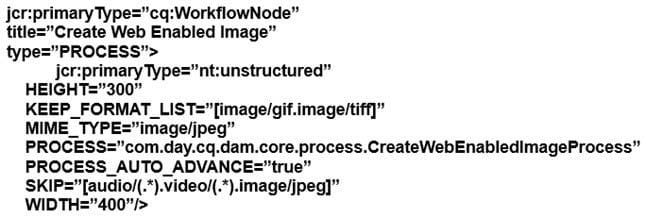
Which statement about the result of this workflow process is true?
A. A JPEG rendition of the original asset is created.
B. A rendition is created that is identical to the original.
C. A 400 x 300 pixel rendition of the original is created.
D. No new renditions of the original asset are created.
Questions 13
A user would like to take an image in AEM Assets and send a copy of the image to an external system. The copy of the image that is sent must have a specific height and width. The client cannot have rendition with the dimensions preserved in AEM.
Assuming the external system includes a REST API that supports file uploads, which step in the workflow model will you do after resizing the image?
A. Apply the image profile to the folder and run the smart crop workflow.
B. Upload the image to the external system; then, delete the rendition from the JCR.
C. Modify the update asset workflow to delete the rendition from the JCR.
D. Call the REST API from the external system.


Home | About Us | Contact Us | FAQ | Guarantee Policy | Privacy Policy
Any charges made through this site will appear as Global Simulators Limited. All trademarks are the property of their respective owners.
Copyright © 2004-2026 pass2lead.com, All Rights Reserved.