

AD0-E117 Online Practice Questions and Answers
Questions 4
An AEM Sites implementation is migrating from on-premise to AEM as a Cloud Service. Previously, the application was deployed in a single package for both code and access policy nodes. After initial deployment and testing in the new infrastructure, it is reported that user permissions are not working as expected.
What change should the Architect make to address this issue?
A. Update package metadata to use MergePreserve for handling access policy nodes
B. Move access policy nodes to a dedicated package and install manually
C. Refactor access policy nodes to Apache Sling JCR Repoinit scripts in the same package
D. Document permissions and request the Customer Success Engineer to configure
Questions 5
A website built on AEM Sites displays the company's stock price in the footer of all pages. The stock data is retrieved from a third party REST service using two-way SSL and rendered in an AEM component using HTL During performance testing in the last development sprint it becomes apparent that the third party service sometimes takes up to 30 seconds to respond, which degrades the overall site performance.
How should an Architect address this issue?
A. Call the REST service directly from the browser
B. Temporarily remove the component from all content
C. Load the stock data component asynchronously
D. Add a 5 second timeout to the REST call
Questions 6
A client's marketing pages are generally slow to load which is causing a significant drop in sales. All other AEM pages load within expected performance guidelines regardless of whether the visitor is being served the desktop or mobile experiences.
The marketing pages typically get slower when multiple external campaigns such as Facebook and AdWords drive traffic to those pages. The page performance tends to dip during high traffic periods. Internal campaign clicks such as those from hero images use similar campaign codes as external campaign traffic.
What should the Architect do to resolve this issue?
A. Modify the dispatcher.any file's section to ignore campaign-based URL parameters
B. Set AEM to use GZIP compression instead of the web server's compression
C. Add a new dispatcher farm to assist with the client's marketing pages
D. Convert the marketing pages to a responsive design instead of an adaptive design
Questions 7
An Architect needs to design a deployment process without downtime for end users. The system architecture contains an AEM author, two AEM publishers, two publish Dispatchers, and a centrally managed load balancer. The publishers serve some content that cannot be cached.
Which two actions should the Architect take to meet these requirements? (Choose two.)
A. Connect each publish Dispatcher to one AEM publish
B. Use each publish Dispatcher to load-balance to both AEM publishers
C. Deploy software packages by replicating them from author to publishers
D. Configure the centrally managed load balancer to connect directly to the AEM publisher that is not being dedKyed to
E. Deploy software package to AEM Publishers one by one
Questions 8
A client is in the discovery process for building a React native app, which is a single codebase that runs natively on iOS and Android. The goal is to reduce development costs. The client wants to reduce content creation costs in the new react Native app by reusing as much of the marketing content already publish in their AEM instance.
What should the Architect recommend to meet this requirement?
A. Experience Fragments
B. OSGi Bundles
C. Sling Resource Resolution
D. Content Fragments
Questions 9
A customer wants to implement an AEM solution to serve localized content to several regional websites. Which AEM capability should the Architect recommend?
A. Use translation connector and Multi Site Manager
B. Use il8N API and Multi Site Manager
C. Use translation connector and il8N API
D. Use translation connector and translation workflows
Questions 10
In a client's test environment AEM QA Testers from multiple groups and regions are testing and making requests to the AEM application. Due to the sheer number of hosts making connections, an Architect needs a quick and easy way to allow any hosts to make requests to the AEM application.
Which approach should the Architect take to meet this requirement for this non-production environment?
A. Add GET as a Filter Method in the Apache Sling Referrer OSGi Configuration
B. Use Allowlists instead of Blocklists in the Dispatcher Configuration
C. Restrict Clients that can flush the cache in the Dispatcher Configuration
D. Enable Allow Empty in the Apache Sling Referrer OSGi Configuration
Questions 11
An AEM customer is designing a new website. The design shows that images are very prominent on the website but there is a concern about the big variety of aspect ratios used. Images can potentially be used on different places and
components on the website. The customer is looking for a maintainable solution to limit the amount of content editing work when adding the assets to the pages.
Which solution should an Architect recommend?
A. Integrate with Dynamic Media (Scene 7) and enable smart cropping
B. Use inline cropping feature of the image component on the pages
C. Use the cropping feature on the asset in the AEM DAM
D. Integrate with Dynamic Media (Scene 7) and enable smart imaging
Questions 12
A client has an existing AEM site using components that proxy AEM WCM Core Components. The site uses simple page authoring without referenced content, The client wants to create a new experience on another marketing channel. The plan is to use as much of the existing page content as possible to avoid refactoring the current content and to maintain consistency across channels.
Which AEM capability should an Architect use to meet these requirements?
A. Experience Fragments
B. Content Fragments
C. Assets API
D. Sling Model Exporter
Questions 13
Refer to the exhibit.
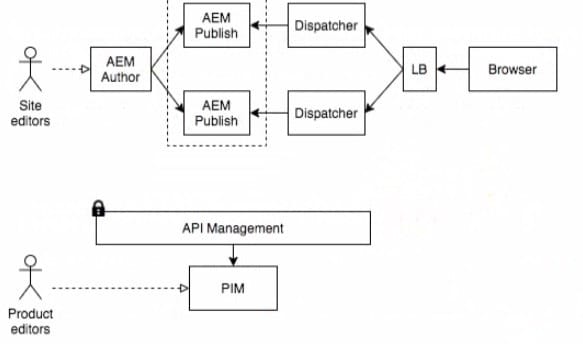
A customer with an existing AEM implementation wants to enrich product pages with technical data coming from their PIM system. The PIM system sits behind an API Management solution that publicly exposes the PIM API's as RESTful web services with basic authentication as the security mechanism. Data consistency with the PIM and secure access to the APIs are key elements of the integration.
How should the Architect set up the integration between AEM and the PIM?
A. Integrate the AEM Publishers directly with the API Management solution
B. Use a client-side integration with AJAX from the browser to the API Management
C. Import the technical data into the AEM Author and replicate to Publishers
D. Convert the technical data to Content Fragments and expose using Content Services


Home | About Us | Contact Us | FAQ | Guarantee Policy | Privacy Policy
Any charges made through this site will appear as Global Simulators Limited. All trademarks are the property of their respective owners.
Copyright © 2004-2026 pass2lead.com, All Rights Reserved.