

AD0-E600 Online Practice Questions and Answers
Questions 4
A marketer has been tasked with setting up an export of a certain segment of their profile data to their cloud storage. Which two types of file export options are available to the marketer? (Choose two.)
A. full
B. Incremental
C. Partial
Questions 5
Given thefollowing:
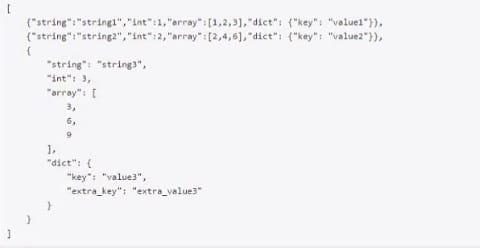
How should a data engineer ingest this data?
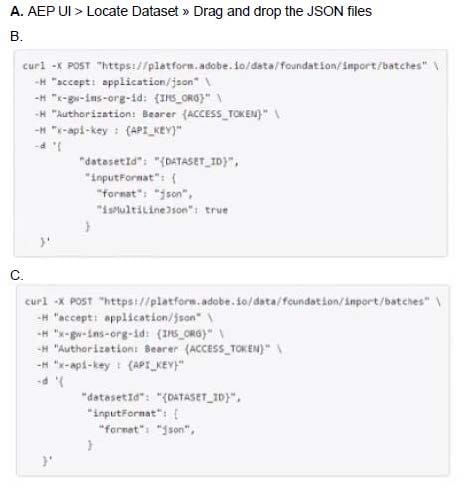
A. Option A
B. Option B
C. Option C
Questions 6
A data engineer is using Data Prep to format data for ingestion. The data engineer needs to load Date/Time as Date values for a field called CustomerCreateDate. The use of this field does not require a time component and as is String
based.
The JSON value in this example is '.platosaprod.customerCreateDateVZOOS-11 -0415:44".
Which Data Prep functions and order should the data engineer use to format the date without the time component?
A. format(p'atosaprod.custometCreateDate.dd-MM-yyyy')
B. format(date(_platosaprod.customerCreateDate),'dd-MM-yyyy')
C. dformaUdateLP'atosaprod.customerCreateDateJ.'dd-MM-yyyy')
D. date(_platosaprod.customerCreateDate.'dd-MM-yyyy')
Questions 7
A data engineer wants to connect a new data source into AEP using an Amazon S3 Bucket. The S3 Bucket currently will be added with the daily deltas.
The historical data and the recurrent deltas must be imported.
In which way can this task be performed with minimal effort?
A. Create a one-time dataflow for the historical data and one scheduled dataflow for the deltas
B. Create one scheduled dataflow and enable partial ingestion
C. Create one scheduled dataflow and enable the backfill
D. Create one scheduled dataflow for the deltas and import the historical data through a data ingestion workflow
Questions 8
What is the difference between a data science training run and a data science scoring run?
A. A training run involves learning patterns from your data while a scoring run is about generating insights from your data. A training run requires that a scoring run hasoccurred.
B. A training run involves learning patterns from your data while a scoring run is about generating insights from your data. A scoring run requires that a training run hasoccurred.
C. A training run involves generating insights from your data while a scoring run is about learning patterns from your data. A scoring run requires that a training run hasoccurred.
D. A training run involves generating insights from your data while a scoring run is about learning patterns from your data. A training run requires that a scoring run hasoccurred.
Questions 9
A marketer recently set up an Amazon S3 cloud storage destination. The last successful flow for the destination exported 12 million records. in the Amazon S3 bucket, how will the export be presented to the marketer?
A. 3 CSV files in the format of: filename.csv {containing 5 million records) filename_2.c$v (containing 5 million records) ftlename_3.csv (containing 2 million records)
B. 1 CSV file in the format of: filename.csv (containing 12 million records)
C. 2 CSV files in the format of filename.csv (containing 6 million records) filename_2.csv (containing 6 million records)
D. 3 JSON files in the format of: filenamejson (containing 5 million records) filename_2json (containing 5 million records) filename.3json (containing 2 million records)
Questions 10
A data engineer is ingesting time-series data in CSV format from a CRM system. The source data contains a "subscription" field that contains what level of subscription the customer has purchased.
The data is ingested into a target field called "subscriptionLevel". which is an enum field that accepts the following values: "Lite*. "Standard", and "Pro''.
The data engineer knows that the CSV files contain some rows that do not conform to the above enum. Instead of rejecting those rows, the data engineer wants to transform non- conforming fields to "Standard".
Which mapping function(s) will accomplish this?
A. iif(subscription.equals("Lite") andandsubscriptiorvequ3ls("Standard") andand sub$ctiption.eqoals("Pro"). subscription. el$e("5tandard"))
B. iif(subscription.noiEquals(*Lite" || "Standard" || "Pro"), subscription, subscription, replacestrf "Standard"))
C. iif(subscription.notEquals("Lite") || subscription.notEqualsl "Standard") || subscription.notEquatsCPro'). 'Standard', subscription)
D. iif(subscription.equals("Lite") || subscription.equals("Standard") || subscriptionequalsfPro"). subscription. "Standard")
Questions 11
A data engineer is ingesting the transactional information from an ecommerce platform through a daily feed. In AEP, one Experience Event-based schema will collect the purchase events from this feed.
The eventType field of the schema must be populated with "commerce.purchases' if in a CSV record in which the column 'pure ha sesf arid ate' and 'purchaseenddate" happen on the same day, If the "purchasee/irfdate" is set to a later date,
the eventType should be *commerce._orgtenant.cancer.
Both dates follow the same format "yyyy-MM-dd'T'HH:mm:ss.SSS'Z~. and the "purchaseenddate' is always populated.
How should the data engineer create a Calculated Field that can be used to populate the eventType according to the required logic?
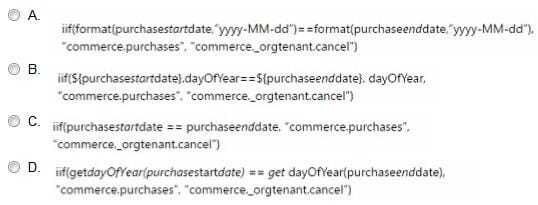
A. Option A
B. Option B
C. Option C
D. Option D
Questions 12
Time-series data has been ingested and linked with a Real-time Customer Profile.
A data engineer wants to look up only the most recent time-series event associated with the Luma ID "100".
Which API call will return the desired event object?
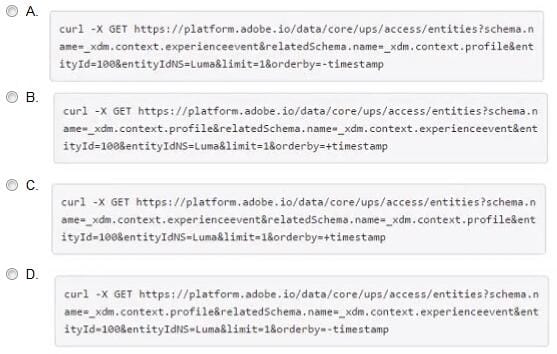
A. Option A
B. Option B
C. Option C
D. Option D
Questions 13
What it the appropriate identity namespacs for an email mat n coming in hashed'
A. Email SHA256
B. Email
C. ECID
D. Email MDS


Home | About Us | Contact Us | FAQ | Guarantee Policy | Privacy Policy
Any charges made through this site will appear as Global Simulators Limited. All trademarks are the property of their respective owners.
Copyright © 2004-2026 pass2lead.com, All Rights Reserved.