

MLS-C01 Online Practice Questions and Answers
Questions 4
A web-based company wants to improve its conversion rate on its landing page. Using a large historical dataset of customer visits, the company has repeatedly trained a multi-class deep learning network algorithm on Amazon SageMaker.
However, there is an overfitting problem: training data shows 90% accuracy in predictions, while test data shows 70% accuracy only.
The company needs to boost the generalization of its model before deploying it into production to maximize conversions of visits to purchases.
Which action is recommended to provide the HIGHEST accuracy model for the company's test and validation data?
A. Increase the randomization of training data in the mini-batches used in training.
B. Allocate a higher proportion of the overall data to the training dataset
C. Apply L1 or L2 regularization and dropouts to the training.
D. Reduce the number of layers and units (or neurons) from the deep learning network.
Questions 5
A Marketing Manager at a pet insurance company plans to launch a targeted marketing campaign on social media to acquire new customers Currently, the company has the following data in Amazon Aurora
1.
Profiles for all past and existing customers
2.
Profiles for all past and existing insured pets
3.
Policy-level information
4.
Premiums received
5.
Claims paid
What steps should be taken to implement a machine learning model to identify potential new customers on social media?
A. Use regression on customer profile data to understand key characteristics of consumer segments Find similar profiles on social media.
B. Use clustering on customer profile data to understand key characteristics of consumer segments Find similar profiles on social media.
C. Use a recommendation engine on customer profile data to understand key characteristics of consumer segments. Find similar profiles on social media
D. Use a decision tree classifier engine on customer profile data to understand key characteristics of consumer segments. Find similar profiles on social media
Questions 6
While reviewing the histogram for residuals on regression evaluation data a Machine Learning Specialist notices that the residuals do not form a zero-centered bell shape as shown. What does this mean?
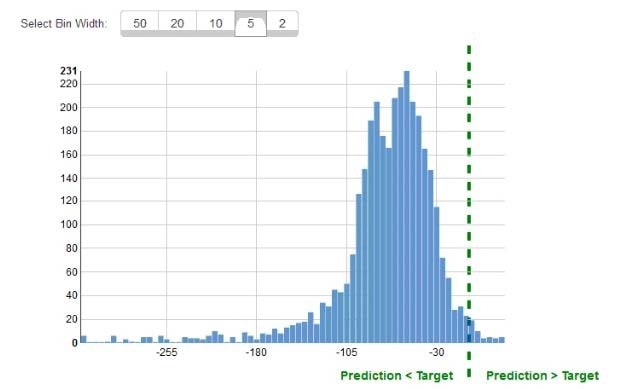
A. The model might have prediction errors over a range of target values.
B. The dataset cannot be accurately represented using the regression model
C. There are too many variables in the model
D. The model is predicting its target values perfectly.
Questions 7
A Machine Learning Specialist receives customer data for an online shopping website. The data includes demographics, past visits, and locality information. The Specialist must develop a machine learning approach to identify the customer shopping patterns, preferences and trends to enhance the website for better service and smart recommendations.
Which solution should the Specialist recommend?
A. Latent Dirichlet Allocation (LDA) for the given collection of discrete data to identify patterns in the customer database.
B. A neural network with a minimum of three layers and random initial weights to identify patterns in the customer database
C. Collaborative filtering based on user interactions and correlations to identify patterns in the customer database
D. Random Cut Forest (RCF) over random subsamples to identify patterns in the customer database
Questions 8
A Machine Learning Specialist is building a model that will perform time series forecasting using Amazon SageMaker. The Specialist has finished training the model and is now planning to perform load testing on the endpoint so they can configure Auto Scaling for the model variant.
Which approach will allow the Specialist to review the latency, memory utilization, and CPU utilization during the load test?
A. Review SageMaker logs that have been written to Amazon S3 by leveraging Amazon Athena and Amazon OuickSight to visualize logs as they are being produced
B. Generate an Amazon CloudWatch dashboard to create a single view for the latency, memory utilization, and CPU utilization metrics that are outputted by Amazon SageMaker
C. Build custom Amazon CloudWatch Logs and then leverage Amazon ES and Kibana to query and visualize the data as it is generated by Amazon SageMaker
D. Send Amazon CloudWatch Logs that were generated by Amazon SageMaker lo Amazon ES and use Kibana to query and visualize the log data.
Questions 9
A machine learning specialist works for a fruit processing company and needs to build a system that categorizes apples into three types. The specialist has collected a dataset that contains 150 images for each type of apple and applied
transfer learning on a neural network that was pretrained on ImageNet with this dataset.
The company requires at least 85% accuracy to make use of the model.
After an exhaustive grid search, the optimal hyperparameters produced the following:
1.
68% accuracy on the training set
2.
67% accuracy on the validation set
What can the machine learning specialist do to improve the system's accuracy?
A. Upload the model to an Amazon SageMaker notebook instance and use the Amazon SageMaker HPO feature to optimize the model's hyperparameters.
B. Add more data to the training set and retrain the model using transfer learning to reduce the bias.
C. Use a neural network model with more layers that are pretrained on ImageNet and apply transfer learning to increase the variance.
D. Train a new model using the current neural network architecture.
Questions 10
A data scientist needs to identify fraudulent user accounts for a company's ecommerce platform. The company wants the ability to determine if a newly created account is associated with a previously known fraudulent user. The data scientist is using AWS Glue to cleanse the company's application logs during ingestion.
Which strategy will allow the data scientist to identify fraudulent accounts?
A. Execute the built-in FindDuplicates Amazon Athena query.
B. Create a FindMatches machine learning transform in AWS Glue.
C. Create an AWS Glue crawler to infer duplicate accounts in the source data.
D. Search for duplicate accounts in the AWS Glue Data Catalog.
Questions 11
A company wants to create a data repository in the AWS Cloud for machine learning (ML) projects. The company wants to use AWS to perform complete ML lifecycles and wants to use Amazon S3 for the data storage. All of the company's
data currently resides on premises and is 40 in size.
The company wants a solution that can transfer and automatically update data between the on-premises object storage and Amazon S3. The solution must support encryption, scheduling, monitoring, and data integrity validation.
Which solution meets these requirements?
A. Use the S3 sync command to compare the source S3 bucket and the destination S3 bucket. Determine which source files do not exist in the destination S3 bucket and which source files were modified.
B. Use AWS Transfer for FTPS to transfer the files from the on-premises storage to Amazon S3.
C. Use AWS DataSync to make an initial copy of the entire dataset. Schedule subsequent incremental transfers of changing data until the final cutover from on premises to AWS.
D. Use S3 Batch Operations to pull data periodically from the on-premises storage. Enable S3 Versioning on the S3 bucket to protect against accidental overwrites.
Questions 12
A machine learning (ML) specialist needs to extract embedding vectors from a text series. The goal is to provide a ready-to-ingest feature space for a data scientist to develop downstream ML predictive models. The text consists of curated sentences in English. Many sentences use similar words but in different contexts. There are questions and answers among the sentences, and the embedding space must differentiate between them.
Which options can produce the required embedding vectors that capture word context and sequential QA information? (Choose two.)
A. Amazon SageMaker seq2seq algorithm
B. Amazon SageMaker BlazingText algorithm in Skip-gram mode
C. Amazon SageMaker Object2Vec algorithm
D. Amazon SageMaker BlazingText algorithm in continuous bag-of-words (CBOW) mode
E. Combination of the Amazon SageMaker BlazingText algorithm in Batch Skip-gram mode with a custom recurrent neural network (RNN)
Questions 13
An ecommerce company discovers that the search tool for the company's website is not presenting the top search results to customers. The company needs to resolve the issue so the search tool will present results that customers are most likely to want to purchase.
Which solution will meet this requirement with the LEAST operational effort?
A. Use the Amazon SageMaker BlazingText algorithm to add context to search results through query expansion.
B. Use the Amazon SageMaker XGBoost algorithm to improve candidate ranking.
C. Use Amazon CloudSearch and sort results by the search relevance score.
D. Use Amazon CloudSearch and sort results by the geographic location.


Home | About Us | Contact Us | FAQ | Guarantee Policy | Privacy Policy
Any charges made through this site will appear as Global Simulators Limited. All trademarks are the property of their respective owners.
Copyright © 2004-2026 pass2lead.com, All Rights Reserved.