

AZ-104 Online Practice Questions and Answers
Questions 4
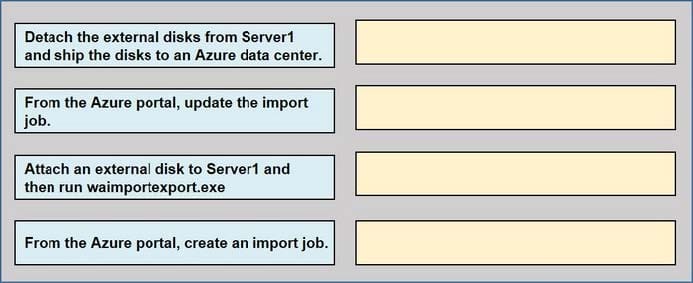
DRAG DROP
You have an Azure subscription that contains a storage account.
You have an on-premises server named Server1 that runs Windows Server 2016. Server1 has 2 TB of data.
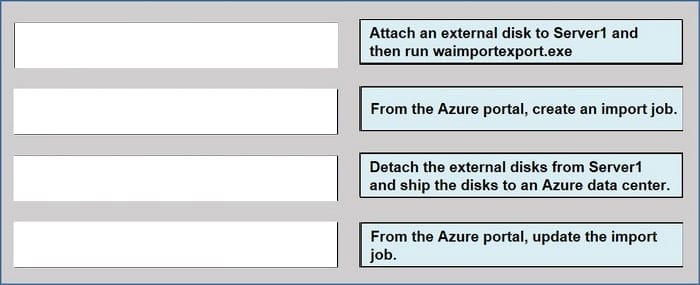
You need to transfer the data to the storage account by using the Azure Import/Export service.
In which order should you perform the actions? To answer, move all actions from the list of actions to the answer area and arrange them in the correct order.
NOTE: More than one order of answer choices is correct. You will receive credit for any of the correct orders you select.
Select and Place:
Questions 5
HOTSPOT
You have the Azure management groups shown in the following table:
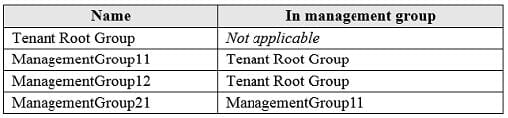
You add Azure subscriptions to the management groups as shown in the following table:

You create the Azure policies shown in the following table:

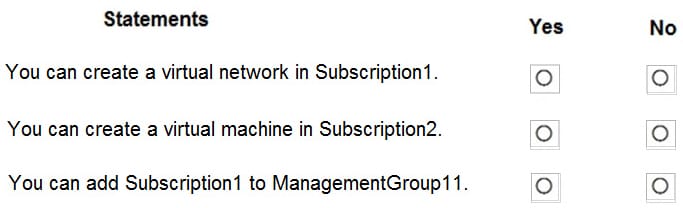
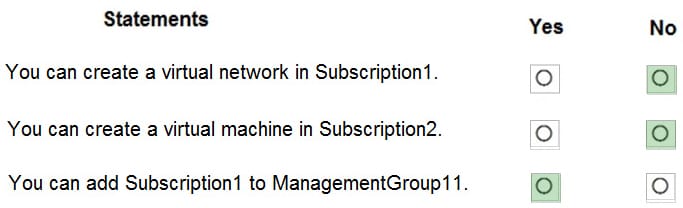
For each of the following statements, select Yes if the statement is true. Otherwise, select No.
NOTE: Each correct selection is worth one point.
Hot Area:
Questions 6
HOTSPOT
You have a virtual network named VNet1 that has the configuration shown in the following exhibit.
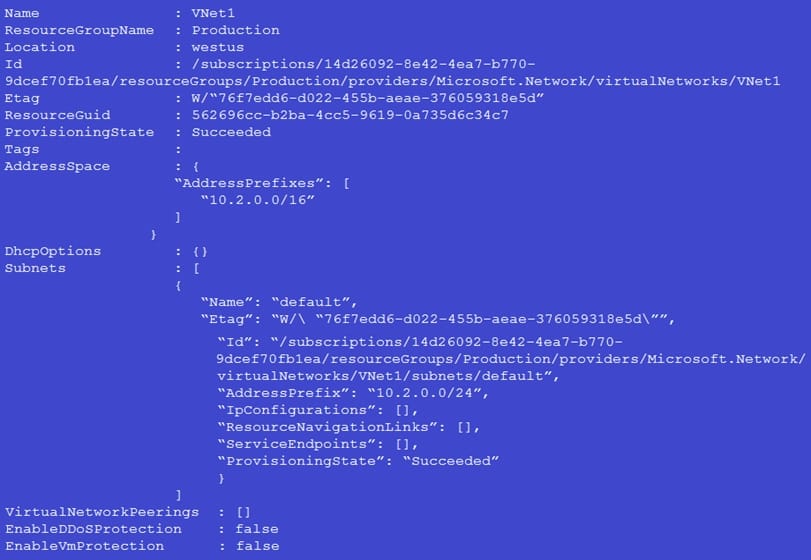
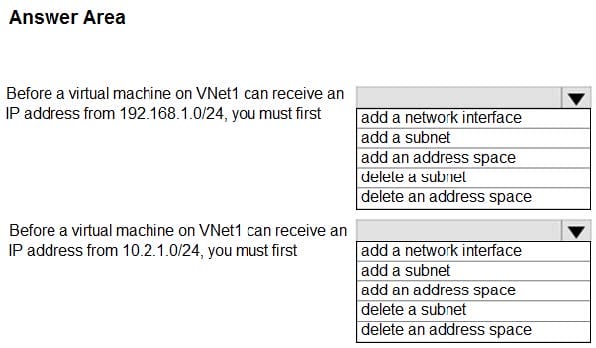
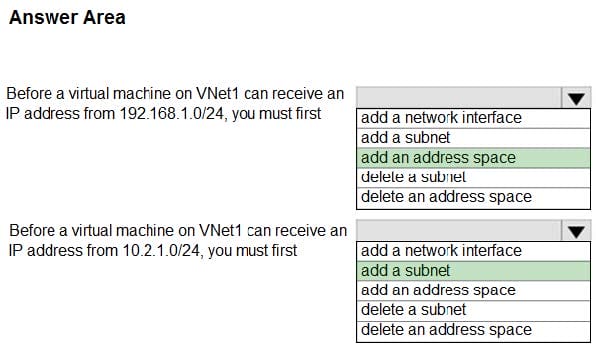
Use the drop-down menus to select the answer choice that completes each statement based on the information presented in the graphic.
NOTE: Each correct selection is worth one point.
Hot Area:
Questions 7
HOTSPOT
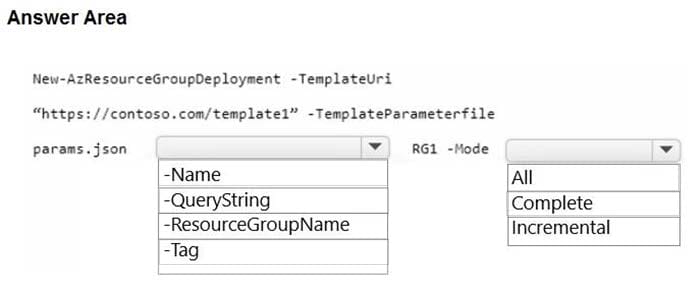
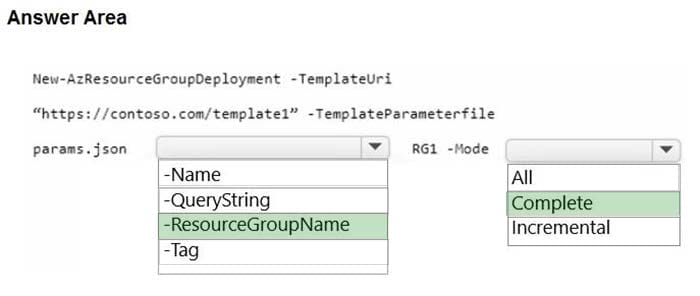
You have an Azure subscription that contains a resource group named RG1.
You plan to use an Azure Resource Manager (ARM) template named template1 to deploy resources. The solution must meet the following requirements:
Deploy new resources to RG1.
Remove all the existing resources from RG1 before deploying the new resources.
How should you complete the command? To answer, select the appropriate options in the answer area.
NOTE: Each correct selection is worth one point.
Hot Area:
Questions 8
HOTSPOT
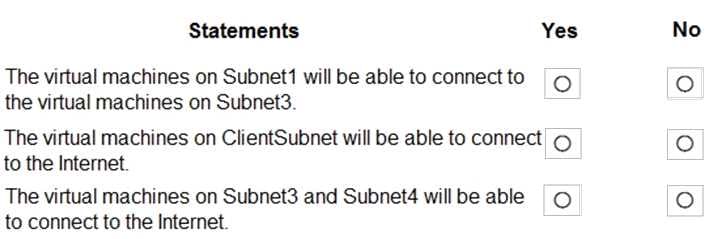
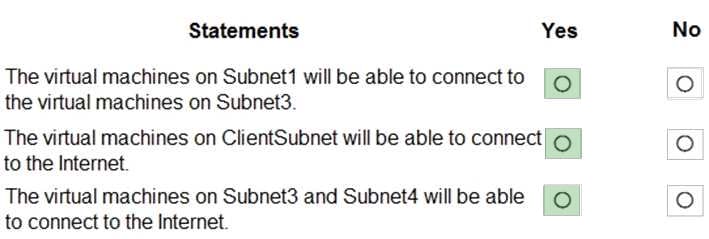
You are evaluating the connectivity between the virtual machines after the planned implementation of the Azure networking infrastructure.
For each of the following statements, select Yes if the statement is true. Otherwise, select No.
Hot Area:
Questions 9
You create the following resources in an Azure subscription:
1.
An Azure Container Registry instance named Registry1.
2.
An Azure Kubernetes Service (AKS) cluster named Cluster1.
You create a container image named App1 on your administrative workstation.
You need to deploy App1 to Cluster1.
What should you do first?
A. Create a host pool on Cluster1.
B. Run the az acr build command.
C. Run the docker build command.
D. Run the docker push command.
Questions 10
You have an Azure subscription.
You plan to deploy an Azure Kubernetes Services (AKS) cluster to support an app named APP1. On-premises clients connect to App1 by using the IP address of the pod.
For the AKS cluster, you need to choose a network type that will support App1.
What should you choose?
A. Azure Private Link
B. Hybrid Connection endpoints
C. Kubened
D. Azure Container Networking Interface (CNI)
Questions 11
You have an Azure Active Directory (Azure AD) tenant that syncs with an on-premises Active Directory domain.
You have an internal web app named WebApp1 that is hosted on-premises.
WebApp1 uses Integrated Windows authentication.
Some users work remotely and do NOT have VPN access to the on-premises network. You need to provide the remote users with single sign-on (SSO) access to WebApp1. Which two features should you include in the solution? Each correct
answer presents part of the solution.
NOTE: Each correct selection is worth one point.
A. Azure AD Application Proxy
B. Azure AD Privileged Identity Management (PIM)
C. Conditional Access policies
D. Azure Arc
E. Azure AD enterprise applications
F. Azure Application Gateway
Questions 12
You have an Azure subscription named Subscription1. Subscription1 contains a virtual machine named VM1. You have a computer named Computer1 that runs Windows 10. Computer1 is connected to the Internet. You add a network interface named Interface1 to VM1 as shown in the exhibit (Click the Exhibit button.)
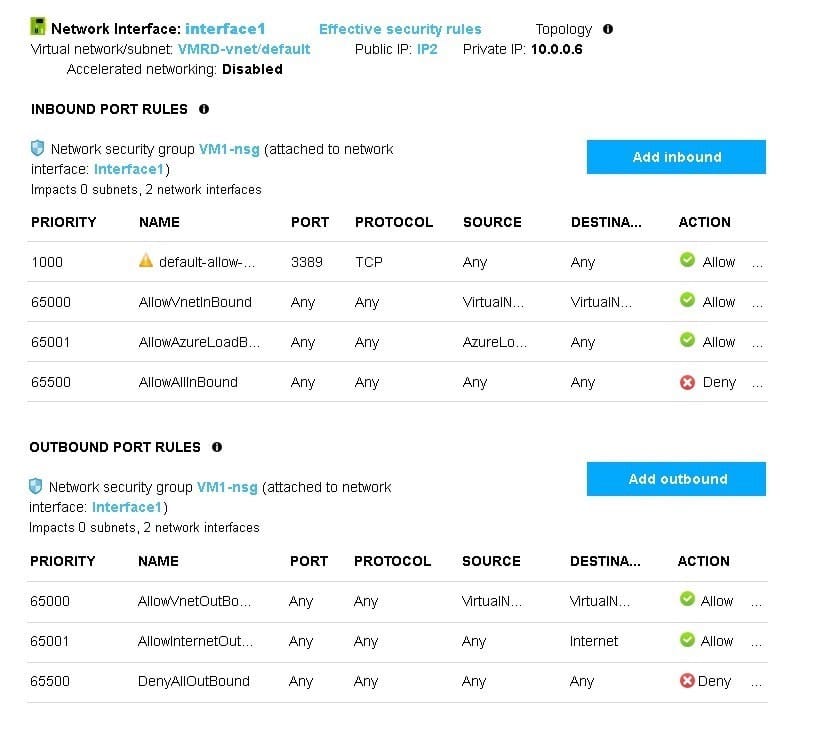
From Computer1, you attempt to connect to VM1 by using Remote Desktop, but the connection fails. You need to establish a Remote Desktop connection to VM1. What should you do first?
A. Start VM1.
B. Attach a network interface.
C. Delete the DenyAllOutBound outbound port rule.
D. Delete the DenyAllInBound inbound port rule.
Questions 13
You have an Azure AD tenant named contoso.com.
You have an Azure subscription that contains an Azure App Service web app named App1 and an Azure key vault named KV1. KV1 contains a wildcard certificate for contoso.com.
You have a user named user1@contoso.com that is assigned the Owner role for App1 and KV1.
You need to configure App1 to use the wildcard certificate of KV1.
What should you do first?
A. Create an access policy for KV1 and assign the Microsoft Azure App Service principal to the policy.
B. Assign a managed user identity to App1.
C. Configure KV1 to use the role-based access control (RBAC) authorization system.
D. Create an access policy for KV1 and assign the policy to User1.


Home | About Us | Contact Us | FAQ | Guarantee Policy | Privacy Policy
Any charges made through this site will appear as Global Simulators Limited. All trademarks are the property of their respective owners.
Copyright © 2004-2026 pass2lead.com, All Rights Reserved.