

B2C-COMMERCE-DEVELOPER Online Practice Questions and Answers
Questions 4
Universal Containers recently completed updates to their storefront shopping cart page. A problem has been discovered since the update. Users are no longer able to submit coupon codes on this page. Additionally, authenticated users who try to add a coupon are logged out. The following processing code is found in the Cart.js controller file:
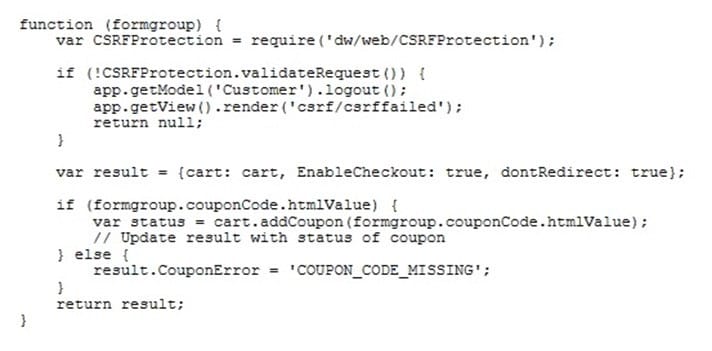
What should the Developer verify to identify the issue?
A. The CSRF cartridge is included in the site's cartridge path.
B. The form group has the secure attribute set to true.
C. The CSRF token is present in the form and is being submitted in the request.
D. The CSRF settings in Business Manager are properly configured.
Questions 5
Once the Cache Information tool of the storefront toolkit is enabled, how can a Digital Developer view caching information for a particular component of the page?
A. Hover over the caching icons now present on the storefront.
B. Open the Request Logs to view the caching information.
C. Start a pipeline debugging session and view the caching information provided.
D. Right-click on the component in UX Studio and view the caching properties of the file.
Questions 6
Universal Containers is preparing their storefront to use Open Commerce APIs (OCAPI).
To which hook should the Digital Developer move taxation logic to ensure consistent order totals within B2C Commerce?
A. dw.ocapi.shop.order.validateOrder
B. dw.ocapi.shop.basket.calculate
C. dw.ocapi.shop.basket.afterPostShipment
D. dw.ocapi.shop.order.afterPOST
Questions 7
A developer is writing a server side script that needs to maintain state across calls. The persistent information needed includes these items.
1.
The current customer
2.
Whether or not the customer is authenticated
3.
The privacy attributes (such as tracking consent or cookie policy)
Which technique should the developer use to maintain state in an efficient and scalable manner that follows best practice?
A. Use a client-side cookie to store the information for the session duration
B. Use the Session class, and its additional class references and attributes, in the B2C Commerce API
C. Use a non-replicable Custom Object to store the information temporarily
D. Use an SFRA controller. Because it runs server-side, the state is automatically maintained
Questions 8
A developer customized the Cart-Show controller route with a LINK cartridge that adds social media data. There is a new requirement to add a dataLayer object to the Cart-Show controller route. How should the developer achieve this to ensure that no code change will be needed if the client decides to remove the LINK cartridge?
A. Replace the existing viewData variable with the dataLayer object in the Cart-Show controller route
B. Replace the Cart-Show controller route in client cartridge and add dataLayer object to the viewData variable
C. Replace the Cart-Show controller route in client cartridge and add dataLayer object to the viewData variable. Ensure that the client cartridge is on the left of the LINK cartridge in cartridge path
D. Append Cart-Show controller route in the client cartridge and add dataLayer object to the viewData variable
Questions 9
A developer working on a simple web service integration is asked to add appropriate logging to allow future troubleshooting.
According to logging best practices, which code should the developer write to log when an operation succeeds, but has an unexpected outcome that may produce side effects?
A. Logger.info(`Unexpected service response.')
B. Logger.warn(`Unexpected service response.')
C. Logger.error(`Unexpected service response.')
D. Logger.debug(`Unexpected service response.')
Questions 10
A developer is tasked with the development of a new Page Designer Page Type, as requested by the merchant.
How should they define the rendering logic of the page?
A. Implement an XML file with a
B. Implement a JavaScript file with a render() function
C. Implement a Controller file with a "render" route
D. Implement a metadata JSON file with a "render" property
Questions 11
A developer cannot create a custom object in Business Manager because the attributes do not show. The developer can view the object but not the attributes. Which action should the developer take to resolve the problem?
A. Change the data type of the attributes
B. Set the attributes to site-specific replicable
C. Create an Attribute Group with the desired attributes in it
D. Sort the attributes in the custom object type
Questions 12
A client has two B2C Commerce sites in the same instance: one for the U.S. market, the other for the European market. The product they make are sold with different safety certificates based on the world location.
For example, they sell a smartphone with certificate A in the U.S. and certificate B in Europe, a hairdryer with certificate C in the U.S. and certificate D in Europe, and more.
How should a developer allow the merchant to display the appropriate certification logo in the product details page, depending on the customer's location?
A. Add a Localizable custom preference to the SitePreference system object type.
B. Add a Site-specific custom attribute to the Product system object type.
C. Add a Localizable custom attribute to the Certificate system object type.
D. Add an Image custom preference to the SitePreference system object type.
Questions 13
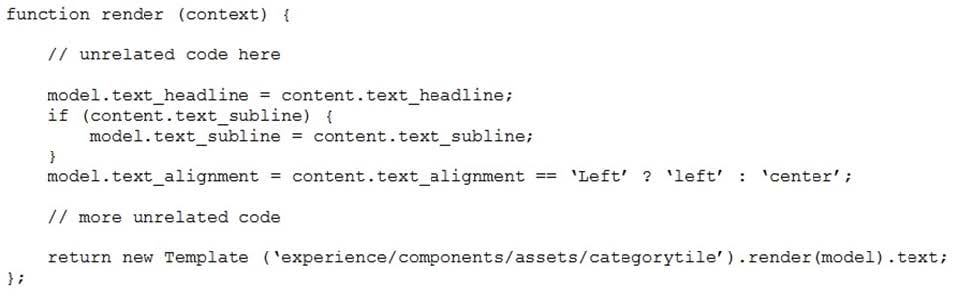
Given the code snippet above, what should be added after this code so it can be used for page component display?
A. module.exports = render;
B. module.exports = server.exports();
C. module.exports.render = render;
D. base.render = render;


Home | About Us | Contact Us | FAQ | Guarantee Policy | Privacy Policy
Any charges made through this site will appear as Global Simulators Limited. All trademarks are the property of their respective owners.
Copyright © 2004-2026 pass2lead.com, All Rights Reserved.