

CAMS-FCI Online Practice Questions and Answers
Questions 4
Which information is it best practice to share at the very beginning of a well-written SAR/STR narrative?
A. A specific description of the involved accounts and transactions, including the origination and application of funds
B. The purpose of the SAR/STR narrative and a general description of the known or alleged violation
C. Information about any follow-up actions conducted by the financial institution on the account
D. Any and all relevant facts about the parties who facilitated the suspicious activity or transactions
Questions 5
When crafting internal procedures on writing and submitting SARs/STRs, one should:
A. use internal keywords and standard industry terms to better provide context within which the suspicious activity was identified.
B. consider the guidelines issued by the national financial intelligence unit {FIU) and local regulator and incorporate any country-specific requirements.
C. include attachments with the SARs/STRs as all information needs to be at the disposal of the financial intelligence unit (FIU)
D. adhere to home junsdiction guidelines across the whole group when local requirements of the country of operation and home jurisdiction conflict.
Questions 6
Which actions should financial institutions perform to ensure proper data governance? (Select Three.)
A. Establish an appropriate data management method for collecting and storing information.
B. Ensure the accuracy of customer identification records and transaction records and appropriately manage data as a prerequisite for the effective use of IT systems.
C. For customers who are determined to be at high risk, review their risk rating and apply risk mitigation measures as appropriate.
D. Periodically validate integrity and accuracy of information used for IT systems such as customer information, customer identification records, and transaction records.
E. Evaluate the nature of foreign remittance under a risk-based structure of AML/CFT and take necessary measures in accordance with the risk-based approach.
F. Review significant discrepancies between the values of the product reported on the invoice and the fair market value.
Questions 7
A financial institution
A. A customer makes several deposits in one month that appear to exceed their expected monthly income.
B. A customer receives a large, one-time wire from a law firm.
C. The Fl is unable to obtain evidence of required licensing or registration despite suspicion of money transmitting.
D. The Fl discovers a large number of securities transactions that appear to be related to day trading.
Questions 8
A KYC specialist from the first line of defense at a bank initiates an internal escalation based on a letter of credit received by the bank.
MEMO
To: Jane Doe. Compliance Manager, Bank B From: Jack Brown, KYC Specialist, Bank B
RE: Concerning letter of credit
A letter of credit (LC) was received from a correspondent bank. Bank A. in Country A. in Asia with strict capital controls, providing guarantee of payment to Bank B's client for the export of 10 luxury cars located in Country B. located in Europe.
Bank A's customer is a general in the army where Bank A is headquartered.
The information contained in the LC is as follows:
1.
Advising amount per unit 30.000.00 EU ?0 units of BMW
2.
Model IX3
3.
Year of registration: 2020
Upon checks on Bank B's client, the exporter mentioned that the transactions were particularly important, and a fast process would be much appreciated in order to avoid reputational damage to the firm and the banks involved in the trade finance process. The exporter has a longstanding relationship with Bank B and was clearly a good income generator. The exporter indicated that, as a general, the importer was trustworthy.
The relationship manager Feedback from the RM: The RM contacted the exporter for a client courtesy visit, but it was rearranged four times as the exporter kept cancelling the appointments. When the exporter was finally pinned down for an interview, employees were reluctant to provide clear answers about the basis of the transaction. The employees were evasive when asked about the wider business and trade activity in the country. Findings from the investigation from various internal and external sources of information: 1. There were no negative news or sanctions hits on the exporter company, directors, and shareholders. 2. The registered address of the exporting business was a residential address. 3. The price of the cats was checked and confirmed to be significantly below the market price of approximately 70,000 EU, based on manufacturer's new price guide. 4. The key controllers behind the exporting company, that is the directors and During the investigation, the investigator determines that a nephew of the general..... A. should be treated well to avoid reputational damage to the bank B. is a high-net-worth individual C. should be flagged as a senior PEP. D. is a trustworthy source.
Questions 9
An analyst reviews an alert for high volume Automated Clearing House (ACH) activity in an account. The analyst's initial research finds the account is for a commercial daycare account that receives high volumes of large government-funded ACH transactions to support the programs. The account activity consists of checks (cheques) made payable to individual names in varying dollar amounts. One check indicates rent to another business.
An Internet search finds that the daycare company owner has previous government-issued violations for safety and classroom size needs, such as not having enough chairs and tables per enrollee. These violations were issued to a different daycare name.
Simultaneous to this investigation, another analyst sends an email about negative news articles referencing local child/adult daycare companies misusing governmental grants. This prompts the financial institution (Fl) to search all businesses for names containing daycare' or 'care1. Text searches return a number of facilities as customers at the Fl and detects that three of these businesses have a similar transaction flow of high volume government ACH funding with little to no daycare expenses.
During the investigation, it was determined that some of the checks were issued to a mother-in-law of a PEP and deposited into her account with the Fl. This customer was not found on the Fl's PEP list How should the investigator proceed in
this situation"? (Select Two.)
A. Conduct the investigation as usual, since the activity in question is not directly connected to the PEP.
B. Reter the newly identified customers account for closure due to the high risk associated with the potential PEP.
C. Use this case as an example to train employees to recognize potential PEPs during their investigation process.
D. Send a referral to Sanctions/List Screening, or similar department/responsible individual, to ensure that the customer due diligence information is up to date.
E. File a SAR/STR due to the potential involvement of a PEP.
Questions 10
What action does the USA PATRIOT Act allow the US government to take regarding financial institutions (FIs) that are based outside of the US?
A. Sanction a country when an individual Fl does not comply with US law.
B. Subpoena documents from FIs that have no presence in the US.
C. Revoke the banking licenses of non-US FIs in countries outside the US.
D. Allow all US regulators to place a non-US Fl on the Specially Designated Nationals and Blocked Persons List.
Questions 11
According to the Financial Action Task Force, as part of their risk assessment, which are important data and information that a Trust and Company Service Provider must understand when establishing and administering a trust? (Select Two.)
A. The responsibility and authority in the structure
B. The management structure of the trust
C. The source of funds in the structure
D. The general purpose behind the structure
E. The general nature of business of the trust
Questions 12
In a review of the account activity associated with Nadine Kien, an investigator observes a large number of small- to medium-size deposits from numerous individuals from several different global regions. The money is then transferred to a numbered company. Which is the next best course of action for the investigator?
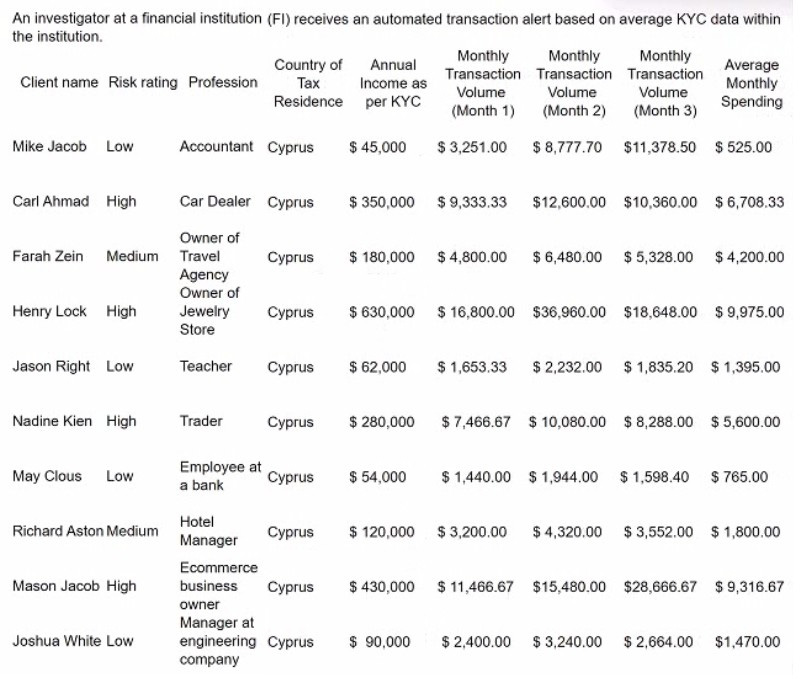
A. Complete the monthly review and note the activity for next month's review.
B. File a SAR/STR on the account activity in relation to a potential funnel account.
C. Recommend the account for exit due to frequent global transactions.
D. No further action is required as the customer is already rated at high-risk and the monthly spending is within expectations.
Questions 13
A client that runs a non-profit organization that aids refugees in leaving their home countries received a remittance from a money services business that was ten times the average. The client was recently detained for providing falsified passports to illegal immigrants. Which predicate offenses could be considered in the SAR/STR? (Select Two.)
A. Human smuggling/trafficking
B. Terrorist financing
C. Narcotics trafficking
D. Antiques smuggling
E. Tax evasion


Home | About Us | Contact Us | FAQ | Guarantee Policy | Privacy Policy
Any charges made through this site will appear as Global Simulators Limited. All trademarks are the property of their respective owners.
Copyright © 2004-2026 pass2lead.com, All Rights Reserved.