

CAU305 Online Practice Questions and Answers
Questions 4
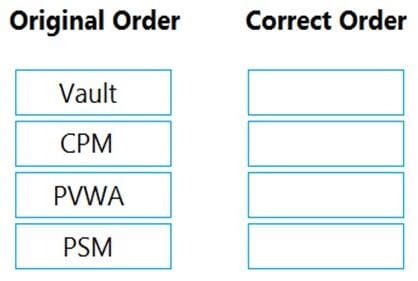
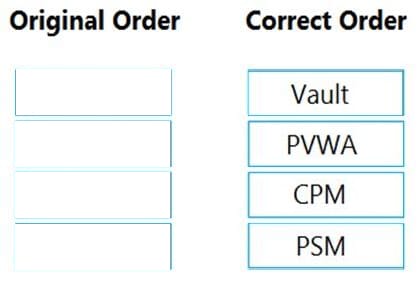
In version 10.7 the correct order of installation for components changed.
Make the necessary corrections to the list below to show the new installation order.
Select and Place:
Questions 6
When a DR Vault Server becomes an active vault, it will automatically revert back to DR mode once the Primary Vault comes back online.
A. True, this is the default behavior.
B. False, the Vault administrator must manually set the DR Vault to DR mode by setting "FailoverMode=no" in the padr.ini file.
C. True, if the AllowFailback setting is set to "yes" in the padr.ini file.
D. False, the Vault administrator must manually set the DR Vault to DR mode by setting "FailoverMode=no" in the dbparm.ini file.
Questions 7
When managing SSH keys, the Central Policy Manager (CPM) stores the private key __________.
A. in the Vault
B. on the target server
C. in the Vault and on the target server
D. nowhere because the private key can always be generated from the public key
Questions 8
After the Vault server is installed, the Microsoft Windows firewall is now commandeered by the Vault.
Can the administrator change these firewall rules?
A. Yes, but the administrator can only modify the firewall rules by editing the dbparm.ini file and the restarting the Vault.
B. Yes, the administrator can still modify firewall rules via the Windows firewall interface.
C. No, the Vault does not permit any changes to the firewall due to security requirements.
D. Yes, but the administrator can only modify the firewall rules by editing the FirewallRules.ini file and the restarting the Vault.
Questions 9
When a DR Vault Server becomes an active vault, it will automatically fail back to the original state once the Primary Vault comes back online.
A. True, this is the default behavior.
B. False, this is not possible.
C. True, if the AllowFailback setting is set to "yes" in the padr.ini file.
D. True, if the AllowFailback setting is set to "yes" in the dbparm.ini file.
Questions 10
What is the purpose of EVD?
A. To extract vault metadata into an open database platform.
B. To allow editing of vault metadata.
C. To create a backup of the MySQL database.
D. To extract audit data from the vault.
Questions 11
Which of the following Privileged Session Management (PSM) solutions provide a detailed audit log of session activities?
A. PSM (i.e., launching connections by clicking on the connect button in the PVWA)
B. PSM for Windows (previously known as RDP Proxy)
C. PSM for SSH (previously known as PSM-SSH Proxy)
D. All of the above
Questions 12
If a user is a member of more than one group that has authorizations on a Safe, by default that user is granted __________.
A. the Vault will not allow this situation to occur
B. only those permissions that exist on the group added to the Safe first
C. only those permissions that exist in all groups to which the user belongs
D. the cumulative permissions of all the groups to which that user belongs
Questions 13
The password upload utility must run from the Central Policy Manager (CPM) server.
A. True
B. False


Home | About Us | Contact Us | FAQ | Guarantee Policy | Privacy Policy
Any charges made through this site will appear as Global Simulators Limited. All trademarks are the property of their respective owners.
Copyright © 2004-2026 pass2lead.com, All Rights Reserved.