

CBEST-SECTION-2 Online Practice Questions and Answers
Questions 4
(1)
Produced in 1959, Lorraine Hansberrys play, A Raisin in the Sun, was a quietly revolutionary work that depicted African-American life in a fresh, new, and realistic way. The play made her the youngest American, the first African-American,
and the fifth woman to win the New York Drama Critics Circle Award for Best
Play of the Year. In 1961, it was produced as a film starring Sydney Poitier and has since become a classic, providing inspiration for an entire generation of
African-American writers.
(2)
Hansberry was not only an artist but also a political activist and the daughter of activists. Born in Chicago in 1930, she was a member of a prominent family devoted to civil rights.Her father was a successful real-estate broker, who won an
anti-segregation case before the Illinois Supreme Court in the mid-1930s, and her uncle was a Harvard professor. In her home, Hansberry was privileged to meet many influential cultural and intellectual leaders. Among them were artists and
activists such as Paul Robeson, W.E.B. DuBois, and Langston Hughes.
(3)
The success of A Raisin in the Sun helped gain an audience for her passionate views on social justice. It mirrors one of Hansberrys central artistic efforts, that of freeing many people from the smothering effects of stereotyping by depicting
the wide array of personality types and aspirations that exist within one Southside
Chicago family. A Raisin in the Sun was followed by another play, produced in 1964, The Sign in Sidney Brusteins Window. This play is about an intellectual in
Greenwich Village, New York City, a man who is open-minded and generous of spirit who, as Hansberry wrote, "cares about it all. It takes too much energy not to care."
(4)
Lorraine Hansberry died on the final day of the plays run on Broadway. Her early death, at the age of 34, was unfortunate, as it cut short a brilliant and promising career, one that, even in its short span, changed the face of American
theater. After her death, however, her influence continued to be felt. A dramatic adaptation of her autobiography, To Be Young, Gifted, and Black, consisted of vignettes based on Hansberrys plays, poems, and other writings. It was produced
Off-Broadway in 1969 and appeared in book form the following year.Her play, Les Blancs, a drama set in Africa, was produced in 1970; and A Raisin in the Sun was adapted as a musical, Raisin, and won a Tony award in 1973.
(5)
Even after her death, her dramatic works have helped gain an audience for her essays and speeches on wide-ranging topics, from world peace to the evils of the mistreatment of minorities, no matter what their race, and especially for her
works on the civil-rights struggle and on the effort by Africans to be free of colonial rule. She was a woman,much like the characters in her best-known play, who was determined to be free of racial, cultural, or genderbased constraints.
On the basis of above passage please answer the following question.
By including paragraphs 4 and 5, the author most likely intended to show that
A.
the civil-rights struggle continued even after Hansberry died.
B.
Hansberry actually wrote more poems and essays than she did plays.
C.
Raisin in the Sun was more successful after Hansberry's death than it was before she died.
D.
Hansberry's work continued to influence people even after her death.
E.
Hansberry died unusually young.
Questions 5
INDEX fire protection, 5155, 108, 115 forest conflicts: European, 8, 9193, 116117, 133134, 186188 forest destruction and ecological decline, 143; and fire, 3135; and industrialization, 156173; and railways 2729; and scientific forestry, 6061; and villagers, 107, 115116; and World Wars, 4243, forest fires, 72, 87, 100105, 124; and pasture, 48, 5153, 115118; arson, 51, 122, 126130; see also fire protection forest law: breaches of, 3441, 4952, 55, 70, 115116, 121123; see also forest conflicts forest management: and agrarian economy, 104105, 121, 186189; and imperial needs, 28, 35; and slash-and-burn farming, 1218, 48; and commercial orientation of, 3032; peasant resistance to, 6976, 89, 99106 On the basis of above Index please answer the following question On the basis of the index, on which page would you be most likely to find information about the outlawed practice of burning forested areas to create fields for grazing small herds of livestock?
A. page 89
B. page 55
C. page 107
D. page 48
E. page 51
Questions 6
1) The Woodstock Music and Art Fair—better known to its participants and to history simply as "Woodstock"-should have been a colossal failure. 2) Just a month prior to its August 15, 1969 opening, the fairs organizers were informed by the council of Wallkill, New York, that permission to hold the festival was withdrawn. 3) Amazingly, not only was a new site found, but word got out to the public of the fairs new location. 4) At the new site, fences that were supposed to facilitate ticket collection never materialized, and all attempts at gathering tickets were abandoned. 5)Crowd estimates of 30,000 kept rising; by the end of the three days, some estimated the crowd at 500,000. 6) And then, on opening night, it began to rain. 7) Off and on, throughout all three days, huge summer storms rolled over the gathering. 8) In spite of these problems, most people think of Woodstock not only as a fond memory but as the defining moment for an entire generation. On the basis of above passage please answer the following question Which of the following would be the most appropriate title for this passage?
A. Woodstock as Metaphor
B. Backstage at Woodstock
C. Woodstock: From The Band to The Who
D. Remembering Woodstock
E. Woodstock: The Untold Story
Questions 7
(1)
Milton Hershey was born near the small village of Derry Church, Pennsylvania, in 1857. It was a modest beginning that did not foretell his later popularity. Milton only attended school through the fourth grade; at that point, he was apprenticed to a printer in a nearby town. Fortunately for all chocolate lovers,Milton did not excel as a printer. After a while, he left the printing business and was apprenticed to a Lancaster, Pennsylvania, candy maker. It was apparent he had found his calling in life and, at the age of eighteen, he opened his own candy store in Philadelphia. In spite of his talents as a candy maker, the shop failed after six years. (2)Milton Hersheys fans today may be surprised to learn that his first candy success came with the manufacture of caramel. After the failure of his Philadelphia store, Milton headed for Denver, where he learned the art of caramel making. There he took a job with a local manufacturer who insisted on using fresh milk in making his caramels; Milton saw that this made the caramels especially tasty. After a time in Denver, he once again attempted to open his own candy-making businesses, in Chicago, New Orleans, and New York City. Finally, in 1886, he went to Lancaster, Pennsylvania, where he raised the money necessary to try again. This companythe Lancaster Caramel Companymade Miltons reputation as a master candy maker. (3) In 1893, Milton attended the Chicago International Exposition, where he saw a display of German chocolate-making implements. Captivated by the equipment, he purchased it for his Lancaster candy factory and began producing chocolate, which he used for coating his caramels. By the next year, production had grown to include cocoa, sweet chocolate, and baking chocolate. The Hershey Chocolate company was born in 1894 as a subsidiary of the Lancaster Caramel Company. Six years later, Milton sold the caramel company, but retained the rights, and the equipment, to make chocolate. He believed that a large market of chocolate consumers was waiting for someone to produce reasonably priced candy. He was right. (4)Milton Hershey returned to the village where he had been born, in the heart of dairy country, and opened his chocolate-manufacturing plant. With access to all the fresh milk he needed, he began producing the finest milk chocolate. The plant that opened in a small Pennsylvania village in 1905 is today the largest chocolate factory in the world. The confections created at this facility are favorites in the U.S. and internationally. (5) The area where the factory is located is now known as Hershey, Pennsylvania. Within the first decades of its existence, the town thrived, as did the chocolate business. A bank, a school, churches, a department store, even a park and a trolley system all appeared in short order. Soon, the town even had a zoo. Today, a visit to the area reveals the Hershey Medical Center, Milton Hershey School, and Hersheys Chocolate World, a theme park where visitors are greeted by a giant Reeses Peanut Butter Cup. All of these thingsand a huge number of happy chocolate loverswere made possible because a caramel maker visited the Chicago Exposition of 1893! On the basis of above passage please answer the following question As it is used in paragraph 1, the underlined phrase found his calling in life most nearly means
A.
became educated.
B.
discovered a vocation.
C.
was a talented person.
D.
called on other people to help him.
E.
had good luck.
Questions 8
(1)
Milton Hershey was born near the small village of Derry Church, Pennsylvania, in 1857. It was a modest beginning that did not foretell his later popularity. Milton only attended school through the fourth grade; at that point, he was apprenticed to a printer in a nearby town. Fortunately for all chocolate lovers,Milton did not excel as a printer. After a while, he left the printing business and was apprenticed to a Lancaster, Pennsylvania, candy maker. It was apparent he had found his calling in life and, at the age of eighteen, he opened his own candy store in Philadelphia. In spite of his talents as a candy maker, the shop failed after six years. (2)Milton Hersheys fans today may be surprised to learn that his first candy success came with the manufacture of caramel. After the failure of his Philadelphia store, Milton headed for Denver, where he learned the art of caramel making. There he took a job with a local manufacturer who insisted on using fresh milk in making his caramels; Milton saw that this made the caramels especially tasty. After a time in Denver, he once again attempted to open his own candy-making businesses, in Chicago, New Orleans, and New York City. Finally, in 1886, he went to Lancaster, Pennsylvania, where he raised the money necessary to try again. This companythe Lancaster Caramel Companymade Miltons reputation as a master candy maker. (3) In 1893, Milton attended the Chicago International Exposition, where he saw a display of German chocolate-making implements. Captivated by the equipment, he purchased it for his Lancaster candy factory and began producing chocolate, which he used for coating his caramels. By the next year, production had grown to include cocoa, sweet chocolate, and baking chocolate. The Hershey Chocolate company was born in 1894 as a subsidiary of the Lancaster Caramel Company. Six years later, Milton sold the caramel company, but retained the rights, and the equipment, to make chocolate. He believed that a large market of chocolate consumers was waiting for someone to produce reasonably priced candy. He was right. (4)Milton Hershey returned to the village where he had been born, in the heart of dairy country, and opened his chocolate-manufacturing plant. With access to all the fresh milk he needed, he began producing the finest milk chocolate. The plant that opened in a small Pennsylvania village in 1905 is today the largest chocolate factory in the world. The confections created at this facility are favorites in the U.S. and internationally. (5) The area where the factory is located is now known as Hershey, Pennsylvania. Within the first decades of its existence, the town thrived, as did the chocolate business. A bank, a school, churches, a department store, even a park and a trolley system all appeared in short order. Soon, the town even had a zoo. Today, a visit to the area reveals the Hershey Medical Center, Milton Hershey School, and Hersheys Chocolate World, a theme park where visitors are greeted by a giant Reeses Peanut Butter Cup. All of these thingsand a huge number of happy chocolate loverswere made possible because a caramel maker visited the Chicago Exposition of 1893! On the basis of above passage please answer the following question The author most likely included the information in paragraph 5 in order to show that
A.
Hershey's chocolate factory was so successful that a whole town was built around it.
B.
people all over the world have become tourists in Hershey, Pennsylvania.
C.
Hershey's chocolate factory has now become a successful theme park.
D.
Hershey moved back to the town where he was born.
E.
the Hershey Chocolate Company manufactures both chocolate and caramel.
Questions 9
OConnell Street is the main thoroughfare of Dublin City. Although it is not a particularly long street, Dubliners will tell the visitor proudly that it is the widest street in all of Europe. This claim usually meets with protests, especially from French tourists, claiming the Champs Elysees of Paris as Europes widest street. But the witty Dubliner will not relinquish bragging rights easily and will trump the French visitor with a fine distinction: the Champs Elysees is a boulevard; OConnell is a street. Divided by several important monuments running the length of its center, the street is named for Daniel OConnell, an Irish patriot. _______________ ____________________________.OConnell stands high above the unhurried crowds of shoppers, business people, and students on a sturdy column, surrounded by four serene angels seated at each corner of the monuments base. Further up the street is the famous General Post Office that the locals affectionately call "the GPO." During the 1916 rebellion, the GPO was taken over and occupied by the Irish rebels to British rule, sparking weeks of armed combat in the citys center. To this day, the angels of OConnells monument bear the marks of the fighting: one sits reading calmly, apparently unaware of the bullet hole dimpling her upper arm; another, reaching out to stroke the ears of a huge bronze Irish wolfhound, has survived what should be a mortal wound to her heart. On the basis of above passage please answer the following question What is the best definition for the word "trump" as it is used in the first paragraph of the passage?
A. to trumpet loudly, to blare or drown out
B. to trample
C. to get the better of by using a key or hidden resource
D. to devise a fraud, to employ trickery
E. to use a particular suit of cards
Questions 10
In 1899, Czar Nicholas II of Russia invited the nations of the world to a conference at The Hague. This conferenceand a follow-up organized by Theodore Roosevelt in 1907ushered in a period of vigorous growth in international law. This growth was in response to several factors, not least of which was the increasing potential for destruction of modern warfare. The recently concluded Civil War in the United States made this potential clear. During this growth, the subjects of international law were almost exclusively restricted to the relationships that countries had with one another. Issues of trade and warfare dominated both the disputes and the agreements of the period. _________, the developments of this period paved the way for further expansion of international law, which has occurred in the last several years. ________, organizations such as the United Nations and the International Court of Justice are greatly concerned not only with the way countries deal with one another, but the ways in which they treat their own citizens. On the basis of above passage please answer the following question Which words or phrases, if inserted in order into the blanks in the passage, would help the reader understand the sequence of the authors ideas?
A. Therefore; In addition
B. However; Now
C. Furthermore; Yet
D. Even if; On the other hand
E. As a result;Meanwhile
Questions 11
Emperor Charlemagne of the Franks was crowned in 800 A.D. The Frankish Empire at that time extended over what is now Germany, Italy, and France.
Charlemagne died in 814, but his brief reign marked the dawn of a distinctly European culture. The artists and thinkers that helped create this European civilization drew on the ancient texts of the Germanic, Celtic, Greek, Roman, Hebrew,
and Christian worlds. __________________________________________. These mores in turn laid the groundwork for the laws, customs, and even attitudes of todays Europeans.
On the basis of above passage please answer the following question
Which of the following is the best meaning of the word "culture" as it is used in the passage?
A. the fashionable class
B. a community of inter-related individuals
C. a partnership
D. a group of loosely associated outsiders
E. an organized group with a common goal
Questions 12
A narrow fellow in the grass Occasionally rides;
You may have met him did you not?
His notice sudden is.
The grass divides as with a comb,
A spotted shaft is seen,
And then it closes at your feet And opens further on.
He likes a boggy acre,
A floor too cool for corn,
Yet when a boy, and barefoot,
I more than once at noon Have passed, I thought, a whip-lash
Unbraiding in the sun,
When, stooping to secure it,
It wrinkled, and was gone.
Several of natures people I know and they know me;
I feel for them a transport Of cordiality;
But never met this fellow,
Attended or alone,
Without a tighter breathing And zero at the bone.
On the basis of above poem please answer the following question
The phrase "Without a tighter breathing / And zero at the bone" most nearly indicates
A. fright.
B. cold.
C. grief.
D. awe.
E. relief.
Questions 13
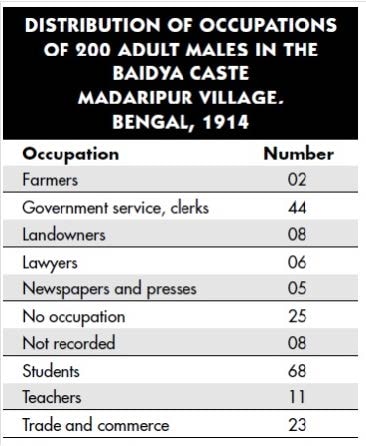
On the basis of above table please answer the following question What percentage of the Baidya caste men are employed in the legal profession?
A. 12%
B. 0.3%
C. 6%
D. 3%
E. 1.2%


Home | About Us | Contact Us | FAQ | Guarantee Policy | Privacy Policy
Any charges made through this site will appear as Global Simulators Limited. All trademarks are the property of their respective owners.
Copyright © 2004-2026 pass2lead.com, All Rights Reserved.