

CPA-21-02 Online Practice Questions and Answers
Questions 4
What happens when you attempt to compile and run the following code?
#include
using namespace std;
class BaseClass
{
public:
int *ptr;
BaseClass(int i) { ptr = new int(i); }
~BaseClass() { delete ptr; delete ptr;}
void Print() { cout << *ptr; }
};
void fun(BaseClass x);
int main()
{
BaseClass o(10);
fun(o);
o.Print();
}
void fun(BaseClass x) {
cout << "Hello:";
}
A. It prints: Hello:1
B. It prints: Hello:
C. It prints: 10
D. Runtime error.
Questions 5
Which statement should be added in the following program to make work it correctly?
using namespace std;
int main (int argc, const char * argv[])
{
cout<<"Hello";
}
A. #include
B. #include
C. #include
D. #include
Questions 6
What happens when you attempt to compile and run the following code?
#include
using namespace std;
int main()
{
const int x=0;
const int *ptr;
ptr = andx;
cout<<*ptr;
return 0;
}
A. It prints: 0
B. It prints address of x
C. It prints: 1
D. Compilation error
Questions 7
What happens when you attempt to compile and run the following code?
#include
using namespace std;
namespace myNamespace1
{
int x = 5;
int y = 10;
}
namespace myNamespace2
{
float x = 3.14;
float y = 1.5;
}
int main () {
{
using namespace myNamespace1;
cout << x << " ";
}{
using namespace myNamespace2;
cout << y;
}
return 0;
}
A. It prints: 5 1.5
B. It prints: 3.14 10
C. Compilation error
D. None of these
Questions 8
What happens when you attempt to compile and run the following code?
#include
using namespace std;
int op(int x, int y);
float op(int x, float y);
int main()
{
int i=1, j=2, k;
float f=0.3;
k = op(i, j);
cout<< k << "," << op(0, f);
return 0;
}
int op(int x, int y)
{
return x+y;
}
float op(int x, float y)
{
return x?y;
}
A. It prints: 3,1
B. It prints: 3,?0.3
C. It prints: 3,0
D. It prints: 0,0
Questions 9
What happens when you attempt to compile and run the following code?
#include
using namespace std;
class A {
public:
void Print(){ cout<<"A";}
};
class B:public A {
public:
virtual void Print(){ cout<< "B";}
};
class C:public B {
public:
void Print(){ cout<< "C";}
};
int main()
{
A ob1;
B ob2;
C ob3;
B *obj;
obj = andob2;
obj?>Print();
obj = andob3;
obj?>Print();
}
A. It prints: BB
B. It prints: AA
C. It prints: BC
D. It prints: AB
Questions 10
Which line of code inserted instead of the comment will make the following code run properly without causing memory leaks?
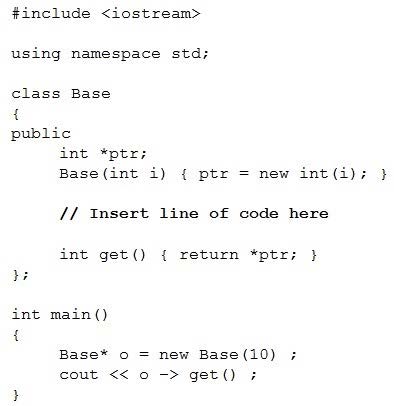
A. ~Base() ( delete this; }
B. no additional code is needed
C. ~Base() { delete ptr; delete ptr; }
D. ~Base() { delete ptr; }
Questions 11
What happens when you attempt to compile and run the following code?
#include
using namespace std;
int op(int x, int y);
int main()
{
int i=2, j=2, k;
float f=0.3;
k = op(i, j);
cout<< k << "," << op(1, f);
return 0;
}
int op(int x, int y)
{
return x+y;
}
A. It prints: 4,1
B. It prints: 4,0.7
C. It prints: 4,0
D. It prints: 0,4
Questions 12
If there is one, point out an error in the program
#include
using namespace std;
int main()
{
int c = 'a';
switch(i)
{
case '2':
cout<<"OK";
case '1':
cout<<"Error";
default:
break;
}
return 0;
}
A. No Error
B. Use of undeclared identifier 'i'
C. Illegal use of 'continue'
D. Illegal use of 'break'
Questions 13
What happens when you attempt to compile and run the following code?
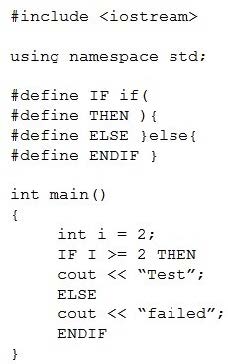
A. It causes a compilation error
B. It prints: Tesc failed
C. .It prints: failed
D. It prints: Tesc


Home | About Us | Contact Us | FAQ | Guarantee Policy | Privacy Policy
Any charges made through this site will appear as Global Simulators Limited. All trademarks are the property of their respective owners.
Copyright © 2004-2026 pass2lead.com, All Rights Reserved.