

DATABRICKS-CERTIFIED-PROFESSIONAL-DATA-SCIENTIST Online Practice Questions and Answers
Questions 4
You are working on a problem where you have to predict whether the claim is done valid or not. And you find that most of the claims which are having spelling errors as well as corrections in the manually filled claim forms compare to the honest claims. Which of the following technique is suitable to find out whether the claim is valid or not?
A. Naive Bayes
B. Logistic Regression
C. Random Decision Forests
D. Any one of the above
Questions 5
You are creating a model for the recommending the book at Amazon.com, so which of the following recommender system you will use you don't have cold start problem?
A. Naive Bayes classifier
B. Item-based collaborative filtering
C. User-based collaborative filtering
D. Content-based filtering
Questions 6
In which lifecycle stage are appropriate analytical techniques determined?
A. Model planning
B. Model building
C. Data preparation
D. Discovery
Questions 7
In which of the following scenario we can use naTve Bayes theorem for classification
A. Classify whether a given person is a male or a female based on the measured features. The features include height, weight and foot size.
B. To classify whether an email is spam or not spam
C. To identify whether a fruit is an orange or not based on features like diameter, color and shape
Questions 8
Logistic regression is a model used for prediction of the probability of occurrence of an event. It makes use of several variables that may be......
A. Numerical
B. Categorical
C. Both 1 and 2 are correct
D. None of the 1 and 2 are correct
Questions 9
Suppose A, B , and C are events. The probability of A given B , relative to P(|C), is the same as the probability of A given B and C (relative to P ). That is,
A. P(A,B|C) P(B|C) =P(A|B,C)
B. P(A,B|C) P(B|C) =P(B|A,C)
C. P(A,B|C) P(B|C) =P(C|B,C)
D. P(A,B|C) P(B|C) =P(A|C,B)
Questions 10
You are using one approach for the classification where to teach the agent not by giving explicit categorizations, but by using some sort of reward system to indicate success, where agents might be rewarded for doing certain actions and
punished for doing others.
Which kind of this learning?
A. Supervised
B. Unsupervised
C. Regression
D. None of the above
Questions 11
Select the correct statement which applies to Supervised learning
A. We asks the machine to learn from our data when we specify a target variable.
B. Lesser machine's task to only divining some pattern from the input data to get the target variable
C. Instead of telling the machine Predict Y for our data X, we're asking What can you tell me about X?
Questions 12
Select the correct algorithm of unsupervised algorithm
A. K-Nearest Neighbors
B. K-Means
C. Support Vector Machines
D. Naive Bayes
Questions 13
Refer to the exhibit.
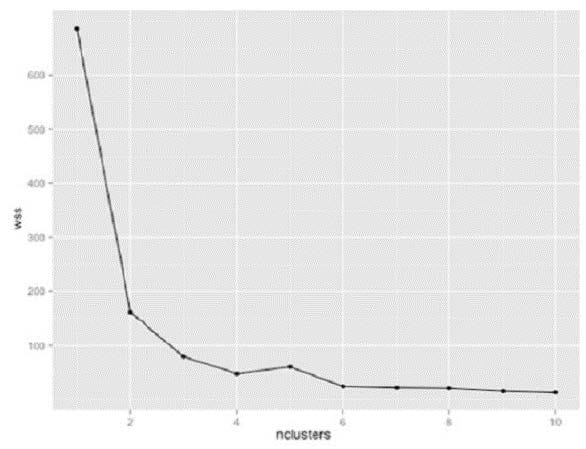
You are using K-means clustering to classify customer behavior for a large retailer. You need to determine the optimum number of customer groups. You plot the within-sum-of- squares (wss) data as shown in the exhibit. How many customer groups should you specify?
A. 2
B. 3
C. 4
D. 8


Home | About Us | Contact Us | FAQ | Guarantee Policy | Privacy Policy
Any charges made through this site will appear as Global Simulators Limited. All trademarks are the property of their respective owners.
Copyright © 2004-2026 pass2lead.com, All Rights Reserved.