

DATABRICKS-MACHINE-LEARNING-PROFESSIONAL Online Practice Questions and Answers
Questions 4
Which of the following describes concept drift?
A. Concept drift is when there is a change in the distribution of an input variable
B. Concept drift is when there is a change in the distribution of a target variable
C. Concept drift is when there is a change in the relationship between input variables and target variables
D. Concept drift is when there is a change in the distribution of the predicted target given by the model
E. None of these describe Concept drift
Questions 5
Which of the following describes label drift?
A. Label drift is when there is a change in the distribution of the predicted target given by the model
B. None of these describe label drift
C. Label drift is when there is a change in the distribution of an input variable
D. Label drift is when there is a change in the relationship between input variables and target variables
E. Label drift is when there is a change in the distribution of a target variable
Questions 6
A machine learning engineer and data scientist are working together to convert a batch deployment to an always-on streaming deployment. The machine learning engineer has expressed that rigorous data tests must be put in place as a part
of their conversion to account for potential changes in data formats.
Which of the following describes why these types of data type tests and checks are particularly important for streaming deployments?
A. Because the streaming deployment is always on, all types of data must be handled without producing an error
B. All of these statements
C. Because the streaming deployment is always on, there is no practitioner to debug poor model performance
D. Because the streaming deployment is always on, there is a need to confirm that the deployment can autoscale
E. None of these statements
Questions 7
A machine learning engineering team wants to build a continuous pipeline for data preparation of a machine learning application. The team would like the data to be fully processed and made ready for inference in a series of equal-sized
batches.
Which of the following tools can be used to provide this type of continuous processing?
A. Spark UDFs
B. Structured Streaming
C. MLflow
D. Delta Lake
E. AutoML
Questions 8
A data scientist has written a function to track the runs of their random forest model. The data scientist is changing the number of trees in the forest across each run. Which of the following MLflow operations is designed to log single values like the number of trees in a random forest?
A. mlflow.log_artifact
B. mlflow.log_model
C. mlflow.log_metric
D. mlflow.log_param
E. There is no way to store values like this.
Questions 9
Which of the following is a benefit of logging a model signature with an MLflow model?
A. The model will have a unique identifier in the MLflow experiment
B. The schema of input data can be validated when serving models
C. The model can be deployed using real-time serving tools
D. The model will be secured by the user that developed it
E. The schema of input data will be converted to match the signature
Questions 10
A data scientist set up a machine learning pipeline to automatically log a data visualization with each run. They now want to view the visualizations in Databricks. Which of the following locations in Databricks will show these data visualizations?
A. The MLflow Model Registry Model page
B. The Artifacts section of the MLflow Experiment page
C. Logged data visualizations cannot be viewed in Databricks
D. The Artifacts section of the MLflow Run page
E. The Figures section of the MLflow Run page
Questions 11
A machine learning engineer has developed a model and registered it using the FeatureStoreClient fs. The model has model URI model_uri. The engineer now needs to perform batch inference on customer-level Spark DataFrame spark_df,
but it is missing a few of the static features that were used when training the model. The customer_id column is the primary key of spark_df and the training set used when training and logging the model.
Which of the following code blocks can be used to compute predictions for spark_df when the missing feature values can be found in the Feature Store by searching for features by customer_id?
A. df = fs.get_missing_features(spark_df, model_uri) fs.score_model(model_uri, df)
B. fs.score_model(model_uri, spark_df)
C. df = fs.get_missing_features(spark_df, model_uri) fs.score_batch(model_uri, df)
D. df = fs.get_missing_features(spark_df) fs.score_batch(model_uri, df)
E. fs.score_batch(model_uri, spark_df)
Questions 12
A machine learning engineer wants to move their model version model_version for the MLflow Model Registry model model from the Staging stage to the Production stage using MLflow Client client. Which of the following code blocks can they use to accomplish the task?
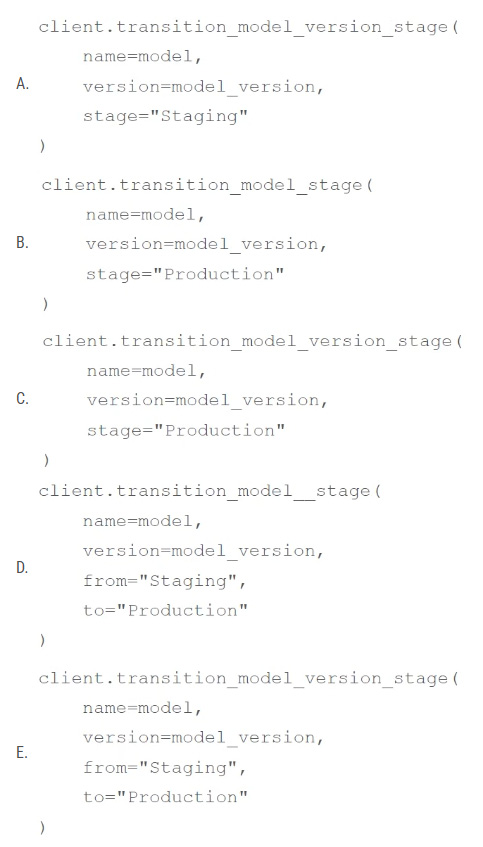
A. Option A
B. Option B
C. Option C
D. Option D
E. Option E
Questions 13
A machine learning engineer wants to move their model version model_version for the MLflow Model Registry model model from the Staging stage to the Production stage using MLflow Client client. At the same time, they would like to archive any model versions that are already in the Production stage.
Which of the following code blocks can they use to accomplish the task?

A. Option A
B. Option B
C. Option C
D. Option D
E. Option E


Home | About Us | Contact Us | FAQ | Guarantee Policy | Privacy Policy
Any charges made through this site will appear as Global Simulators Limited. All trademarks are the property of their respective owners.
Copyright © 2004-2026 pass2lead.com, All Rights Reserved.