

DP-300 Online Practice Questions and Answers
Questions 4
You need to provide an implementation plan to configure data retention for ResearchDB1. The solution must meet the security and compliance requirements.
What should you include in the plan?
A. Configure the Deleted databases settings for ResearchSrv01.
B. Deploy and configure an Azure Backup server.
C. Configure the Advanced Data Security settings for ResearchDB1.
D. Configure the Manage Backups settings for ResearchSrv01.
Questions 5
You have several Azure SQL databases on the same Azure SQL Database server in a resource group named ResourceGroup1.
You must be alerted when CPU usage exceeds 80 percent for any database. The solution must apply to any additional databases that are created on the Azure SQL server.
Which resource type should you use to create the alert?
A. Resource Groups
B. SQL Servers
C. SQL Databases
D. SQL Virtual Machines
Questions 6
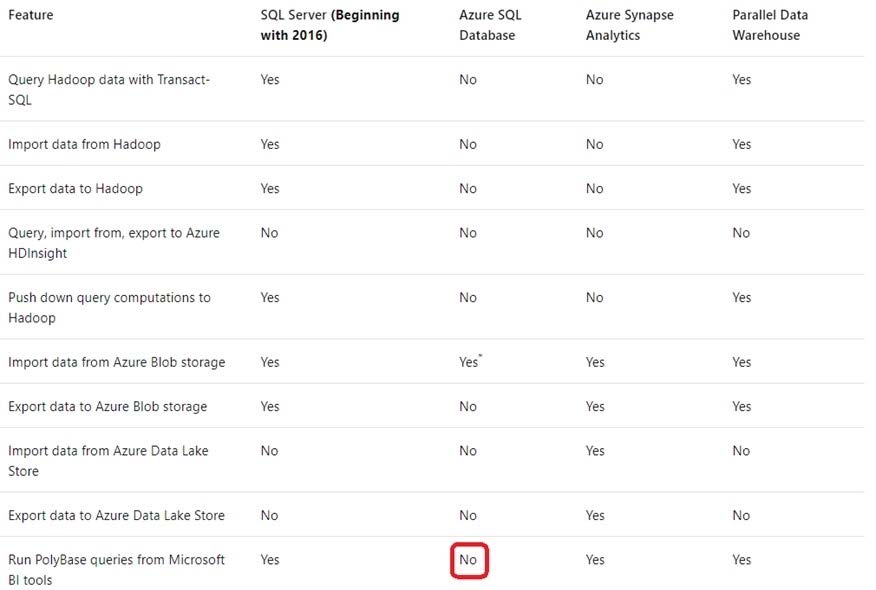
You have a Microsoft SQL Server 2019 database named DB1 that uses the following database-level and instance-level features.
1.
Clustered columnstore indexes
2.
Automatic tuning
3.
Change tracking
4.
PolyBase
You plan to migrate DB1 to an Azure SQL database.
What feature should be removed or replaced before DB1 can be migrated?
A. Clustered columnstore indexes
B. PolyBase
C. Change tracking
D. Automatic tuning
Questions 7
You have an Azure subscription that contains an Azure SQL database named SQL1.
SQL1 is in an Azure region that does not support availability zones.
You need to ensure that you have a secondary replica of SQL1 in the same region.
What should you use?
A. log shipping
B. auto-failover groups
C. active geo-replication
D. Microsoft SQL Server failover clusters
Questions 8
You have an on-premises datacenter that contains a 14-TB Microsoft SQL Server database.
You plan to create an Azure SQL managed instance and migrate the on-premises database to the new instance.
Which three service tiers support the SQL managed instance? Each correct answer presents a complete solution.
NOTE: Each correct selection is worth one point.
A. General Purpose Standard
B. Business Critical Memory Optimized Premium
C. General Purpose Premium
D. Business Critical Premium
E. Business Critical Standard
Questions 9
You have an Azure SQL database named DB1.
You need to ensure that DB1 will support automatic failover without data loss if a datacenter fails. The solution must minimize costs.
Which deployment option and pricing tier should you configure?
A. Azure SQL Database Premium
B. Azure SQL Database serverless
C. Azure SQL Database managed instance General Purpose
D. Azure SQL Database Hyperscale
Questions 10
HOTSPOT
You are performing exploratory analysis of bus fare data in an Azure Data Lake Storage Gen2 account by using an Azure Synapse Analytics serverless SQL pool.
You execute the Transact-SQL query shown in the following exhibit.
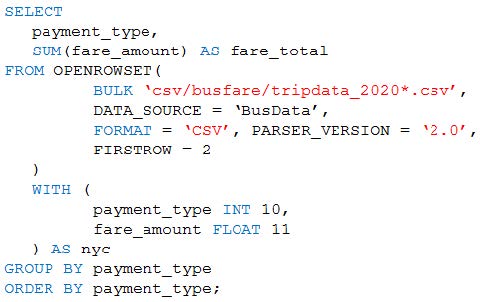
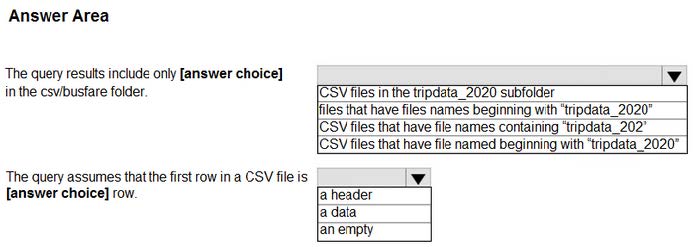
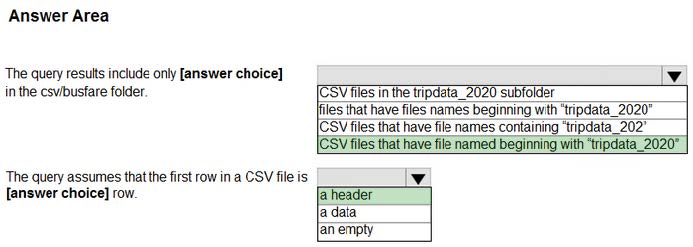
Use the drop-down menus to select the answer choice that completes each statement based on the information presented in the graphic.
Hot Area:
Questions 11
HOTSPOT
You have an Azure subscription.
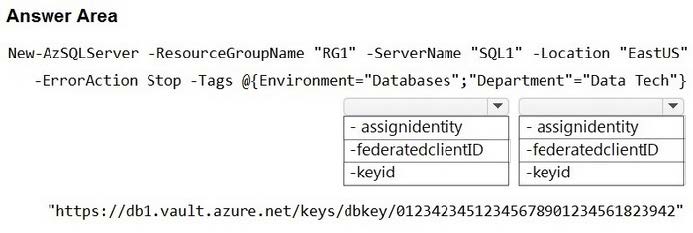
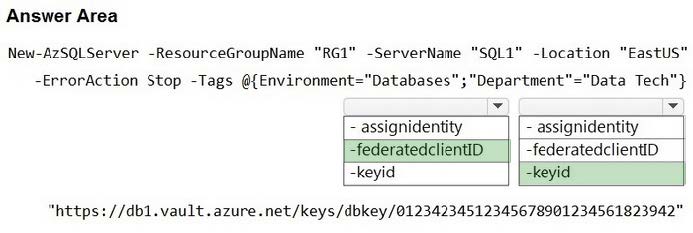
You need to deploy a logical SQL server by using PowerShell. The solution must ensure that the logical SQL server can create Azure AD users and provide Transparent Data Encryption (TDE) with a customer-managed key.
How should you complete the command? To answer, select the appropriate options in the answer area.
NOTE: Each correct selection is worth one point.
Hot Area:
Questions 12
HOTSPOT
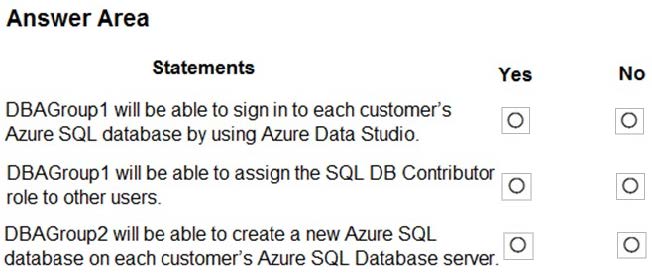
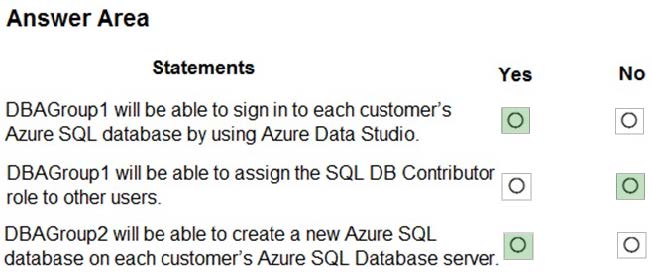
You are evaluating the role assignments.
For each of the following statements, select Yes if the statement is true. Otherwise, select No.
NOTE: Each correct selection is worth one point.
Hot Area:
Questions 13
DRAG DROP
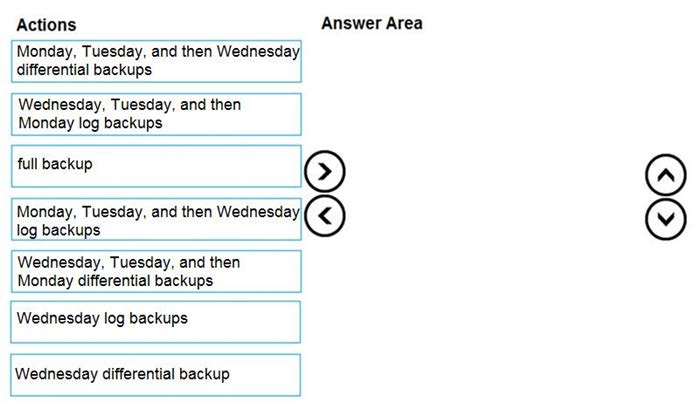
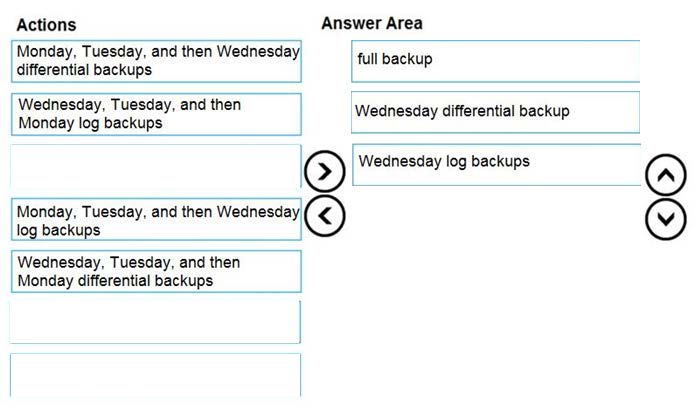
You have SQL Server on an Azure virtual machine that contains a database named DB1. DB1 is 30 TB and has a 1-GB daily rate of change.
You back up the database by using a Microsoft SQL Server Agent job that runs Transact-SQL commands. You perform a weekly full backup on Sunday, daily differential backups at 01:00, and transaction log backups every five minutes.
The database fails on Wednesday at 10:00.
Which three backups should you restore in sequence? To answer, move the appropriate backups from the list of backups to the answer area and arrange them in the correct order.
Select and Place:


Home | About Us | Contact Us | FAQ | Guarantee Policy | Privacy Policy
Any charges made through this site will appear as Global Simulators Limited. All trademarks are the property of their respective owners.
Copyright © 2004-2026 pass2lead.com, All Rights Reserved.