

E20-807 Online Practice Questions and Answers
Questions 4
What is requirement when setting up a Composite Group (CG) for SRDF/Star in an open systems environment?
A. Composite Group is created with the Star Build CG action
B. Composite Group is created with the type set to ANY
C. Recovery group assignments should match the recovery groups defined in the Star Options file
D. Names assigned to RDF groups match the site names in the Star Options file
Questions 5
SRDF/Metro has been deployed between two data centers. SRDF/Metro is operating normally. Maintenance tasks at the R1 data center require the array to be offline.
Which SRDF operation should be executed on the Metro RDF pairs to facilitate the planned outage without affecting application I/O?
A. Failover
B. Split with bias set to R2
C. Suspend with bias set to R2
D. Swap
Questions 6
While analyzing performance of a VMAX3 array, the following details are observed?
High host response time Low FE response time High host CPU utilization
What should be investigated further?
A. SAN connectivity
B. Disk delays
C. I/O queuing on the host
D. I/O queuing on the frontend
Questions 7
A VDI deployment is planned for an environment that consists of VMAX3 and XtremIO. The data will have a high degree of deduplication and will require QoS and VVOL support. How can the existing infrastructure be leverage while minimizing increased storage capacity?
A. Use XtremIO for the new deployment
B. Use FAST.X with XtremIO for the new deployment
C. Add full capacity required for VMAX3
D. Add half the capacity required for the VMAX and use compression
Questions 8
Based on the exhibit, where is data considered to be in motion?
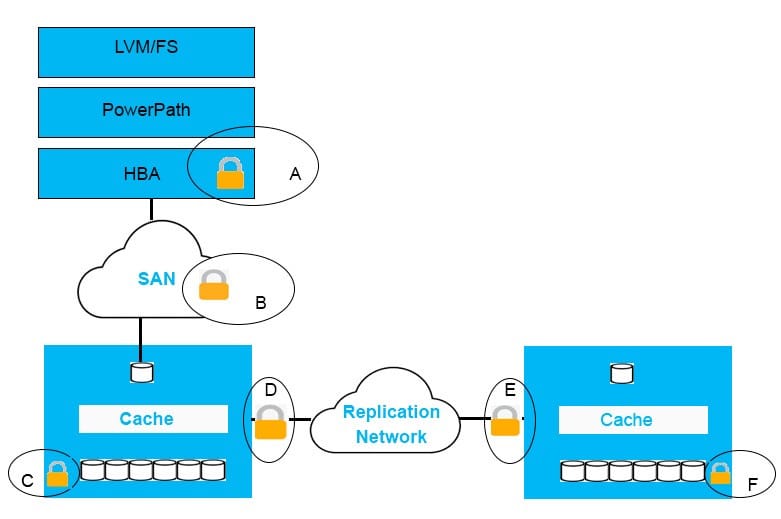
A. SAN and replication network
B. Host, SAN, and arrays
C. Host and arrays
D. SAN, arrays, and replication network
Questions 9
When FAST.X is used to access five VNX arrays from a single VMAX3, what is the minimum number of DX ports required?
A. 4
B. 10
C. 20
D. 40
Questions 10
What is the starting point for a new SRDF/Metro deployment?
A. Empty RDF group and Staging RDF group between two VMAX3 arrays SRDF pairs in a Staging group in a Suspended state
B. RDF group between two VMAX3 arrays SRDF pairs in an Active mode and a Suspended state
C. RDF group between two VMAX3 arrays SRDF pairs in a Suspended state
D. Empty RDF group between two VMAX3 arrays Non-SRDF devices on both arrays
Questions 11
A company is evaluating the deployment of SRDF/Star on VMAX3 arrays. One of the concerns is that the SRDF daemon represents a single point of failure.
How could this concern be addressed?
A. RDF daemon process runs on the embedded Tools Virtual Machines and has built-in high availability.
B. Run RDF daemons on multiple management stations at the workload site. RDF daemons will cooperate with each other.
C. Run an RDF daemon on one management station at each of the three sites. If the workload site RDF daemon fails, one of the RDF daemons from the other two sites will take over.
D. RDF daemon process runs on the VMAX3 array. If the workload site RDF daemon fails, the RDF daemon from one of the other sites will take over.
Questions 12
Performance analysis on a VMAX3 has shown that the current workload is 15,000 IOPS at an average response time of 13 ms. Workload will increase to 30,000 IOPS.
What will be the response time expectation?
A. 14 ms
B. Between 13-26 ms
C. 26 ms
D. Greater than 26 ms
Questions 13
Concurrent SRDF/Star has been implemented and Star protection has been enabled. The storage administrator wants to perform a planned switch of the workload to the Synchronous site. Which actions should the administrator perform before the switch?
A. halt Star and then Disconnect both target sites
B. Stop application I/O at the Workload site and then Halt Star
C. Stop application I/O at the Workload site and then Disable Star
D. Disable Star and then Halt Star


Home | About Us | Contact Us | FAQ | Guarantee Policy | Privacy Policy
Any charges made through this site will appear as Global Simulators Limited. All trademarks are the property of their respective owners.
Copyright © 2004-2026 pass2lead.com, All Rights Reserved.