

HP0-Y51 Online Practice Questions and Answers
Questions 4
A company is deploying an HP Unified Wired-Wireless controller solution with an HP BYOD solution. Guests will connect to an open Guest SSID and be redirected by their default gateway to a portal hosted by User Access Manager (UAM). The default gateway is a Comware routing device.
The administrator has set up portal authentication on the Comware device to implement the redirect. The administrator asks the BYOD solution designer about the correct RADIUS and domain settings for portal authentication on the switch. What should the BYOD solution designer explain to the administrator?
A. The administrator does not need to make any changes as long as the switch is managed by IMC. UAM will automatically access the managed switch and configure the correct settings.
B. These settings are not necessary because the UAM BYOD portal automatically handles the authentication and then forces the guest to reconnect the SSID and authenticate with MAC-Auth.
C. The RADIUS scheme and domain must be configured with the same settings that would be used for traditional portal authentication to UAM. In addition, the RADIUS scheme must use the standard server type.
D. The RADIUS scheme and domain must be configured with the same settings that would be used for traditional portal authentication to UAM. In addition, the RADIUS scheme must enable transparent MAC authentication.
Questions 5
Refer to the exhibit.
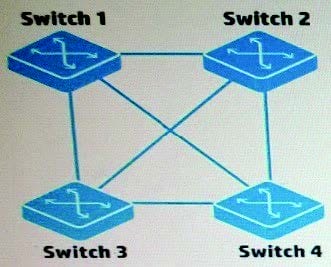
The switches shown in the exhibit use the HP VAN SDN Controller as the OpenFlow controller. They connect to the controller on their out-of-band management (OOBM) ports, but these connections are not shown in the exhibit. The switches also run spanning tree protocol. An SDN application installed on the HP VAN SDN Controller is programmed to discover live ports, find redundant paths, and create loopfree paths for traffic infrastructure shown in the exhibit. However the application is not able to complete these functions because the switches are reporting some ports as blocked.
What should the administrator do to let the application create the loopfree paths?
A. Disable spanning tree on the OpenFlow-enabled switches and do not configure link aggregation.
B. Enable spanning tree on the OpenFlow-enabled switches but set the application as the spanning tree flood parameter controller.
C. Enable spanning tree on the OpenFlow-enabled switches and configure all of the redundant links as egress-only-ports
D. Disable spanning tree on the OpenFlow-enabled switches and configure the redundant links as static link aggregations
Questions 6
A large shopping center has an HP BYOD solution with these requirements:
User Access Manager (UAM) should provide the portal in which guests register their own accounts.
Guests should only have to register and log in once. After that, the guest device automatically logs in by MAC address.
Each shop has its own SSID.
The administrator wants UAM to display a custom portal page to users based on the SSID to which they connect. What is the proper way to configure this solution?
A. In the guest access service, bind different SSIDs to different portal pages.
B. In the global guest registration settings, add an SSID map, which binds SSIDs to portal pages.
C. In the access service assigned to the BYOD Anonymous account, bind different SSIDs to different portal pages.
D. In the global portal settings, add an SSID map, which binds SSIDs to portal pages.
Questions 7
What is one benefit of the HP patent for Adaptive Multicast channel width and Guard Interval 802.11n?
A. HP APs can bind up to three channels together for any multicast transmissions in the 5 GHz frequency range, including 802.11a and 802.11n.
B. HP APs can adjust whether they send multicasts over a bonded channel based on the 802.11 standards supported on device in the current environment.
C. HP APs can adapt the precise frequency on which they transmit to each client, enabling them to transmit multicasts to more than one clients at the same time.
D. HP APs can transmit multicasts as broadcasts or unicasts, helping to ensure higher transmission rates and more reliable delivery for multicast.
Questions 8
An HP Unified Wired-Wireless controller is configured to enforce portal authentication on a Guest SSID. The company plans to use the local portal server on the controller but needs customized portal pages that show information about the company. What is one of the rules for customizing the pages?
A. Additional pages beyond the six main pages can be loaded, but every page must include the logon.cgi action.
B. Any number of pages can be loaded, but the six main pages must use the default filenames and include script for certain actions.
C. The customized local pages must call up pages that are hosted on an external Web server such as User Access Manager (UAM).
D. The portal can only use up to six pages, but the text and logo files on these pages can be customized as desired.
Questions 9
A company has three HP VAN SDN Controllers, which will be deployed in a team. The administrator is deciding whether to create one region or three regions. What is a benefit of creating three regions rather than one region?
A. The team can load balance the team leader role, increasing the total number of RESTful API and Java API calls that the solution can handle.
B. The team can provide high availability for SDN application functions rather than only for the OpenFlow controller functions rather than only for the OpenFlow controller functions.
C. The team can load balance the Master OpenFlow controller role, increasing the total number of packetin messages per second that the solution can handle.
D. The team can provide high availability for all the OpenFlow controller functions rather than only for the SDN application functions.
Questions 10
An administrator has set up an HP BYOD solution for an HP MSM760 controller and its APs.
These are the specifications:
Guests should only have to register and log in once After that, the guest device should be automatically logged in.
User Access Manager (UAM) provides the portal in which guests register their own accounts.
The MSM760 is connected to a Comware switch, which redirects unregistered guests to the UAM portal.
Currently guests can reach the portal, register for their accounts, and log in. However, guests report that they cannot reach the Internet after they log in. When the administrator asks the guests to disconnect from the wireless network and then connect again, they succeed in reaching the Internet.
What could fix this problem?
A. In the Comware switch settings, add the guest router to the free rule list
B. In the DHCP scope for the onboardmg VLAN, lower the lease time to about 10 seconds.
C. Configure SOAP settings for the MSM controller on UAM.
D. Configure the Comware switch to accept dynamic authorization updates from UAM.
Questions 11
An administrator is customizing an HP BYOD self-registration page. The administrator does not want guests to see the identity number field. Instead the User Access Manager (UAM) server should automatically choose a valid identity number for a guest account when the guest registers.
What are the correct settings for the identity number field in the customized page? (Select three)
A. Required
B. Fixed
C. Not required
D. Invisible
E. Random
F. Visible
Questions 12
Table of Acronyms
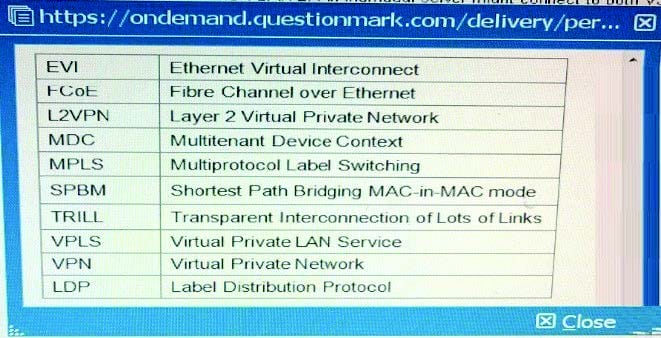
An administrator has configured an HP Comware IRF virtual device to support FCoE in Fibre Channel Forwarder (FCF) mode. The IRF device supports VLAN 1, 10, 20, and 30.
The device requires two virtual SANs (VSANs), VSAN 1 and VSAN 2. An individual server might connect to for binding the VSANs. What is valid configuration to VLANs?
A. VSAN 1 and VSAN 2 to VLAN 10
B. VSAN 1 and VSAN 2 to VLAN 1; VSAN 1 to VLAN 10; VSAN 2 to VLAN 20
C. VSAN 1 and VSAN 2 to VLAN 10; VSAN 1 and VSAN 2 to VLAN 20
D. VSAN 1 to VLAN 10; VSAN 2 to VLAN 20
Questions 13
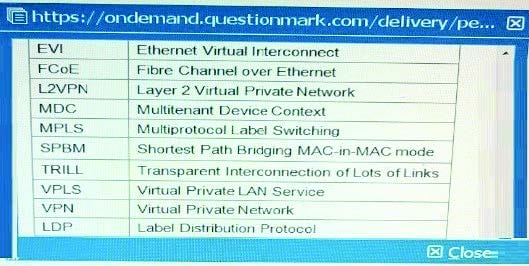
Table of Acronyms
Refer to the exhibit.
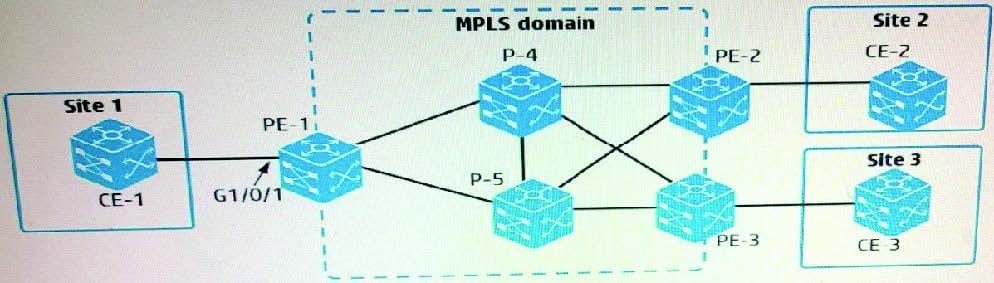
An administrator is setting up MPLS Layer 2 VPN connections between several customer sites:
Connection 1 = Customer site 1 to customer site 2
Connection 2 = Customer site 1 to customer site 3
On PE-1, interface GigabitEthernet1/0/1 connects to CE-1 at site 1. Which setup establishes the desired connections?
A. CE-1 connects to CE-2 in one VLAN, which it assigns to VPN instance 1. It connects to CE-3 in a different VLAN, which it assigns to VPN instance 2. PE-1 instant places G1/0/1 in both VPN instances 1 and 2 and associates each VPN instance with a PW for one of the connections.
B. CE-1 connects to CE-2 in one VLAN and to CE-3 in a different VLAN. PE-1 has two services instances on G1/D/1. One instance encapsulates one VLAN ID and has PW to PE-2, and the other instance encapsulates the other VLAN and has a PW to PE-3
C. PE-1 has two policy-based routing (PBR) policies, each of which selects traffic destined to Site 2 or Site 3. The appropriate policy is applied to the PW for each connection
D. CE-1 implements MPLS. It establishes two PWs with PE-1, one for its connection to CE-2 and one for its connection to CE-3. PE-1 maps the out label for the first PW to the in label for a PW to PE-2. It maps the labels similarly for a PW to PE-3.


Home | About Us | Contact Us | FAQ | Guarantee Policy | Privacy Policy
Any charges made through this site will appear as Global Simulators Limited. All trademarks are the property of their respective owners.
Copyright © 2004-2026 pass2lead.com, All Rights Reserved.