

HPE6-A42 Online Practice Questions and Answers
Questions 4
How can network administrators upgrade AirMatch on an Aruba Mobility Master (MM)?
A. Upgrade Client Match as part of a global software upgrade, and upgrade AirMatch separately as a loadable service module (LSM).
B. Upgrade AirMatch as part of a global software upgrade, and upgrade Client Match separately as a loadable service module (LSM).
C. Upgrade AirMatch and Client Match through a global software upgrade.
D. Upgrade Client Match and AirMacth separetely as a loadable service modules (LSMs).
Questions 5
A Mobility Controller (MC) runs ArubaOS 8. What is a valid reason for an administrator to set the MC to master-local mode?
A. The company already has a partially hierarchical deployment based on the 6.x code and wants to keep the current architecture.
B. The company needs to manage third-party network infrastructure devices with the use of the master controller interface.
C. The company wants a deployment architecture that allows administrators to configure all MC settings from a single location.
D. The company requires a centralized licensing architecture that provides global license pools.
Questions 6
Refer to the exhibits. Exhibit 1
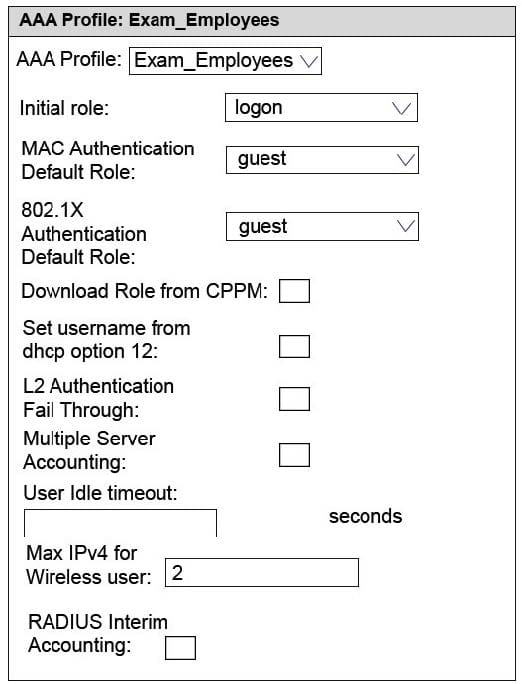
Exhibit 2

An Aruba solution supports a WLAN that uses WPA2-Enterprise security. Exhibit 1 shows the AAA policy for the WLAN. Users are supposed to be assigned to different roles after authentication. Network administrators test a connection with the employee user account. Exhibit 2 shows the status for the client after this test.
What is a possible reason for the issue shown in Exhibit 2?
A. The shared key configured for the ClearPass server is incorrect.
B. The RADIUS server is not correctly set up to send a user role for the employee account.
C. MAC authentication is enabled on the WLAN, and the test device does not have an authorized address.
D. The administrators entered the wrong password for the employee account.
Questions 7
Refer to the exhibit.
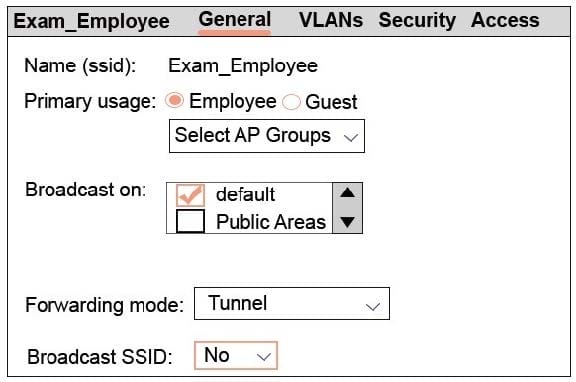
What describes the behavior for this WLAN?
A. APs in the default group broadcast the SSID. Clients can connect to the WLAN on APs in the default group only.
B. No APs broadcast the SSID. Clients cannot connect to the WLAN until administrators activate it.
C. No APs broadcast the SSID. Clients can connect to the WLAN on APs in the default gorup only.
D. APs in the default group broadcast the SSID. Clients can connect to the WLAN on APs in any group.
Questions 8
Which class of controller is more appropriate in a branch installation with up to 64 APs?
A. 7008
B. 7030
C. 7205
D. 7210
Questions 9
A company has a Mobility Master (MM)-based solution. How does a Mobility Controller (MC) behave if it loses contact with all MM nodes?
A. The MC loses all licenses and cannot support APs or clients.
B. The MC retains its current licenses for 30 days.
C. The MC contacts Aruba Activate and uses the licensing limits defined there.
D. The MC maintains only licenses that have been locally installed on it.
Questions 10
Which APs operate in an autonomous or standalone mode?
A. remote APs (RAPs)
B. spectrum analyzers (SAs)
C. mesh points (APs)
D. instant AP (IAP) clusters
Questions 11
Refer to the exhibits. Exhibit 1
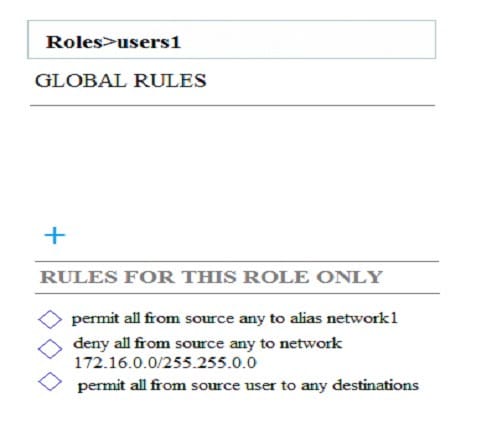
Exhibit 2
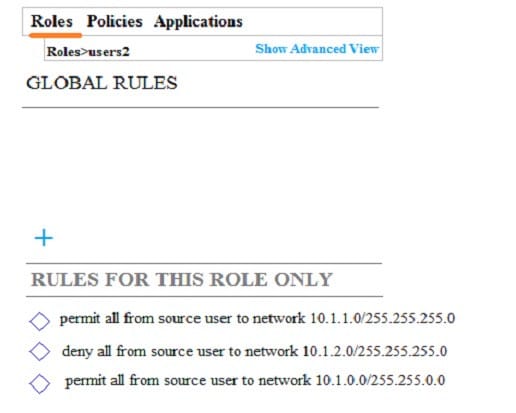
A company has an Aruba solution. Client 1 is assigned to the users1 role, and client 2 is assigned to the users2 role. The exhibits show current firewall rules for those roles. The network1 alias used to be 10.1.1.0/24, but the network administrator now changes the network1 alias to 172.16.1.0/24. Client 1 and Client 2 both send a packet destined to 172.16.1.10.
How does the firewall handle these packets?
A. It permits the packet from Client 1 and denies the packet from Client 2.
B. It permits both packets.
C. It denies the packet from Client 1 and permits the packet from Client 2.
D. It denies both packets.
Questions 12
An Aruba Mobility Master (MM)-based solution has two Virtual MM nodes, a primary and a backup node. The solution must support 30 Virtual Mobility Controllers (VMCs) that will support a total of 960 APs.
Which VMC licenses meet the needs and DO NOT unnecessarily exceed them?
A. two 1000 VMC licenses (MC-VA-1000)
B. one 1000 VMC license (MC-VA-1000)
C. two 50 VMC licenses (MC-VA-50)
D. one 50 VMC license (MC-VA-50)
Questions 13
A company plans to deploy a Mobility Master (MM) solution with two MM nodes. The MM solution will manage 10 Mobility Controller (MC) appliances that will control a total of 400 APs.
How should the network administrator install the AP licenses?
A. 40 AP licenses on the MM and no licenses on the MC
B. 400 AP licenses on the MM and no licenses on the MC
C. 800 AP licenses on each MC and no licenses on the MC
D. 800 AP licenses on the MM and 40 AP licenses on each MC


Home | About Us | Contact Us | FAQ | Guarantee Policy | Privacy Policy
Any charges made through this site will appear as Global Simulators Limited. All trademarks are the property of their respective owners.
Copyright © 2004-2026 pass2lead.com, All Rights Reserved.